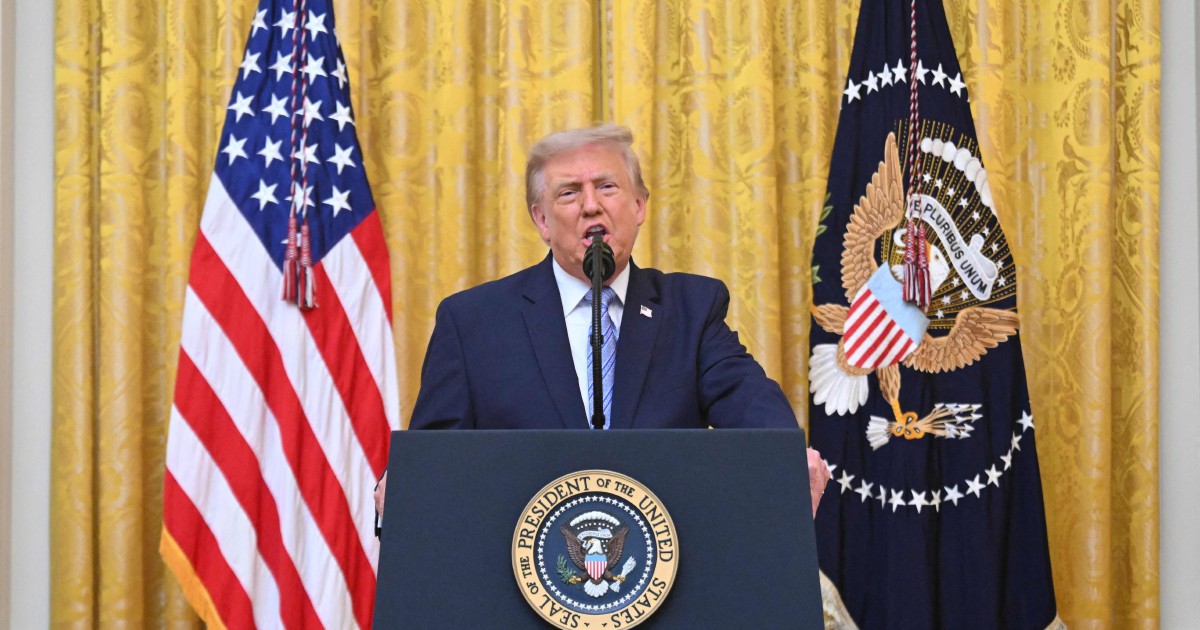
In a Thursday address, US President Donald Trump has once again promoted discredited allegations regarding the integrity of the 2020 presidential election, reasserting false claims about foreign interference and electoral fraud that experts and official investigations have thoroughly rejected. The president's renewed assertions centre on claims that China orchestrated the theft of millions of voter records and insinuated that Venezuela possessed the capability to tamper with American voting machines, allegations that have no credible evidentiary foundation.
These pronouncements mark yet another iteration of Trump's sustained campaign to contest the legitimacy of his 2020 defeat, despite extensive investigations by election officials, the Department of Justice, and multiple court proceedings that have found no evidence supporting claims of widespread fraud or foreign manipulation. The persistence of these narratives, despite consistent refutation by judicial bodies, election administrators, and cybersecurity authorities, illustrates the durability of electoral misinformation within American political discourse.
For Malaysian observers and Southeast Asian analysts, this episode underscores broader concerns about election misinformation and the weaponisation of false electoral narratives in democratic systems. The Malaysian context, where electoral integrity remains periodically contested and digital literacy regarding election processes varies significantly, provides sobering parallels. The ability of prominent political figures to repeatedly assert debunked claims without immediate consequence raises questions about institutional mechanisms for countering authoritative misinformation—a challenge not unique to the United States.
The specific allegations regarding Chinese interference and Venezuelan manipulation carry geopolitical dimensions relevant to the region. China's purported theft of voter data figures prominently in Trump's narrative, reflecting broader US-China tensions that reverberate throughout Southeast Asia, where nations navigate competing great power interests. Similarly, invocations of Venezuelan interference, though seemingly geographically removed, represent part of a broader rhetorical pattern that conflates adversarial nations with electoral vulnerabilities.
Experts in electoral security have consistently demonstrated that American voting systems, despite their fragmented nature across state jurisdictions, incorporate sufficient safeguards against remote interference. The voting infrastructure relies substantially on paper ballots and in-person verification mechanisms that resist digital manipulation, a reality that undermines claims of vulnerability to foreign actors. Nevertheless, the repeated assertions of such vulnerabilities can themselves corrode public confidence in electoral processes, creating secondary damage distinct from actual fraudulent activity.
The recurrence of these allegations also reflects strategic considerations within American domestic politics. By maintaining focus on contested 2020 results rather than substantive policy platforms, Trump sustains mobilisation of his electoral base while occupying substantial media and political attention. This dynamic generates significant opportunity costs for substantive political discourse, a phenomenon increasingly evident across multiple democracies grappling with how to respond to systemic electoral delegitimisation.
For policymakers in Southeast Asia and Malaysia particularly, the American experience offers cautionary lessons regarding institutional vulnerability to electoral misinformation campaigns. The relative difficulty of definitively correcting false narratives even after multiple fact-checking efforts and judicial determinations suggests that reactive responses alone prove insufficient. Developing proactive media literacy initiatives, transparent electoral administration practices, and institutional credibility becomes critical for safeguarding electoral legitimacy.
The international dimensions of election misinformation have evolved substantially. While foreign state actors occasionally attempt direct interference, the amplification of false narratives by domestic political figures and sympathetic media outlets often proves more corrosive to electoral confidence than actual foreign manipulation attempts. Trump's revival of 2020 fraud claims illustrates this pattern, whereby domestic amplification of debunked claims constitutes the primary threat to electoral integrity rather than the underlying allegations themselves.
Media institutions grappling with how to cover such claims face genuine dilemmas. Ignoring them risks appearing to suppress legitimate political discourse, yet providing prominent coverage amplifies misinformation to broader audiences. Malaysian media outlets confronting similar electoral narratives from local political figures encounter analogous challenges, particularly during election periods when claims demand urgent public clarification.
The trajectory of these allegations also reveals the temporal persistence of electoral misinformation. Four years after the 2020 election, these claims remain sufficiently salient within American political discourse to warrant presidential repetition. This extended lifecycle of debunked narratives contrasts sharply with more ephemeral misinformation campaigns and suggests that narratives aligned with partisan identity prove particularly resistant to correction, regardless of evidentiary basis.
Looking forward, the normalisation of unfounded electoral fraud claims in presidential discourse establishes concerning precedents. When major political figures can repeatedly assert debunked allegations without significant political cost, the threshold for future electoral delegitimisation efforts descends substantially. Southeast Asian democracies, some still consolidating institutional strength and public confidence in electoral mechanisms, require particular vigilance against similar normalisation of electoral misinformation.
The episode ultimately illustrates that modern democratic challenges extend beyond technical electoral vulnerabilities to encompass the institutional capacity to maintain shared factual baselines regarding electoral outcomes. Whether American, Malaysian, or Southeast Asian systems, sustaining electoral legitimacy depends increasingly on whether societies can effectively constrain the amplification of deliberately false claims, even when those claims emanate from prominent political actors with substantial platforms and motivated constituencies.

