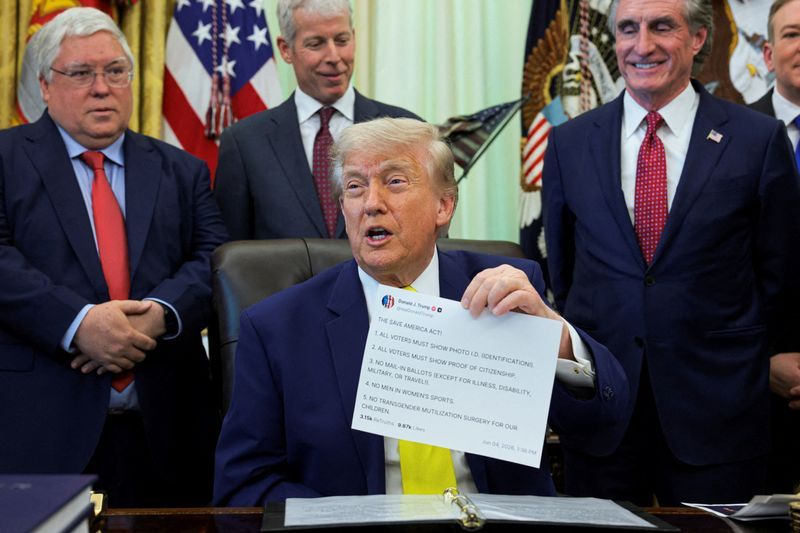
Two prominent media organisations have taken legal action against Donald Trump, challenging a commercial service that grants paying subscribers early access to his Truth Social posts at rates reaching $100,000 per month. The Intercept and the Freedom of the Press Foundation filed their complaint in Manhattan federal court, alleging that Truth API, a feed operated by Trump Media & Technology Group, fundamentally compromises the principle of equitable information access while simultaneously enriching the U.S. president.
Truth API launched on August 1, offering privileged access to ten high-profile Truth Social accounts, with Trump's own account being the primary draw for subscribers. The timing proved contentious, arriving just four days after Democratic Senators Elizabeth Warren of Massachusetts and Adam Schiff of California formally petitioned the Securities and Exchange Commission to investigate whether the service might damage financial market integrity while benefiting Wall Street insiders and Trump himself. The complaint seeks to prevent the White House from making official government announcements exclusively through Truth Social while this paid-access mechanism exists.
The lawsuit raises fundamental questions about the intersection of commerce and governance in the modern presidency. Trump has long leveraged Truth Social to disclose significant information—ranging from tariff decisions to developments in Middle East conflicts—that routinely influences stock prices, oil markets, and other financial instruments. By monetising early access to such market-moving announcements, the plaintiffs argue, the service creates a system whereby the president profits directly from timing advantages that wealthy subscribers gain over the general public. This arrangement, they contend, violates constitutional protections ensuring equal access to government information.
Plaintiffs characterised Truth API as "profoundly corrupt" given Trump's direct financial stake in the service's success. The complaint specifically notes that Trump holds a 41.3% stake in Trump Media worth approximately $950 million through his Donald J. Trump Revocable Trust, making the company's revenue directly connected to his personal wealth. His oldest son, Donald Trump Jr., serves as a Trump Media director and oversees the trust, further intertwining family interests with the company's operations. This structural arrangement, critics argue, creates obvious incentives for the president to favour Truth Social when making announcements that could influence markets.
The First Amendment dimension of the case presents a novel constitutional argument. The plaintiffs contend that all citizens possess an equal right to access official government communications, and that charging for expedited access fundamentally violates this principle. They further argue that the government has no legitimate interest in selling the president's posts to private subscribers while allowing him to profit from the arrangement. According to the complaint, many of Trump's 9,000 to 11,000 Truth Social posts and reposts during his second term were never accompanied by formal White House statements, suggesting that Truth Social has become the president's primary communication channel rather than a supplementary platform.
Trump Media's defence emphasises that numerous platforms and news outlets, many operating subscription models, already disseminate Trump's information to broader audiences. A company spokesperson argued that "countless" existing services provide similar distribution, characterising the lawsuit as a politically motivated effort to silence the president. The company accused "left-wing activists" of attempting to weaponise the courts both to censor Trump and to harm Trump Media shareholders. Trump Media interim Chief Executive Kevin McGurn noted during a recent earnings call that Truth API enables subscribers to receive news "fractionally faster" than the general public, framing the advantage as a minor timing benefit rather than a substantive information asymmetry.
The financial stakes involved are substantial. With subscription fees reaching $100,000 monthly, even a modest subscriber base would generate millions in annual revenue for Trump Media. Beyond Trump himself, the service grants early access to posts from Vice President JD Vance, Health and Human Services Secretary Robert F. Kennedy Jr., FBI Director Kash Patel, and the White House institutional account. This breadth raises additional concerns about whether government officials are being incentivised to use Truth Social as their primary communication platform, potentially disadvantaging traditional media outlets and the broader public.
The regulatory environment surrounding this dispute remains uncertain. The SEC's three current commissioners are Republicans, which may influence how seriously federal securities regulators pursue investigations into whether Truth API undermines market integrity. The timing of the lawsuit—coming weeks after Democratic senators raised formal concerns—suggests this will become a sustained political battle rather than a quick legal resolution. The case touches on longstanding tensions between a president's right to communicate directly with supporters and the public's right to equal access to government information.
For Malaysian and Southeast Asian readers, this dispute highlights broader questions about how political leaders worldwide might monetise their direct communication platforms. As social media has become increasingly important for political discourse globally, this case may establish precedents affecting how leaders and governments operate in the digital sphere. The outcome could influence whether similar commercial arrangements become normalised internationally or remain restricted as conflicts of interest. The lawsuit ultimately forces a reckoning with how modern presidents balance commercial interests with constitutional obligations to serve the entire public equally.

