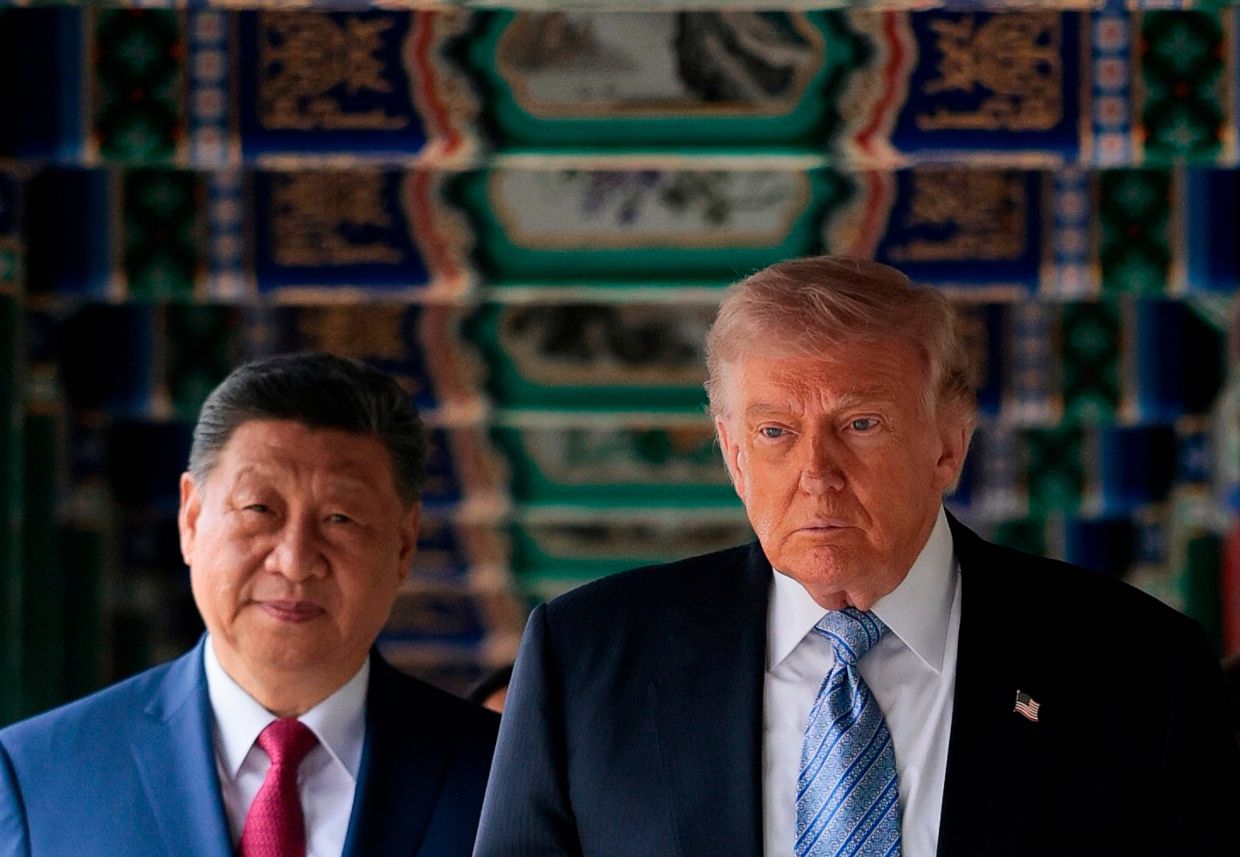
President Trump's approach to managing relations with China continues to oscillate between public criticism and behind-the-scenes diplomacy, most visibly in his response to allegations that Beijing is covertly arming Iran. Speaking on Wednesday, Trump said he would find such a development "surprising" given Xi Jinping's assurances, while simultaneously reminding observers that the Chinese leader's scheduled visit to the United States on September 24 remains on track. This juxtaposition captures the defining tension in Trump's China strategy: combative rhetoric paired with a determination to preserve high-level engagement.
The immediate trigger for Trump's comments was a Reuters report suggesting that China had arranged to supply weapons to Iran through a logistics route originating in western China and transiting Pakistan, with the deal valued between US$60 million and US$70 million. Such transfers would represent a significant escalation in military cooperation between Beijing and Tehran at a time of heightened regional tensions. China's Foreign Ministry swiftly rejected the allegations as "untrue and not factual at all", reiterating its stated commitment to de-escalation and an end to the conflict. This pattern of denial mirrors Beijing's response to similar accusations before Trump's May visit to the Chinese capital, when it dismissed weapons supply allegations as "completely groundless".
Trump's measured scepticism appears calibrated to avoid immediate confrontation. He indicated that Xi had given him personal assurances during their Beijing meeting that China would not participate in arming Iran under any circumstances, adding with evident satisfaction that "considering our relationship, I take him at his word". Yet the president did inject a note of warning, stating that if China were to breach this commitment, "it would be very bad for them – certainly not in their best interests". This formulation allows Trump to express trust while preserving the implicit threat of consequences, should the allegations prove accurate.
The measured tone on China contrasts sharply with Trump's simultaneous escalation of attacks against American health officials. On Wednesday, he launched an extended assault on his social media platform targeting figures within the US health establishment, most notably Dr Anthony Fauci. Trump rehashed his longstanding assertion that Covid-19 originated in a laboratory in Wuhan, China, claiming that Fauci "strongly disagreed" with this assessment and had consistently attempted to "protect China". These accusations ignore the broader scientific consensus, which has increasingly favoured natural spillover from animals rather than laboratory origins, though the debate continues among researchers.
This rhetorical pattern reveals the contradictions embedded within Trump's China policy. In a prime-time address delivered just days before these exchanges, Trump accused Beijing of perpetrating "the largest compromise of election data in history", claiming that China had illicitly obtained 220 million American voter files. He even declassified documents allegedly supporting this claim and warned of an "unprecedented election security nightmare". Yet despite these inflammatory charges—which one might expect to trigger immediate punitive measures—the Trump administration has since announced no new sanctions, trade penalties, or diplomatic consequences targeting China. Instead, preparations for Xi's September visit have proceeded without interruption.
This absence of follow-through is particularly striking given the gravity of the alleged transgression. Electoral interference represents a direct assault on American sovereignty and democratic processes, and under normal circumstances would prompt swift retaliation. The fact that Trump's administration has chosen not to escalate suggests that diplomatic considerations and the desire to maintain dialogue with Beijing take precedence over enforcing consequences for alleged misconduct. For regional observers, particularly in Southeast Asia, this pattern indicates that Trump's public statements about China, however forceful, may not translate into sustained policy shifts.
Trump's handling of the Iran weapons supply question demonstrates how this contradiction operates in practice. Last week, Trump claimed that in his "opinion" neither China nor Russia were genuinely "participating" in Iran's conflict—a characterization that appears difficult to square with credible reports of ongoing military cooperation. Yet by framing China's involvement as either non-existent or at least amenable to diplomatic persuasion, Trump preserves the option of engagement. This approach reflects a calculation that maintaining the possibility of negotiated settlements on priority issues—whether trade, technology, or great-power competition—outweighs the diplomatic cost of overlooking controversial Chinese behaviour in other theatres.
For Malaysia and other Southeast Asian nations, these dynamics carry important implications. Trump's willingness to compartmentalise his criticism of China and maintain high-level contacts creates uncertainty about the reliability of US commitments in the region. Nations that have aligned themselves with Washington's tougher stance on Beijing cannot be certain that US policy will remain consistent, particularly if Trump determines that cooperation with China serves American interests in other domains. The September visit by Xi Jinping will provide an important test of whether Trump's diplomatic overture translates into substantive agreements or remains largely ceremonial.
Moreover, Trump's simultaneous attacks on American health officials over their handling of Covid-19 origin questions suggests that domestic political considerations shape his China messaging as much as strategic calculation. By blaming Fauci and others for allegedly defending China's interests, Trump appeals to his political base while maintaining plausible deniability about Beijing's actual responsibility for the pandemic's origins. This conflation of domestic political grievance with China policy adds another layer of unpredictability to bilateral relations and regional dynamics.
The upcoming Xi visit will likely reveal more about Trump's actual priorities regarding China. If the meeting produces concrete agreements—particularly on trade, technology cooperation, or strategic issues—it will confirm that Trump views diplomatic engagement as more valuable than public confrontation. Conversely, if the visit remains largely symbolic and produces few substantive outcomes, it may indicate that Trump's harsh rhetoric reflects genuine strategic concerns that cannot be bridged through dialogue. Either way, the pattern of mixed signals will almost certainly continue, reflecting Trump's preference for maximising negotiating flexibility over committing to clearly defined long-term policy positions.

