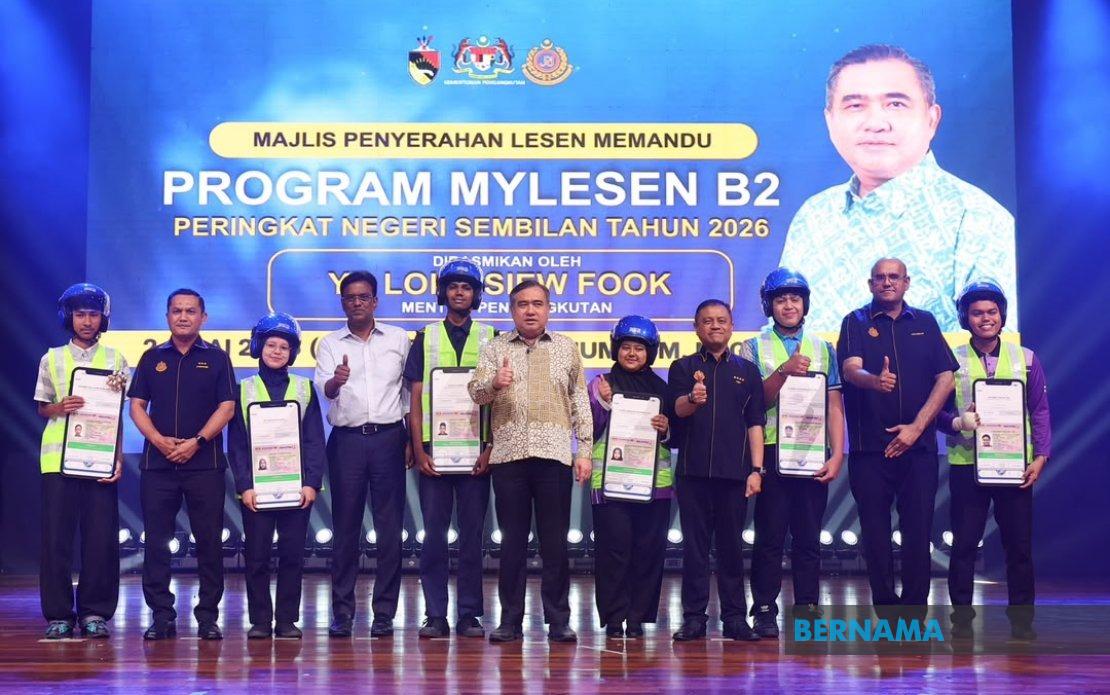
Transport Minister Anthony Loke has delivered a forceful message to young Malaysians receiving motorcycle licences under the MyLesen B2 Programme: the document they hold is a responsibility, not a permission slip for dangerous behaviour. Speaking at a licence presentation ceremony in Seremban on July 2, Loke underscored the gravity of road safety, reminding the newest generation of riders that their actions have life-and-death consequences not only for themselves but for fellow road users.
The context for Loke's remarks is sobering. Approximately 60 per cent of annual road fatality statistics involve motorcyclists and pillion riders, with the vast majority of victims under 30 years old. This demographic reality illustrates why government messaging around the MyLesen B2 scheme must extend beyond simply distributing licences to cultivating a culture of responsible riding. For Malaysia, where motorcycle ownership remains widespread across urban and rural communities, the behaviour of young licence-holders directly shapes public safety outcomes and road fatality trends.
The MyLesen B2 Programme itself represents a significant government initiative aimed at broadening access to motorcycle licensing while simultaneously channelling riders through structured training and competency assessment. Since its launch in 2023, the scheme has already benefited more than 100,000 recipients nationwide, making it a substantial intervention in the driving licence ecosystem. The programme reflects recognition that motorcycle mobility is integral to Malaysian transport patterns, particularly for younger citizens seeking employment and educational opportunities. By providing free licensing, the government seeks to formalise what might otherwise occur informally, bringing riders into the regulatory framework where safety standards and legal compliance become enforceable.
Negeri Sembilan exemplifies the programme's expansion. The state's quota has more than doubled, rising from 1,000 participants last year to 2,300 this year, indicating accelerating uptake and government commitment. As of the ceremony date, 1,979 participants had obtained their Learner's Driving Licence, with 1,879 having completed training and passed competency tests to secure their Probationary Driving Licence. These numbers suggest a well-functioning administrative pipeline, yet they also represent nearly 2,000 new riders entering Malaysia's roads within a single state—a figure that underscores why ministerial intervention on safety culture is timely and necessary.
Loke's warnings specifically targeted illegal street racing, a persistent problem in Malaysian urban areas that has claimed numerous young lives. He noted that the Dewan Rakyat had recently passed the Road Transport (Amendment) Bill 2026, which introduces stricter penalties for illegal racing and speed testing across all vehicle categories. The legislative shift is significant: offenders now face not merely financial penalties but potential imprisonment, signalling that lawmakers view street racing as a serious criminal matter rather than youthful mischief. For young MyLesen B2 holders, this represents a clear legal boundary, with consequences extending far beyond a fine or licence suspension.
The emphasis on weekend behaviour is particularly revealing. Loke specifically cautioned that weekends should not become occasions for racing or illegal activity, suggesting that authorities have observed temporal patterns in dangerous riding behaviour. This observation aligns with broader Malaysian social patterns, where young people's leisure activities and peer group dynamics significantly influence risk-taking on roads. By addressing weekend specifically, Loke implicitly acknowledges that responsible riding requires constant vigilance, not just compliance during weekday commutes.
Equally important is Loke's insistence on proper safety equipment. He urged all new licence holders to wear SIRIM-certified helmets whenever riding or travelling as pillion passengers, reinforcing that legal compliance encompasses protective equipment standards. SIRIM certification ensures helmets meet established safety specifications, yet the reminder suggests that not all young riders automatically prioritise such protection. This gap between regulatory requirement and actual behaviour represents an ongoing challenge for road safety enforcement and education in Malaysia.
The broader framing of MyLesen B2 by the Transport Ministry emphasises its role in facilitating legitimate social mobility. The programme ostensibly opens pathways to employment, tertiary education, and improved socio-economic circumstances through legal, safe mobility. This narrative—that motorcycling can be a legitimate and law-abiding component of life advancement—contrasts sharply with the reality that street racing and illegal activities offer immediate peer status and excitement. The government's challenge is ensuring that the legitimate benefits of motorcycle licensing prove sufficiently appealing that young riders resist the countervailing attractions of illegal racing cultures.
The officials present at the Seremban ceremony, including Transport Ministry Secretary-General Datuk Seri Jana Santhiran Muniyan, Road Transport Department Director-General Datuk Aedy Fadly Ramli, and state JPJ officials, represent the institutional machinery responsible for implementing both licensing distribution and enforcement. Their presence signals whole-of-government coordination on road safety, though the effectiveness of such coordination ultimately depends on sustained enforcement efforts and sustained messaging to young riders.
For Malaysian society, the success or failure of efforts like those articulated by Loke at the Seremban ceremony carries implications extending beyond individual licence holders. Road fatality trends affect public health systems, emergency services, families, and communities. Every young motorcyclist who internalises messages about responsible riding and rejects illegal racing contributes to marginal but cumulative improvements in aggregate safety statistics. Conversely, cultural persistence of street racing and dangerous riding among youth perpetuates the grim statistics Loke cited—the 60 per cent figure and the concentration of deaths among under-30s.
The MyLesen B2 Programme thus represents more than administrative efficiency in licence distribution. It embodies an attempt to reshape the relationship between young Malaysians and motorcycle riding, transforming it from an informal, often unsupervised activity into a structured, regulated, and safety-conscious practice. Whether this transformation takes hold depends substantially on whether young licence holders genuinely accept that their permits represent privilege constrained by responsibility, or whether they continue viewing motorcycles primarily as tools for peer-group status and excitement. Loke's message, delivered at ground level to the licence recipients themselves, represents an important moment in that cultural negotiation.

