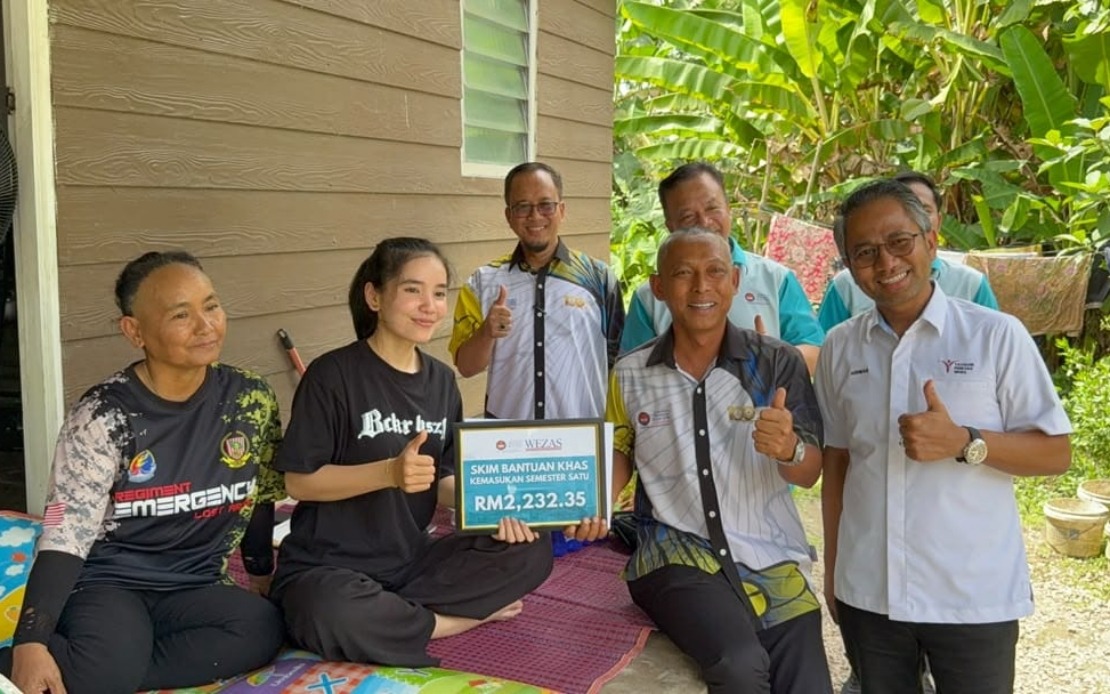
Three academically accomplished students will begin their university education at Universiti Pendidikan Sultan Idris (UPSI) this academic year after receiving targeted financial support to overcome registration and preparation costs. The initiative, spanning multiple government and institutional partners, demonstrates a coordinated effort to ensure financial hardship does not prevent capable students from accessing tertiary education in Malaysia. The assistance programme, involving UPSI, Yayasan Perkasa Siswa (YPS), and the Higher Education Ministry's Department of Pendidikan Tinggi (JPT), illustrates growing recognition among policymakers that early intervention can transform educational trajectories for disadvantaged but deserving students.
Among the beneficiaries is Sijil Tinggi Persekolahan Malaysia (STPM) achiever Lovely Sabana Augustine, whose enrolment at UPSI's Faculty of Human Sciences had been jeopardised by inability to meet registration expenses. Growing up in Tumpat, Kelantan, Sabana lives with her mother Mek Kenui, whose income as a school cleaner amounts to approximately RM800 monthly. Her father, a former soldier, passed away in 2017, leaving the family to navigate financial pressures with the mother balancing employment with responsibilities as a Malaysian Volunteer Corps Department (RELA) member. The youngest of four siblings, Sabana's circumstances exemplify the structural challenges faced by capable young Malaysians whose potential might otherwise remain unrealised due to circumstance rather than ability.
The other two recipients, Siti Nurdianis Nordin and Muhamad Ilias Danish, similarly confronted obstacles rooted in family economic vulnerability. Siti Nurdianis, planning to study in the Faculty of Management and Economics, comes from a household dependent on irregular daily wages, creating unpredictability in meeting educational expenses. Muhamad Ilias Danish, whose Faculty of Languages and Communication studies will commence this academic session, has assumed partial responsibility for his family's financial stability following his father's death. Each student received RM1,500 distributed through complementary funding mechanisms: RM500 contributed by UPSI's Centre for Waqf, Endowment, Zakat, Khairat, and Sadaqah (WEZAS), with the remaining RM1,000 supplied by YPS.
The intervention became possible following public attention to Sabana's circumstances, which gained traction on social media platforms when she publicly appealed for assistance ahead of her scheduled September 13 registration. Rather than remaining an isolated case, the momentum generated by her story prompted institutional examination of similar situations among other prospective students awaiting enrolment. This approach—identifying and supporting multiple students simultaneously rather than responding only to cases that achieve viral attention—suggests maturation in how Malaysian universities coordinate welfare assistance with government bodies.
Hirman Awang, director of the JPT Student Affairs Division, articulated the Higher Education Ministry's positioning of such assistance as central to equitable access. The statement emphasised that YPS maintains readiness to function as a frontline support mechanism for university students encountering welfare challenges, characterising the RM1,000 contribution as intended to strengthen students' psychological readiness for university entry whilst simultaneously addressing immediate material needs. This framing situates financial aid beyond mere monetary transfer, acknowledging that students facing severe constraint experience psychological barriers alongside material ones.
UPSI's Deputy Vice-Chancellor for Student Affairs and Alumni, Prof Dr Norkhalid Salimin, underscored institutional commitment to identifying students requiring early intervention. The university's approach, coordinated through the Student Affairs and Alumni Department (JHEPA) and WEZAS, emphasises proactive identification rather than waiting for students to reach crisis point. This model reflects understanding that many disadvantaged students hesitate to formally declare difficulties, preferring to silently withdraw rather than seek support, meaning universities require intentional monitoring mechanisms to identify those requiring assistance.
The collaboration between UPSI, YPS, and JPT represents structured coordination across institutional levels—university operations, dedicated foundation bodies, and ministry-level policy implementation. Such partnerships potentially offer replicable frameworks for other public universities seeking to systematise student welfare provision. The programme's emphasis on early assistance, provided before semester commencement, acknowledges that registration costs and immediate preparation expenses often constitute decisive barriers for students from lower-income backgrounds, with failure to secure funds at this juncture sometimes forcing academic postponement indefinitely.
For Malaysian policymakers observing regional education trends, such initiatives assume particular relevance given demographic shifts and economic pressures affecting middle and lower-income households. Southeast Asia's university participation rates depend significantly on whether financial barriers can be minimised for capable students. Without intervention mechanisms, substantial untapped potential disperses among families lacking resources, representing economic inefficiency alongside social injustice. The UPSI case suggests Malaysian institutions increasingly recognise this calculus.
The assistance programme also reflects evolving understanding of how Islamic finance principles—particularly waqf and zakat mechanisms through WEZAS—can operationalise welfare support within secular higher education contexts. Rather than treating religious and institutional welfare systems as separate, integrating WEZAS contributions alongside government foundation funding creates complementary mechanisms addressing the same underlying need. This integrated approach potentially offers models for other universities seeking to mobilise diverse funding sources for student support.
Longer-term policy questions remain regarding sustainability and scale. The current assistance addresses immediate registration and preparation costs but does not directly support ongoing tuition or living expenses throughout degree programmes. Expansion to encompass broader welfare support—accommodation assistance, meal subsidies, or emergency funds—would require substantial resource commitment. Additionally, whether such targeted interventions can scale across Malaysia's university system whilst maintaining programme quality and avoiding bureaucratic complexity remains undetermined. The UPSI initiative nonetheless demonstrates that institutional will combined with policy support can translate into tangible outcomes for disadvantaged but talented students.

