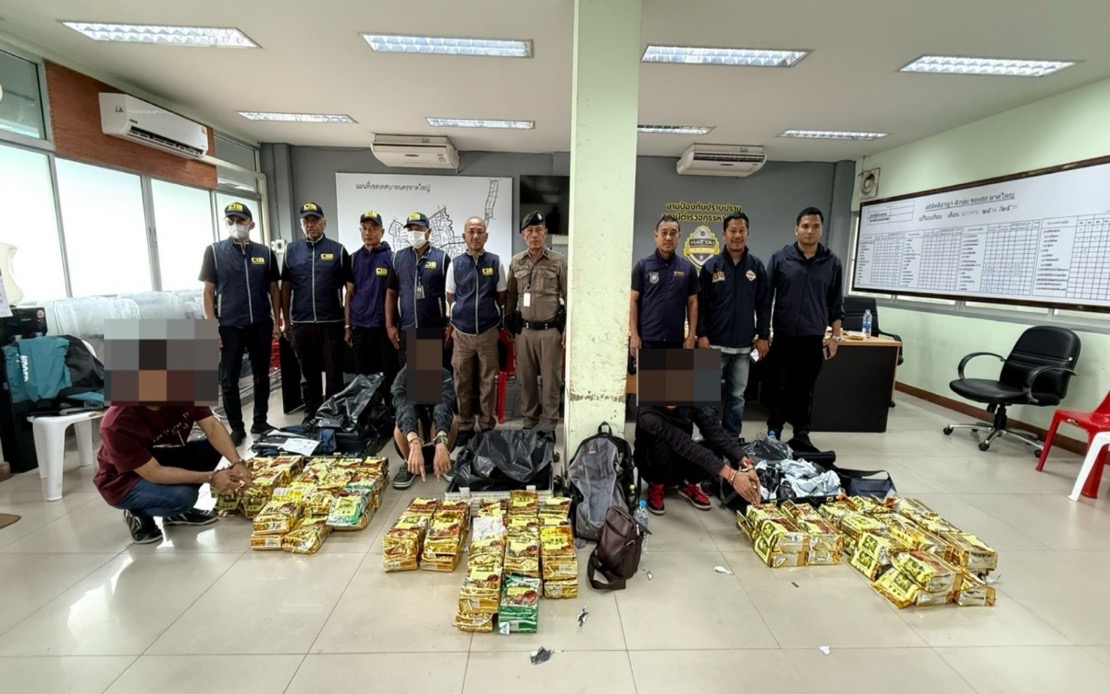
Three Malaysian men were taken into custody on July 31 at Hat Yai Railway Station in Thailand's Songkhla province following an operation targeting a cross-border drug trafficking operation. The suspects were intercepted shortly after their train from Bangkok arrived at the station, with authorities discovering 87 kilograms of crystal methamphetamine concealed within three wheeled suitcases and three backpacks. The seizure represents a significant interdiction in the region's ongoing battle against transnational drug smuggling networks.
The arrest operation was coordinated across multiple Thai law enforcement agencies, reflecting the scale and complexity of the investigation. The "Tawan Hat Yai" unit led the operation in conjunction with railway police, the Crime Suppression Division, the Anti-Trafficking in Persons Division, tourist police, the Narcotics Suppression Bureau, and the Region 9 Office of the Narcotics Control Board. According to Ratchapon Palakul, director of the ONCB Region 9 Office, this multi-agency collaboration enabled the interception at a key transit point where the smuggling attempt was particularly vulnerable to detection.
During initial interrogation, one of the detained men revealed that members of an organised syndicate had recruited them for the operation, offering each participant RM8,000 as compensation for transporting the narcotics across the border. This recruitment pattern typifies the modus operandi of drug trafficking organisations operating throughout mainland Southeast Asia, which frequently exploit the financial desperation of individuals willing to assume significant legal risks for relatively modest sums. The low compensation relative to the quantity and street value of the seized drugs underscores how such networks prioritise disposability of couriers while concentrating profits among higher-level operatives.
Under Thai law, the three men face serious charges related to possession and trafficking of a Category 1 controlled substance with intent to distribute. If convicted, they face imprisonment of up to 15 years and potential fines reaching 1.5 million baht, equivalent to approximately RM183,000. These penalties reflect Thailand's stringent drug laws, which remain among Asia's most severe and have been consistently enforced under successive administrations committed to combating narcotics trafficking. The severity of potential sentences demonstrates the elevated risk Malaysian drug couriers assume when accepting recruitment into transnational smuggling schemes.
The incident highlights the persistent vulnerability of land and rail routes connecting Thailand with Malaysia as conduits for illicit drug movement. Hat Yai's position as a major transport hub and its proximity to the Malaysian border have long made it a focal point for narcotics interdiction efforts by both Thai and Malaysian authorities. The railway station specifically serves as a critical chokepoint where routine security measures can effectively intercept shipments that might otherwise successfully traverse the porous border region. This capture suggests that enhanced vigilance at transportation nodes continues to yield results in disrupting trafficking operations.
Authorities have commenced expedited investigations aimed at dismantling the broader syndicate responsible for orchestrating the smuggling attempt. By identifying the individuals who recruited the three Malaysians, coordinated the procurement and concealment of the narcotics, and arranged transportation logistics, Thai investigators hope to unravel a network that likely extends across multiple jurisdictions. Such investigations frequently reveal connections to larger trafficking organisations operating throughout the Golden Triangle region and its periphery, encompassing parts of Thailand, Laos, Myanmar, and increasingly, Malaysia as a transit and destination market.
The case underscores Malaysia's position within regional drug trafficking dynamics. Malaysian nationals increasingly appear in trafficking operations, both as end-market consumers and as couriers for international networks. The involvement of Malaysian couriers in Thai-based interdictions suggests that sophisticated organised crime groups continue targeting Malaysia as a distribution hub for crystal methamphetamine and other synthetic drugs. This phenomenon reflects broader regional trends wherein Malaysia's strategic location, established criminal networks, and growing demand for methamphetamine have rendered it an attractive market for transnational trafficking organisations.
For Malaysian policymakers and enforcement agencies, this arrest reinforces the necessity of sustained international cooperation frameworks with Thai counterparts. The effectiveness of the joint operation demonstrates how coordinated intelligence-sharing and unified operational planning enhance enforcement capacity. Malaysia's Narcotics Control Board and law enforcement agencies maintain regular liaison mechanisms with Thai authorities, though resource constraints and jurisdictional limitations sometimes impede seamless cooperation. Enhanced bilateral protocols specifically targeting railway and land border trafficking could potentially yield additional interdictions.
The incident also illustrates the human cost of drug trafficking recruitment. Individuals accepting courier positions, particularly those motivated by financial circumstances, face disproportionate legal consequences whilst higher-level organisers typically operate with greater insulation from apprehension. The RM8,000 offered to each courier pales in comparison to the wholesale value of 87 kilograms of methamphetamine, concentrating enormous profits among network leadership whilst front-line participants absorb virtually all legal risk. This asymmetry perpetuates cycles wherein economically vulnerable individuals across the region remain susceptible to recruitment despite the severe consequences of capture.
Looking forward, this seizure will inform ongoing regional threat assessments and may trigger enhanced scrutiny of specific trafficking routes and recruitment networks. Thai authorities typically share such intelligence through ASEAN law enforcement forums and bilateral channels, enabling Malaysian agencies to anticipate and prevent similar attempts at the Malaysian side of the border. Simultaneously, the case serves as a cautionary reminder of the persistent allure transnational trafficking networks maintain for economically marginalised individuals across Southeast Asia, suggesting that comprehensive counter-narcotics strategies must combine enforcement with demand reduction and poverty alleviation initiatives addressing root causes of trafficking participation.

