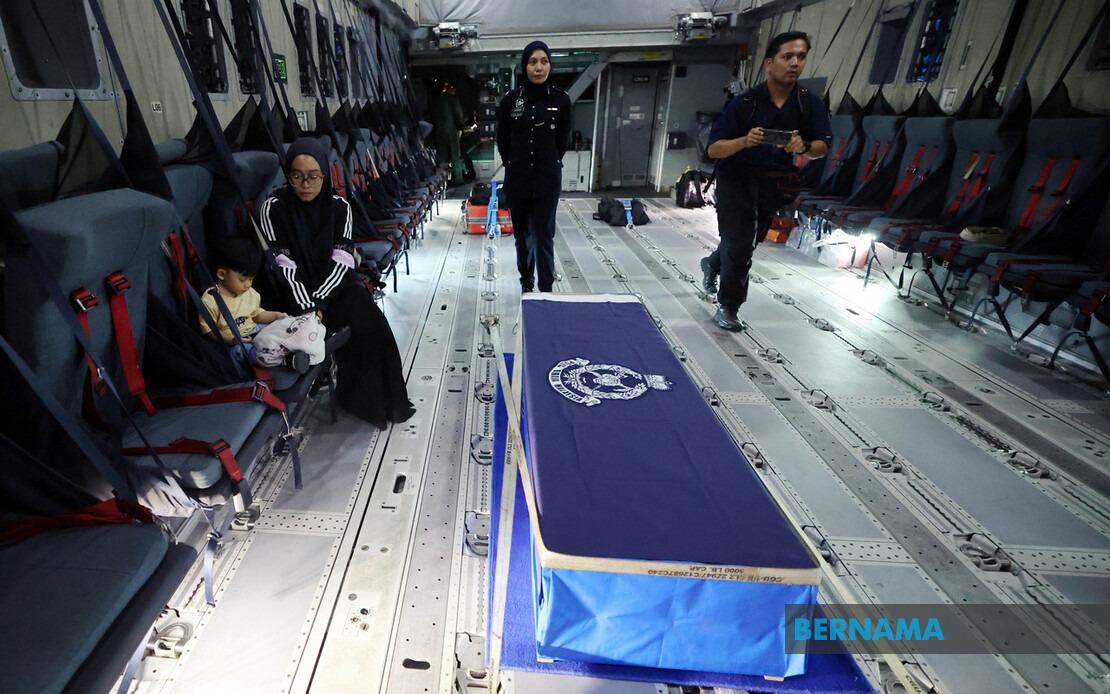
Three police officers who lost their lives in an electrocution incident in Beaufort, Sabah, have been flown to their respective hometowns following completion of forensic procedures. The repatriation operation, coordinated by the Royal Malaysian Air Force and the Royal Malaysia Police Air Operations Force, underscores the logistical complexities involved in transporting deceased personnel across Malaysia's geographically dispersed regions. The tragic incident, which occurred outside Weston Police Station at 5.50 pm on August 6, claimed the lives of officers stationed across different parts of the country, requiring a coordinated multi-agency response to ensure dignified homecoming for the fallen personnel.
Corporal Mohamad Nur Hafiz Ibrahim, aged 29 from Kelantan, and Constable Muhammad Raimi Ismarubee, aged 26 from Terengganu, were transported via Royal Malaysian Air Force aircraft departing Kota Kinabalu International Airport at 7.10 pm on August 7. The aircraft was scheduled to land first at the RMAF Air Base in Kuantan before proceeding to Gong Kedak in Terengganu, allowing for efficient distribution of the officers' remains to their respective states. This routing reflects the logistical planning required to serve a multi-state operation while maintaining the dignity and efficiency expected in such sensitive circumstances.
Corporal Chiu Teck Siong, 40 years old and originally from Sarawak, followed a separate repatriation route through the police air operations infrastructure. His body was initially processed at the police base in Kota Kinabalu before being transferred aboard a police aircraft destined for Sarawak. The different routing arrangements highlight how Malaysia's dispersed geography necessitates flexible operational responses, particularly when dealing with personnel stationed far from their home states.
All three officers underwent comprehensive post-mortem examinations conducted at noon on August 7 at the Forensics Department of Queen Elizabeth Hospital in Kota Kinabalu. The examinations were completed by approximately 2.56 pm, following which the bodies were released to respective agencies for immediate repatriation. The timing of these procedures reflects standard protocols designed to provide rapid closure for grieving families while ensuring thorough documentation for investigative purposes.
The electrocution tragedy raises important questions about workplace safety protocols at police installations throughout Malaysia, particularly regarding electrical hazard management at operational stations. Weston Police Station's incident represents a stark reminder of the occupational hazards faced by law enforcement personnel beyond the commonly highlighted risks of their duties. The circumstances surrounding the electrocution—occurring outside the station premises—suggest potential lapses in electrical infrastructure maintenance or safety awareness that warrant rigorous investigation.
For the families involved, the loss represents an acute personal tragedy compounded by geographical separation. Officers serving in stations far from their home states face the additional burden that their families often cannot maintain daily proximity, making the immediate aftermath of such incidents particularly challenging. The repatriation process, while necessary and respectful, nonetheless underscores the sacrifice inherent in police service that requires officers to operate across diverse postings throughout the nation.
The incident also illuminates the broader context of occupational health and safety within the Royal Malaysia Police force. While the service prioritizes officer training and operational readiness, infrastructure maintenance and hazard prevention at institutional facilities equally demand attention. Electrical systems at police stations, often aging or subject to variable maintenance standards, represent hidden risks that merit systematic review and upgrades across facilities nationwide.
Sabah, as Malaysia's second-largest state by area, frequently faces unique operational challenges for the police force given its dispersed geography and relatively lower population density compared to peninsular Malaysia. Weston, located in the Beaufort district, serves as an important policing hub for the region. The tragedy at this installation will likely prompt broader safety audits across Sabah's police infrastructure and potentially influence resource allocation decisions for facility maintenance and upgrades.
The repatriation of these three officers also carries symbolic weight within the police service hierarchy. Their deaths in circumstances unrelated to operational engagement—rather than frontline policing activities—broadens the conversation about comprehensive workplace safety. The visible mobilization of air force and police air operations resources for dignified repatriation demonstrates institutional respect for fallen personnel while simultaneously highlighting the resources that must be invested in protecting officer welfare across all operational dimensions.
Investigations into the precise electrical circumstances of the incident will likely examine whether standard safety protocols were followed, whether warning systems were in place, and whether infrastructure maintenance records were adequate. Such findings will inform recommendations for enhanced safety measures not only at Weston Police Station but potentially across police installations throughout Sabah and the broader national network. The incident serves as a critical juncture for institutional reflection on preventable workplace hazards.
For Malaysian police personnel generally, this tragedy represents a sobering reminder that the profession encompasses multiple layers of risk beyond those typically associated with law enforcement operations. The loss of three colleagues simultaneously serves as a catalyst for safety consciousness and demands heightened attention to institutional infrastructure across the service. The coming weeks will likely see enhanced safety reviews and potentially revised operational procedures at similar facilities nationwide, ensuring that future incidents of this nature are systematically prevented.

