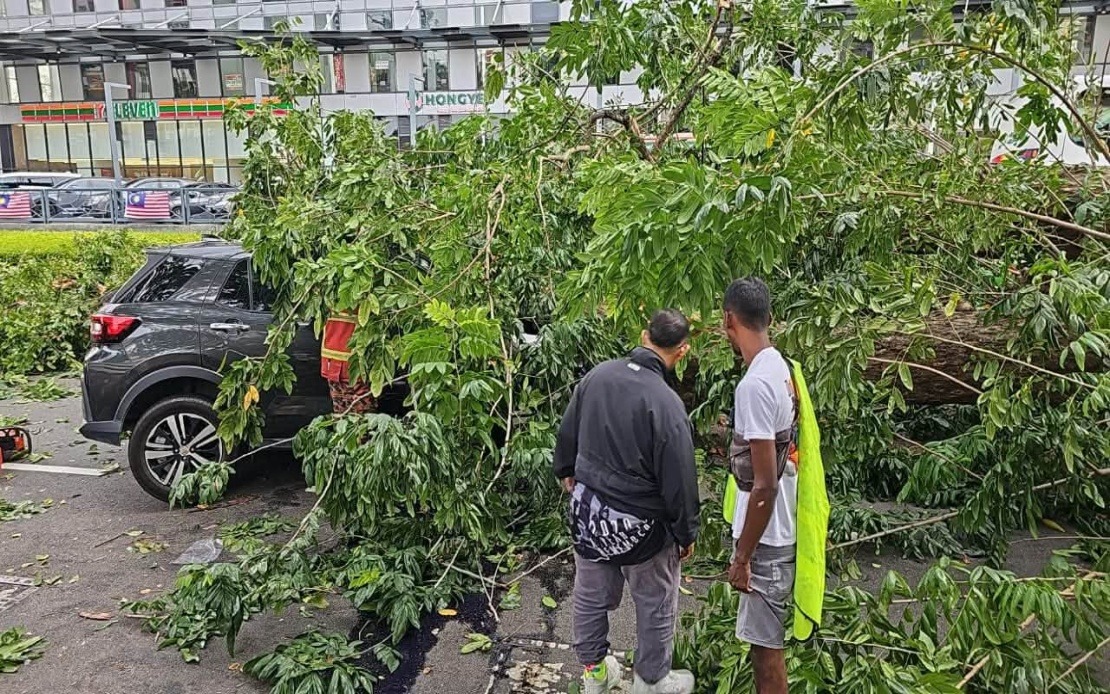
An elderly couple and their granddaughter had a fortunate escape from what could have been a fatal incident when a large tree came crashing down onto their Perodua Ativa on Jalan Macalister in George Town today. The three occupants, who became trapped in the vehicle, sustained injuries in the collision but were quickly extracted from the wreckage by quick-thinking members of the public who were present at the scene. Fire and rescue personnel subsequently transported all three victims to hospital for medical evaluation and treatment.
Emergency responders received notification of the incident at 9:12 am, prompting the Malaysian Fire and Rescue Department (JBPM) to mobilise a response team. The Assistant Director of the Operations and Firefighting Division for JBPM's Penang branch, John Sagun Francis, confirmed that eight firefighters from the Jalan Perak Fire and Rescue Station were dispatched immediately upon receiving the distress call. However, the emergency crew arrived to find that civilian bystanders had already successfully liberated the three trapped passengers, demonstrating the critical role ordinary citizens can play in life-threatening situations where seconds matter.
The rapid intervention by bystanders likely prevented the situation from deteriorating further. In vehicle entrapment scenarios, delays in removing occupants can lead to complications ranging from internal bleeding to shock, making the public's immediate action a potentially life-saving intervention. The professional responders then took over to ensure proper medical care and stabilisation of the victims for transport to medical facilities.
Following the rescue, fire department teams remained engaged in extensive clearing operations at the incident site throughout the morning and into the afternoon. As of noon, personnel were actively working to cut away the fallen tree and remove debris from the roadway, a process necessary both to prevent additional hazards to the public and to restore traffic flow along this busy thoroughfare. The scale of the debris clearing operation underscores the substantial size and weight of the tree that had come down, suggesting the impact force experienced by the vehicle was considerable.
The incident created significant traffic disruption in the immediate vicinity, with authorities forced to close sections of Jalan Macalister to facilitate emergency response and cleanup efforts. Motorists were diverted around the scene and advised to follow traffic management instructions from personnel at the location. The congestion rippled outward to affect other roads in the George Town area, a reminder of how single incidents on key routes can have cascading effects on urban mobility during peak hours.
Tanjong Member of Parliament Lim Hui Ying, who serves concurrently as Deputy Minister of Women, Family and Community Development, took immediate notice of the incident and mobilised her parliamentary team to gather additional information. Through a social media post, Lim acknowledged reports that the incident had resulted in injuries to three individuals, all of whom were receiving hospital care. Her swift engagement demonstrates the expectation that elected representatives should be responsive to emergencies affecting their constituents, particularly when vulnerable groups such as elderly persons are involved.
Lim's statement emphasised the importance of public vigilance in the area, urging residents and passing motorists to exercise caution and comply with any traffic management measures implemented at the scene. She also expressed hope for the complete recovery of all affected parties, reflecting the broader community concern for the victims' wellbeing. Her team's intention to visit the site and liaise with relevant authorities indicated a desire to understand the circumstances and identify whether preventative measures could reduce the likelihood of similar incidents in future.
The incident raises important questions about tree safety and management along Penang's urban corridors. While tree falls during heavy weather or high winds are occasionally unavoidable, regular inspection and maintenance programmes can identify trees that pose heightened risk due to disease, structural weakness, or root degradation. Whether this particular tree had been flagged for inspection or maintenance will likely be investigated as part of any follow-up inquiry by local authorities.
For Malaysian drivers and families navigating urban areas, this incident serves as a sobering reminder of environmental hazards that exist beyond traditional traffic dangers. While motorists focus on fellow vehicles, pedestrians, and road conditions, overhead hazards such as dead branches, unstable trees, or improperly maintained structures can emerge suddenly. The fortunate outcome in this case—with all three victims surviving and able to reach hospital—reflects both the protective engineering of modern vehicles and the intervention of nearby witnesses, both factors that combined to prevent tragedy.
The broader implications extend to urban planning and infrastructure maintenance standards. Penang, as a major urban centre with high traffic volumes, faces the ongoing challenge of balancing the aesthetic and environmental benefits of street trees with safety imperatives. Municipal authorities across Malaysia may view this incident as a prompt to review their own tree inspection and maintenance protocols, particularly on heavily trafficked routes where falling trees pose risks to multiple vehicles and pedestrians.

