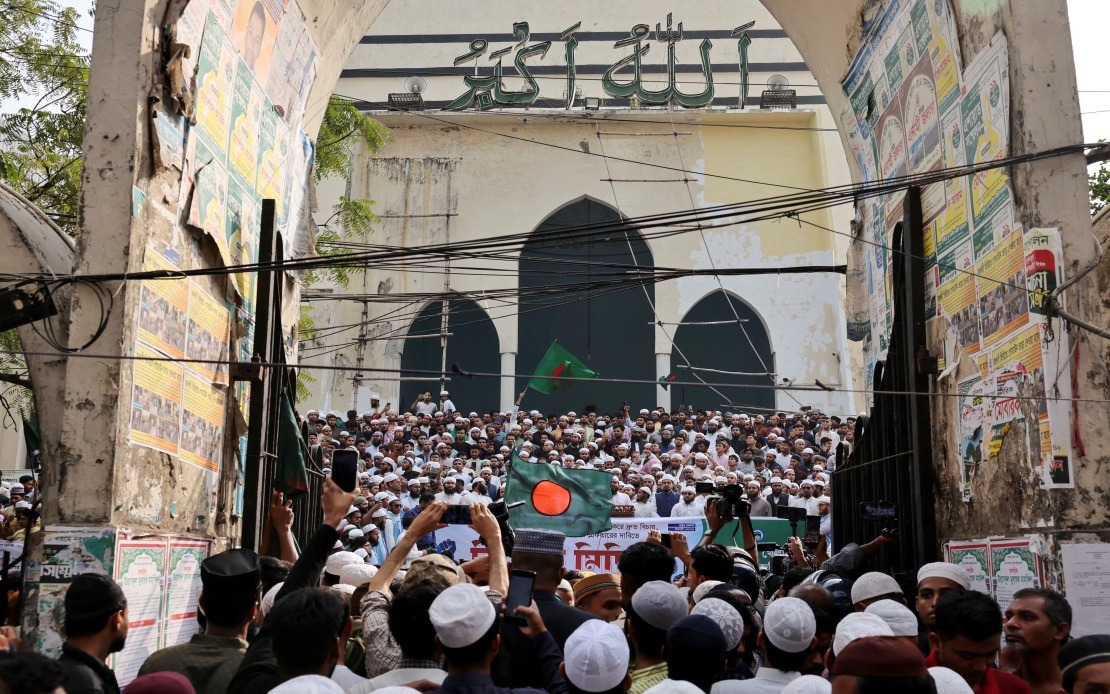
Bangladesh's International Crimes Tribunal has delivered death sentences against three law enforcement officials for their involvement in the deadly suppression of mass protests during the tumultuous July 2024 uprising. The three-member tribunal, presided over by Justice Md Golam Mortuza Mozumder, issued the verdicts in absentia on Sunday, targeting senior figures whose actions precipitated one of the most consequential political crises in the nation's recent history. The convictions mark a significant moment of accountability as the country grapples with the aftermath of a political transition that fundamentally altered its governance landscape.
The condemned officers include Habibur Rahman, the former commissioner of the Dhaka Metropolitan Police, alongside Md Rashedul Islam, a former additional deputy commissioner of the same force, and Md Mashiur Rahman, who previously headed the Rampura Police Station. These individuals were found culpable of crimes against humanity for their direct involvement in shooting and killing demonstrators during the uprising. All three remain fugitives, with no confirmed locations, complicating immediate enforcement of the sentences. The tribunal simultaneously convicted Tariqul Islam Bhuiyan, a former sub-inspector, to life imprisonment plus an additional twenty years, reflecting the hierarchy of responsibility in the command structure.
The deaths that triggered the tribunal's investigation captured widespread attention through social media documentation. One incident involved the fatal shooting of a young man who was filmed hanging from a building in the capital, an image that circulated explosively online and crystallized public outrage. Additional killings in Dhaka during the same period further inflamed tensions, with graphic footage demonstrating the lethal force deployed against unarmed civilians. These viral moments catalyzed broader demonstrations nationwide, transforming isolated incidents into a nationwide reckoning with police brutality and government overreach. The visual evidence proved instrumental in the tribunal's investigation and prosecution, establishing a direct connection between officer actions and civilian deaths.
The uprising fundamentally destabilized the political order. Prime Minister Sheikh Hasina, whose government had employed security forces to suppress dissent, ultimately fled the country in August 2024 and remains in exile. The crackdown's brutality accelerated her departure, as mounting international pressure and domestic resistance made her position untenable. The tribunal had separately sentenced Hasina to death in November of the previous year in an unrelated crimes against humanity case, underscoring the comprehensive nature of judicial review into the conduct of her administration. The confluence of these judgments reflects Bangladesh's determination to establish accountability mechanisms for state violence.
United Nations assessments indicate that approximately 1,400 individuals lost their lives during the 2024 uprising, with thousands more sustaining injuries. The overwhelming majority of these casualties resulted from police gunfire, with members of Hasina's Awami League party directing and executing the security response. The scale of casualties positions the uprising among the deadliest episodes of civil unrest in South Asia in recent years, comparable to major protest movements in neighboring countries. The death toll underscores the intensity with which security forces attempted to maintain order and suppress dissent during the peak mobilization phase.
The tribunal's decisions carry significance extending beyond Bangladesh's borders. Southeast Asian democracies and nascent democratic transitions face comparable challenges in balancing security imperatives with fundamental rights protections. Malaysia, as a regional nation with its own experiences managing large-scale protests, observes closely how Bangladesh navigates post-crisis accountability. The establishment of specialized tribunals and the pursuit of senior officials signal a commitment to institutional justice rather than summary vengeance, an approach that regional governments increasingly recognize as essential for sustainable political healing. Bangladesh's model provides both positive and cautionary lessons for managing the transitional aftermath of political upheaval.
The sentencing of high-ranking police officers also reflects evolving standards regarding state responsibility for security force conduct. The tribunal's willingness to hold senior commanders accountable for actions undertaken by subordinates establishes precedent for command responsibility doctrines in South Asian jurisprudence. This approach diverges from patterns in some regional contexts where lower-ranking officers absorb responsibility while superiors escape consequences. The tribunal's methodology—examining the chain of command and establishing nexus between superior directives and field-level violence—represents a sophisticated application of international criminal law principles adapted to Bangladesh's domestic context.
The absence of the accused from proceedings presents ongoing enforcement challenges. In absentia sentencing proves legally valid but operationally hollow without successful apprehension. Intelligence agencies across multiple jurisdictions would need to cooperate in locating and extraditing the fugitives. Diplomatic complexities may arise if any defendants have relocated to countries lacking extradition treaties with Bangladesh. The tribunal's verdicts therefore serve dual functions: they establish formal legal accountability while simultaneously highlighting the practical limitations facing transitional justice mechanisms when key perpetrators remain at large.
Bangladesh's post-uprising government has prioritized institutional reform of security forces. The tribunal proceedings represent part of a broader recalibration of police accountability structures and training protocols. International human rights organizations have provided technical assistance in establishing due process protections and reducing excessive force doctrines. These parallel institutional reforms, combined with prosecutorial action, aim to prevent recurrence of the systematic violence that characterized the final months of Hasina's tenure. The integration of accountability mechanisms with structural reform reflects contemporary understanding that prosecutions alone prove insufficient without accompanying changes to institutional cultures and command structures.
Regional observers from other Southeast Asian nations recognize that Bangladesh's tribunal approach offers an alternative to either impunity or politically motivated victimization. The tribunal's composition—including international legal expertise—and its focus on crimes against humanity rather than standard criminal charges underscore the gravity attributed to systematic violence. This framework creates space for accountability without necessarily devolving into cycles of retribution. For Malaysia and other regional democracies, Bangladesh's experience illustrates both the necessity and complexity of managing accountability in high-stakes political transitions where security forces have deployed lethal force against civilians.

