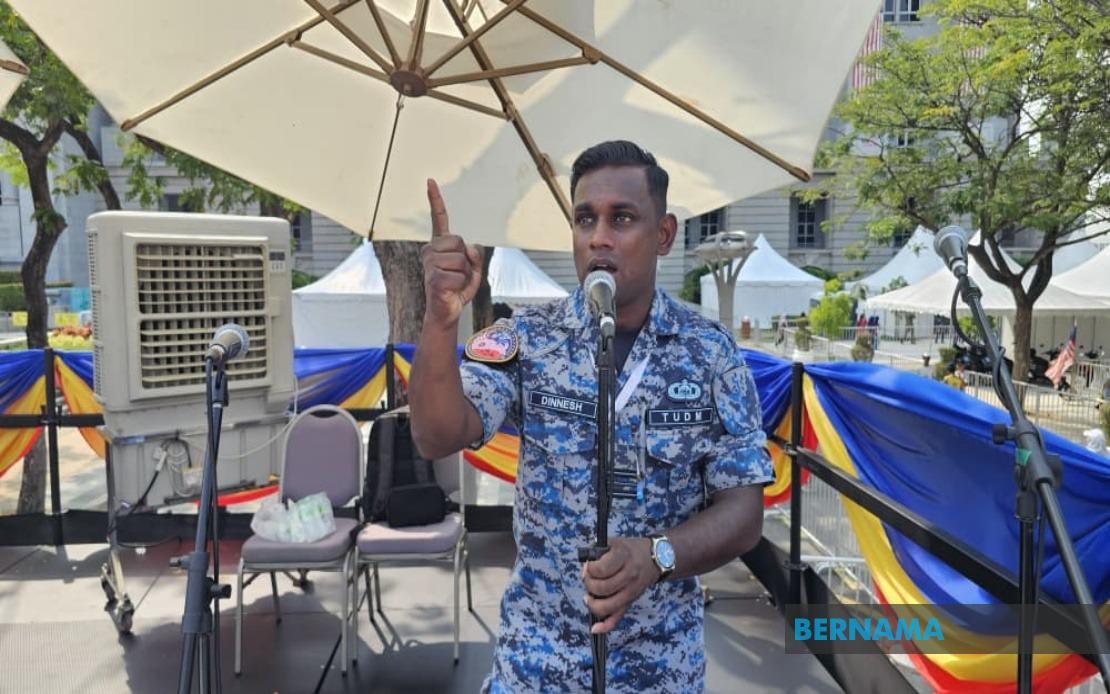
When fighter jets carved their paths across Putrajaya's skies during Malaysia's National Day festivities, a single voice anchored the spectacle for thousands watching from below. Major Dinnesh Nicolas Rene, a 34-year-old officer with the Royal Malaysian Air Force, transformed what could have been silent pyrotechnics into a riveting narrative, explaining each roll, formation, and tactical display with the precision of someone who understands both the machinery and the artistry involved.
The position of air show commentator represents far more than an announcer reading predetermined lines into a microphone. For Dinnesh and his fellow commentators Major Neny Suhaida Ab Suki and Captain Muhammad Iqbal Nasrudin, the role demands encyclopaedic knowledge spanning aircraft specifications, pilot identities, squadron histories, tactical formations, and the precise sequence of every manoeuvre scheduled for the display. This technical foundation transforms raw aerial movement into comprehensible narrative that educates and excites simultaneously.
Dinnesh's entry into air show commentary came through selection as a commentator for the Langkawi International Maritime and Aerospace Exhibition in 2019, an appointment that marked the beginning of what would become a specialised career trajectory. His background with the RMAF Air Defence Control Division, combined with years of operational experience since joining the service in 2015, provided the institutional knowledge necessary to bridge the gap between military aviation operations and public understanding. Yet serving as an air defence officer provides only a foundation; the commentary role demands entirely different skill sets and preparation protocols.
The preparation phase for major national events like the 2026 National Day parade extends far beyond script memorisation. Dinnesh emphasises that comprehensive coordination with ground controllers and pilots represents the cornerstone of effective commentary. Teams must establish precise details regarding aircraft movements, pilot names and backgrounds, squadron insignia and mottos, and the exact timing of each element within the aerial sequence. This coordination process involves multiple stakeholders, from air force personnel to civil aviation authorities to security agencies managing the event parameters.
When national leaders including Malaysia's King and Prime Minister attend such ceremonies, the commentator's role expands to encompass diplomatic protocol considerations. Dinnesh identifies protocol mastery as one of the paramount challenges facing commentators at high-level state functions. The ability to distinguish between information suitable for public consumption and details requiring discretion becomes critical; equally important is the capacity to deliver messaging at precisely calibrated moments that complement rather than distract from official proceedings and ceremonial elements.
Beyond technical knowledge and diplomatic awareness, air show commentary demands extraordinary vocal endurance and management. Unlike masters of ceremonies who can modulate their volume and take extended breaks, air show commentators must project their voices forcefully enough to penetrate the overwhelming noise generated by military aircraft at close range. This requirement creates significant physiological stress that accumulates across rehearsals and the actual performance day. Dinnesh identifies voice preservation as perhaps the most underestimated yet critical challenge his role presents, as vocal failure would compromise the entire public experience of an otherwise meticulously planned display.
The methodology Dinnesh employs to maintain performance quality and audience engagement rests on a deceptively simple principle: commentators must authentically embody and convey the genuine excitement they wish their audience to experience. This emotional authenticity proves particularly important given that spectators often judge the significance and impressiveness of aerial displays partly through the commentator's own evident enthusiasm and engagement. Cynicism or mechanical delivery would undermine even the most spectacular aerial manoeuvres, while genuine wonder and respect for the achievement amplifies the audience's own sense of occasion.
Remarkably, despite accumulated exposure to high-performance fighter jets throughout his military career, Dinnesh maintains an undiminished sense of awe regarding air shows. His continued capacity to experience excitement and wonder toward aviation displays, rather than viewing them as routine operations, represents a psychological asset that directly translates into superior commentary. This sustained enthusiasm allows him to approach each event as though encountering the spectacle for the first time, bringing fresh emotional energy to narration that audiences readily perceive and reciprocate.
For Malaysian audiences particularly, the quality of air show commentary during national celebrations carries special significance. These ceremonies mark moments when civilian and military spheres intersect publicly, and effective commentary helps civilian populations understand and appreciate the technological capabilities and professional expertise their armed forces possess. The role that officers like Dinnesh play extends beyond entertainment into public education and civil-military relations, interpreting complex military operations into accessible narratives that reinforce national pride and institutional respect.
The specialisation emerging around air show commentary within the RMAF reflects broader international trends in military public engagement. As armed forces worldwide recognize that public understanding of military capabilities enhances national security perception and recruitment potential, skilled communicators who can translate technical expertise into compelling public narratives become increasingly valuable. Dinnesh's career path demonstrates how military officers can develop dual expertise, maintaining operational credibility while cultivating communication skills that serve institutional interests beyond the cockpit.
Looking forward, the role of air show commentators will likely expand as nations invest increasingly in aerial displays as components of diplomatic and domestic messaging strategies. The individuals who excel in these positions must combine technical military knowledge with broadcasting skills, diplomatic awareness, and genuine passion for their subject matter. Major Dinnesh Nicolas Rene exemplifies this emerging professional standard, demonstrating that the voices amplifying Malaysia's aerial achievements require as much training and dedication as the pilots and aircraft themselves.

