A simple gesture in a hospital office in northwest England sparked an unexpected moment of recognition. When a colleague offered to peel a mandarin orange for a busy clinician who had skipped lunch, the act triggered something deeper than mere sustenance—it unlocked memories of an entire childhood shaped by the language of food. What appeared to be a small kindness became a window into understanding how different cultures, despite their apparent separation, communicate the same fundamental message through eating and feeding one another.
Growing up in Malaysia, the offering of food was rarely just about addressing hunger. Instead, it represented the primary currency through which family members expressed their love and concern. The act of preparing, serving, and sharing food became woven into the fabric of daily relationships, transforming ordinary meals into declarations of affection. For the author, these memories span decades—from childhood experiences to present adulthood—yet they remain remarkably consistent in their underlying meaning. Whether it was a grandmother peeling fruit or a parent remembering a favourite biscuit brand, each gesture carried the unspoken message: you matter, and I am thinking of you.
The most vivid memories centre on the people who took extra time to prepare food in specific ways tailored to individual preferences. A paternal grandmother would crack open crabs with patience and care, extracting the sweet flesh because she recognized her grandchild's reluctance to perform the task. Years later, that same person still cannot prepare crabs independently, not because of inability but because the memory remains so powerfully associated with an act of love. This pattern repeats throughout childhood: a grandmother hand-feeding a reading-obsessed child during meals to ensure proper nutrition, a mother consistently purchasing a particular biscuit brand despite occasional confusion about flavour preferences, an aunt always adding extra potatoes to curry for someone who preferred vegetables to meat.
These acts of care extended beyond the nuclear family into the broader community fabric. Across religious and cultural boundaries, Malaysian neighbourhoods demonstrated a consistent pattern: food became the vehicle for maintaining relationships and acknowledging important occasions. During Deepavali, an aunt delivered homemade chocolate cake year after year, while another colleague walked the neighbourhood distributing cookies. These gestures were not obligatory; no one required them. Yet they happened with such regularity that they became anticipated rituals, creating continuity and reinforcing bonds between people of different backgrounds living in close proximity.
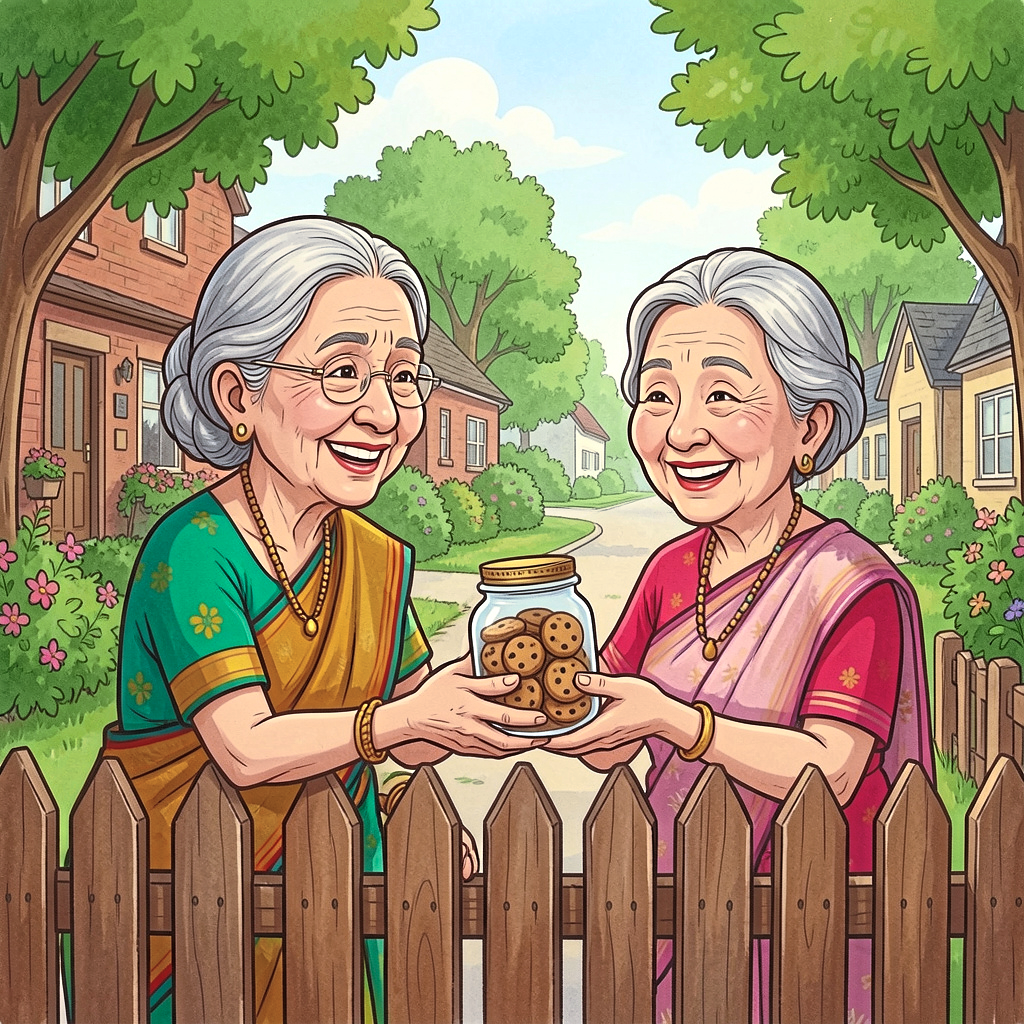
The most poignant example involved a neighbour of more than fifty years who regularly appeared at the fence with prepared dishes—sweet upma for breakfast, onion cucur for afternoon visits. When containers were returned, they always came back filled with something homemade, creating a graceful cycle of reciprocal care. The stroke that eventually prevented this neighbour from cooking seemed to diminish something essential; yet the memory of those shared meals remains vivid and cherished. Food had created such a lasting impression that it became inseparable from the relationship itself.
Seasonal exchanges reinforced these community bonds across religious divides. Chinese New Year brought store-bought cookies from neighbours, while Deepavali cookies from the author's household were reciprocated. A retired colleague still visits every Chinese New Year carrying mandarin oranges, while the author's mother continues her own visits bearing festive sweets. The persistence of these rituals, maintained even after retirement and despite changing circumstances, suggests that food-sharing represents something deeper than custom—it is a fundamental expression of human connection that transcends practical considerations.
What makes the English hospital moment so revelatory is that it demonstrated these caring impulses are not uniquely Malaysian. When the English colleague offered to peel the mandarin orange, she was speaking the same language that the author's grandmother had spoken decades earlier in Malaysia. The gesture carried identical meaning: recognition that another person needed care, coupled with a willingness to provide it through the medium of food. This realisation—that humanity appears to share a fundamental impulse to express care through feeding one another—shifts the conversation from cultural peculiarity to universal human behaviour.
The implications of recognising food as a universal language of care extend beyond nostalgia or sentiment. In contemporary Malaysia, where communities become increasingly diverse and traditional structures shift, understanding that food-sharing is a cross-cultural expression of community maintains relevance. As younger generations navigate different living arrangements and working patterns, the act of preparing and sharing food with colleagues, neighbours, and friends becomes even more significant. It serves as a practical way to maintain relationships in contexts where formal social structures have weakened.
For Malaysians living abroad, the memory of food customs often becomes more precious than it was at home. The mother who still purchases blue packet Hup Seng Teddy biscuits on her son's return is maintaining a thread of connection across geographical distance. She is communicating that despite the separation, her care remains constant and recognisable. Similarly, the retired colleague who appears with mandarin oranges every Chinese New Year is preserving a relationship that might otherwise fade with the passage of years and the reduction of daily contact.
In multicultural Malaysia, food serves as particularly important common ground. When different communities gather to celebrate festivals, sharing food becomes the most natural way to acknowledge mutual respect and build understanding. The cookies exchanged at Chinese New Year and Deepavali, the dishes brought by neighbours of different backgrounds, represent a form of communication that requires no translation. They simply state: you are part of this community, and I acknowledge that.
The reflection on humanity's oldest language also challenges how modern society sometimes dismisses the significance of food-sharing in an era of convenience and efficiency. When people are busy, eating often becomes purely functional—fuel for the body rather than communication. Yet the most memorable and meaningful moments involving food are precisely those where extra effort was invested. The colleague who offered to peel the mandarin, the grandmother who hand-fed a child reading books, the aunt who added extra potatoes to curry—none of these people were simply providing nutrition. They were creating memories and expressing something that words alone cannot convey.
Moving forward, recognising food as a universal language of care offers pathways for strengthening communities in Malaysia and beyond. In healthcare settings, workplaces, and neighbourhoods, the simple act of sharing or preparing food carries disproportionate significance. It costs relatively little in material terms but creates profound relational value. For a nation that has long understood food as central to its identity and cultural expression, this principle remains as relevant as ever, even as external circumstances change.

