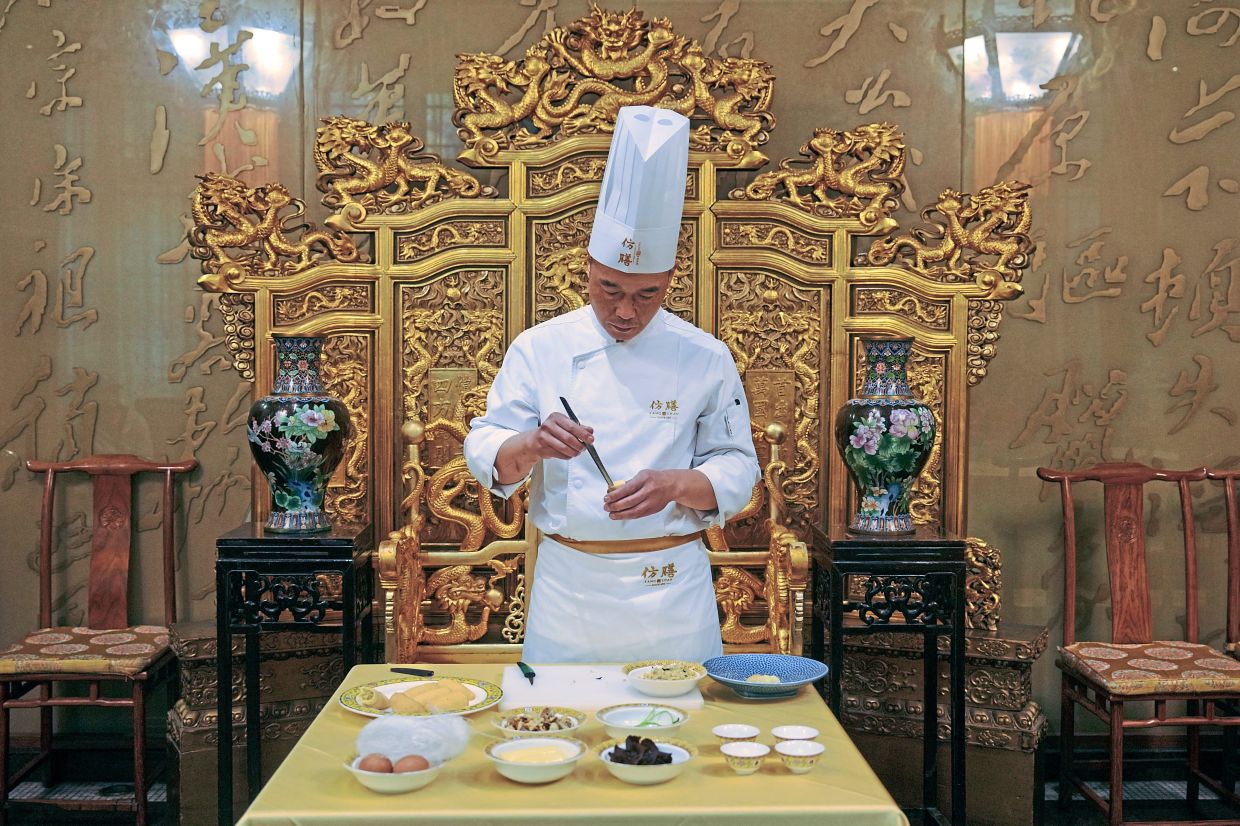
The dream pastry holds special meaning in the history of imperial China's culinary arts. According to legend, Empress Dowager Cixi once envisioned a particular delicacy in her sleep, only to have it mysteriously appear on her breakfast table the following morning. Her delight was profound enough to move her to summon the chef responsible and reward him with a silver ingot. What had originally been known simply as a minced pork pancake was thereafter renamed the dream pastry, its elevation from humble dish to imperial favourite reflecting the power dynamics that surrounded the royal table. This anecdote, preserved through generations, exemplifies how food intersected with court ritual and personal narrative in imperial China, transforming culinary preparation into an act laden with political and cultural significance.
Beijing's Fangshan Restaurant has emerged as the primary custodian of these imperial culinary traditions since its establishment in 1925. The restaurant was founded by former chefs who once served in the Qing Dynasty, individuals who possessed firsthand knowledge of how food was prepared and presented for the imperial court. Located in Beihai Park, a space where successive dynasties held government meetings, performed sacred rituals, and offered emperors respite from administrative duties, Fangshan occupies a site steeped in historical resonance. The restaurant's very name carries meaning, derived from the phrase that translates as "imitating the imperial cuisine," acknowledging its role as a keeper of knowledge rather than a claimant to original imperial authority. Though other Beijing establishments now serve variations of imperial dishes, and institutions like the Palace Museum preserve artefacts including pastry moulds from the Qing period, Fangshan remains the most recognised institution dedicated to reconstructing and maintaining these culinary practices.
Imperial cuisine encompassed far more than simply preparing food to satiate hunger. The meals consumed by emperors each day followed prescribed protocols, whilst the grand banquets held throughout the year operated according to elaborate ceremonial frameworks that embedded hierarchy, power, and cultural values into every moment of consumption. Scholars at the Palace Museum have documented how drinking milk tea served as an opening ritual during Qing banquets, establishing a particular tone and sequence for what would follow. The emperor's role during these occasions extended beyond passive consumption; he actively participated by bestowing wine or food upon princes and officials, each of whom was obliged to perform respectful rites before partaking. This distribution of imperial favour through carefully controlled gifting of edibles reinforced the cosmic and political order that the Qing court sought to maintain, transforming dining into a choreographed performance of power relations.
Beyond banquets, sacrificial rituals constituted an equally significant dimension of imperial dining practices. At the Palace of Earthly Tranquillity, the consumption of sacrificial pork represented one of the most solemn and important rites of the Qing imperial court. The pork was deliberately prepared without salt, a methodological choice that carried profound symbolic weight. After the ceremonial portion of the ritual concluded, the meat was distributed amongst guests, and receiving a portion of sacrificial pork conferred considerable honour upon the recipient. The absence of seasoning was not merely a practical consideration but a deliberate choice rooted in ancient Chinese philosophical traditions. Early ritual texts including the classical Book of Rites describe a meat broth known as grand stew, similarly served without added flavouring during sacrificial ceremonies. Scholars interpret this deliberate blandness as an intentional evocation of earlier, simpler culinary practices, serving as a ritual expression of reverence for antiquity and a symbolic reconnection with cultural origins that the Qing court sought to position itself as inheriting and preserving.
The institutional commitment to pastry production within the imperial court underscores how seriously the Qing regarded the refinement of culinary arts. A dedicated institution specialised solely in crafting pastries, reflecting the belief that these delicacies required expertise, oversight, and systematic development. At Fangshan today, the recipes employed in producing items such as Cixi's dream pastry and steamed corn buns remain rooted in the knowledge systems of the imperial kitchen. Zhou Tong, the chef responsible for these preparations, explains that servers at the restaurant deliberately recount the historical narratives embedded within each dish, recognising that customers derive deeper satisfaction from understanding the stories that animate the food they consume. This integration of culinary skill with historical narrative demonstrates how imperial cuisine functioned as a cultural medium through which power, refinement, and continuity could be expressed and reinforced.
The transmission of imperial cooking knowledge operates through a living chain of mentorship that has persisted across generations. Zhou learned his craft from a master craftsman who himself learned from previous practitioners, establishing an unbroken lineage stretching back into the Qing period. This apprenticeship model prioritises embodied knowledge, the kind of understanding that can only be acquired through extended observation and practice under direct supervision. The techniques employed in imperial cuisine fundamentally reject mechanisation, with no blenders or food processors permitted within the kitchen. Instead, ingredients such as beans are laboriously pulverised using sieves, whilst particular flours are prepared in custom-made copper pots through entirely manual processes. Zhou articulates the reasoning behind this labour-intensive approach with clarity: machines offer convenience but fundamentally alter the final product, stripping away the delicate graininess and sandy mouthfeel that characterise authentically handcrafted imperial pastries. This commitment to traditional methods, even in an era when technological solutions exist, reflects a deeper philosophical position regarding the relationship between process, craftsmanship, and cultural authenticity.
Fangshan's most popular offerings demonstrate the continuing appeal of imperial pastries to contemporary diners. The pea flour cake and red bean roll rank amongst the restaurant's bestselling items, with orders exceeding two hundred cakes daily during peak seasons. These delicacies represent the intersection of historical continuity and modern commercial viability, suggesting that preserving imperial cuisine need not mean relegating it to museums or academic study. The demand for these products indicates that contemporary audiences, including both domestic Chinese customers and international visitors, find genuine value and pleasure in engaging with these carefully prepared traditional foods. This commercial success provides the economic foundation that allows small-scale, labour-intensive production methods to remain financially viable, creating a feedback loop wherein cultural preservation becomes economically self-sustaining.
Executive chef Fan Liangliang's career trajectory illustrates the challenges inherent in reconstructing imperial culinary knowledge in the modern era. Upon joining Fangshan as a kitchen apprentice, Fan was compelled to entirely unlearn the techniques he had acquired at culinary school, replacing speed-oriented methods with the deliberately slower processes that characterise imperial cuisine. One particular technique, Nizihuo, requires practitioners to mince ingredients such as fish, shrimp, or chicken into extraordinarily smooth pastes, which are then meticulously reshaped into decorative forms representing animals and plants. Fan identifies this decorative miniaturisation as a hallmark of imperial cuisine, reflecting a philosophical commitment that every dish must simultaneously achieve innovation, visual beauty, nutritional value, and presentation-worthy excellence suitable for the imperial table. The labour required to produce such items exists in sharp contrast to contemporary culinary efficiency norms, yet its preservation demonstrates that certain values continue to justify extraordinary investment of human skill and time.
Adaptation represents a necessary compromise in maintaining imperial culinary traditions within legal and ethical contemporary contexts. Certain rare ingredients historically served at imperial tables, particularly bear paws, can no longer be procured or ethically served. Rather than abandoning dishes that historically featured such ingredients, contemporary practitioners like Chef Fan have developed refined adaptations that endeavour to retain the essential spirit and conceptual integrity of each preparation. This flexible approach to tradition demonstrates sophisticated understanding of the difference between form and substance, recognising that cultural preservation sometimes requires creative reinterpretation rather than rigid historical reconstruction. The principle underlying these adaptations suggests that living traditions necessarily evolve, provided their core values and aesthetic commitments remain intact.
The relationship between Chinese culinary tradition and broader cultural expression extends far beyond the practical concerns of nutrition and taste. The Tang Dynasty poet Du Fu composed verses celebrating cold noodles prepared with pagoda-tree leaves, but contemporary scholars recognise that these culinary descriptions functioned simultaneously as political commentary, expressing Du Fu's aspirations to serve the emperor and his frustration at thwarted ambitions. Chinese cuisine has historically carried meaning extending beyond the purely gastronomic, serving as a vehicle for conveying attitudes toward politics, aesthetics, and cultural values. These meanings themselves remain subject to historical transformation, shifting as circumstances change and societies reinterpret their pasts according to contemporary preoccupations. The preservation of culinary tradition therefore requires taking seriously the historical meanings embedded within practices, avoiding the trap of treating food as merely nutritional or aesthetic while overlooking its function as a repository of cultural memory and political meaning.
At its foundation, Fangshan's dedication to imperial cuisine represents a fusion of Manchu and Han culinary traditions, deliberately bringing together the food traditions of the Qing rulers and those of China's Han majority population. This fusion, reconstructed and maintained through decades of careful practice, reminds contemporary audiences that the imperial court itself was a space where diverse cultural traditions encountered and influenced one another. The preservation effort undertaken by chefs like Fan and Zhou extends beyond nostalgic recreation toward a more profound project of cultural transmission, wherein the knowledge systems, values, and aesthetic commitments embedded within imperial cooking practices are maintained as living alternatives to dominant contemporary approaches to food preparation and consumption. In an era often characterised by accelerating homogenisation and the triumph of industrial efficiency, Fangshan's commitment to handcrafted techniques, historical learning, and the integration of narrative with culinary practice offers a distinctive model for how cultural heritage might remain vitally relevant rather than relegated to museum displays.

