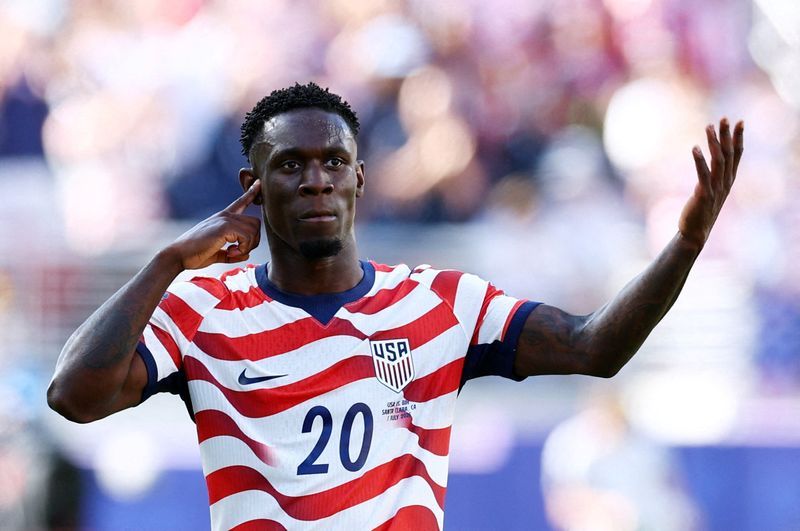
Folarin Balogun was meant to sit out the most important match of his career. The American striker had been shown a red card during the United States' group-stage encounter with Bosnia and Herzegovina, a dismissal that should have rendered him ineligible for Monday's knockout round fixture against Belgium. Instead, FIFA's shocking decision on Sunday to suspend his ban thrust the 25-year-old into the eye of a controversy that transcends sport, entangling questions of identity, citizenship law and presidential politics in ways few athletes have experienced on the World Cup stage.
The incident that triggered Balogun's exclusion occurred when he was adjudged by the Video Assistant Referee system to have planted his boot on the ankle of Bosnia defender Tarik Muharemovic. While the contact appeared inadvertent—more reckless than malicious—the red card stood, and all indications suggested the United States would face Belgium without one of their tournament's most dynamic performers. But the narrative took an extraordinary turn when President Donald Trump, who has made ending birthright citizenship a cornerstone of his political agenda, publicly appealed to FIFA President Gianni Infantino to reconsider Balogun's case. The irony was almost too stark to ignore: the same political figure advocating for restrictions on how Americans acquire citizenship through birth was simultaneously fighting to keep an "accidental American" on the pitch.
Balogun's unlikely path to representing the United States in a World Cup knockout match begins in New York, where his Nigerian mother found herself unable to return home after a trip went further into pregnancy than planned. She was too far advanced to fly, and so Balogun was born on American soil, acquiring citizenship through the 14th Amendment's birthright provisions—the very legal framework Trump has repeatedly targeted for reform. His mother carried him back to Britain when he was just one month old, and there he would spend his formative years, coming through Arsenal's storied academy system in London. When it came time to choose a national team, Balogun initially represented England at youth levels before ultimately opting to join the United States Soccer programme in 2023, a decision he said was influenced by the warmth of American fans he encountered during a vacation to Orlando.
The timing of FIFA's intervention could hardly have been more politically charged. Just days before the suspension decision, the Supreme Court had delivered Trump a significant rebuff by ruling against his administration's efforts to restrict birthright citizenship, handing the president a stinging defeat on what he had positioned as a central policy objective. The reversal made Balogun's case suddenly resonant beyond the confines of football, transforming his on-field transgression into a symbol in a broader national conversation about who belongs in America and how citizenship should be understood. While Infantino publicly denied that Trump's intervention influenced the decision, the optics proved difficult to disentangle—the president had made his desires known, and FIFA had obliged.
Balogun's emergence as the United States' breakout star at this World Cup has itself represented a notable cultural shift. For decades, Christian Pulisic served as American soccer's charismatic ambassador to the world, a rare genuine celebrity in a sport the nation has historically treated with ambivalence. Yet it was Balogun, with three goals through the group stage, who captured the imagination of supporters and sponsors alike. His performances suggested the possibility of a deep tournament run, and his success challenged long-standing perceptions of American soccer as primarily a vehicle for white athletic talent. The contrast was not lost on observers: here was a Black striker of Nigerian descent, representing the United States through the accident of birthright citizenship, becoming the face of the nation's World Cup campaign.
Support for Balogun's continued participation transcended the sporting sphere. Immigration advocates seized on the moment to illustrate the humanitarian logic underlying birthright citizenship. Jorge Loweree, managing director of programs at the American Immigration Council, characterised Balogun's case as "an extraordinary example of the good that is made available to us by things like birthright citizenship, giving people an opportunity that they would not have otherwise, to be their best and to contribute to the United States in ways that benefit all of us." The Miami Herald editorial board similarly declared that "Balogun prove(s) birthright citizenship isn't a loophole—it's America." In this framing, his potential to play against Belgium became not merely about football, but about validating a legal principle under sustained political attack.
The United States occupies a distinctive position globally in its approach to birthright citizenship. An 1898 Supreme Court ruling affirmed that the 14th Amendment guarantees citizenship to those born on American soil regardless of parental status, a principle shared by only 32 other countries, most concentrated in the Western Hemisphere. This relatively permissive standard has made America a destination for migrants and has shaped the nation's demographic composition and self-understanding for generations. Yet Trump's repeated calls to curtail or eliminate birthright citizenship reflect a hardening political stance on immigration and national belonging that has gained traction within certain conservative circles. Balogun's case became a live test of these competing visions of American identity.
The striker himself navigated the swirling controversy with composure. When the red card was shown, his teammate Christian Pulisic—who had himself stirred controversy with a "Trump dance" celebration after scoring a year and a half earlier—wrapped a supportive arm around Balogun as the young player absorbed the moment. In the days that followed, Balogun pledged to channel his energy into supporting teammates from the sideline, adopting the role of vocal leader rather than field participant. Yet when FIFA's stunning reversal arrived, it vindicated not merely Balogun's desire to play, but the broader political and cultural constituencies that had mobilised on his behalf. Public polling showed that most Americans opposed ending birthright citizenship, suggesting that Balogun's reinstatement aligned with prevailing public sentiment, even as Trump's intervention reflected the president's consistent ideological commitments.
The implications of this episode extend beyond the immediate outcome of a single World Cup match. Balogun's journey from an accidental birth in New York to representing the United States at football's grandest stage embodies enduring tensions within American political discourse about immigration, citizenship and national identity. The fact that a sitting president intervened in an international sports body's disciplinary decision—and that the intervention occurred in a case involving an athlete whose very eligibility hinged on birthright citizenship principles the president has publicly opposed—speaks to how deeply these questions now penetrate popular consciousness. Whether intentional or coincidental, FIFA's decision created a narrative in which a young athlete of immigrant heritage became the symbol of a country's commitment to inclusion and opportunity, even as powerful political voices questioned whether such commitments remain tenable in contemporary America.
For Malaysian readers and Southeast Asian observers, Balogun's story illuminates the extent to which contemporary sport serves as a battleground for political ideologies and cultural definitions of national belonging. In a region where questions of citizenship, immigration and national identity remain contested in various contexts, Balogun's case demonstrates how international sports tournaments can amplify and dramatise these debates on a global stage. His presence in the Belgium match represented not merely the selection of a talented footballer, but the vindication—at least temporarily—of a particular vision of what national representation might mean in an increasingly diverse, interconnected world.

