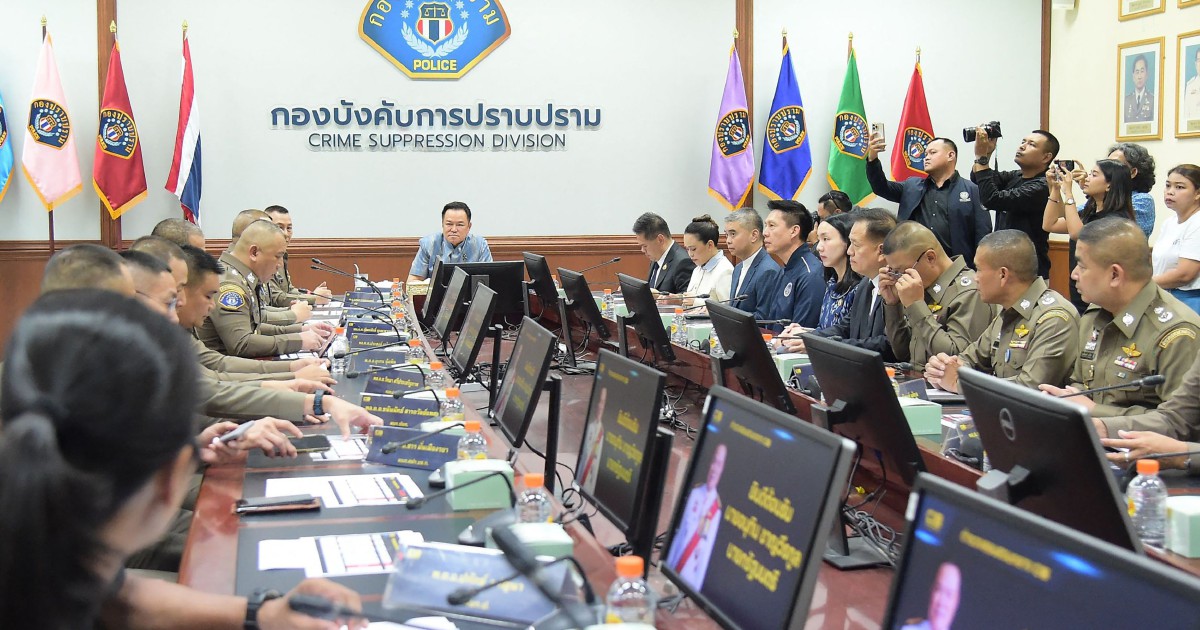
Thailand's civil service system faces one of its most significant integrity crises in recent years, with authorities announcing the impending suspension of approximately 6,000 government officials caught up in a widespread examination fraud scandal. The revelation, disclosed by officials on Thursday, represents a dramatic escalation in what had begun as a relatively contained investigation but has now ballooned into a nationwide crisis affecting thousands of state employees across multiple ministries and departments.
The expanding scope of the scandal underscores systematic weaknesses in Thailand's recruitment and examination procedures, raising critical questions about governance standards in Southeast Asia's bureaucratic institutions. The sheer magnitude of those implicated—nearly 6,000 individuals—suggests the problem extends far beyond isolated cases of individual misconduct. Instead, investigators have uncovered patterns suggesting coordinated cheating, potential involvement of examination administrators, and possible networks facilitating the fraudulent conduct across different examination cycles and recruitment batches.
Three individuals have already been arrested in connection with the scheme, according to investigating authorities, marking the criminal dimension of a situation that combines disciplinary measures with criminal prosecution. The arrests signal that authorities view the conduct as sufficiently serious to warrant prosecution beyond mere administrative sanctions. These initial detentions likely represent only the preliminary stages of a much broader criminal investigation, with prosecutors potentially preparing cases against additional participants in the conspiracy.
The disciplinary suspension of the 6,000 officials demonstrates the Thai government's attempt to address the scale of the problem through immediate administrative action. However, suspensions present practical complications, as removing thousands of civil servants simultaneously risks disrupting government service delivery across multiple sectors and agencies. The suspension mechanism therefore reflects a balancing act between upholding institutional integrity and maintaining functional government operations during the crisis.
For Malaysian observers, the Thai situation carries instructive implications about civil service examination integrity in the region. Malaysia's own civil service recruitment process, overseen by the Malaysian Public Service Commission, maintains similar competitive examination frameworks designed to ensure merit-based selection. The Thai experience demonstrates how examination systems can become vulnerable to coordinated fraud if oversight mechanisms weaken or if examination personnel themselves become compromised. Malaysia's approach to examination security and integrity monitoring warrants periodic review in light of such regional developments.
The scandal also illustrates how institutional corruption can permeate government systems across Southeast Asia, where civil service recruitment remains central to state capacity and governance quality. When examination systems—ostensibly designed to select qualified personnel—become vehicles for fraudulent advancement, the entire foundation of meritocratic governance erodes. This degradation affects not only the legitimacy of individual officials but also public confidence in government institutions broadly.
The expansion of the investigation suggests that authorities have adopted increasingly sophisticated detection methods, possibly including forensic analysis of examination records, comparison of answer patterns across candidates, or examination of communications between test-takers and potential facilitators. Such expanded detection capabilities often emerge only after initial discoveries prompt intensive investigative effort, implying that the full extent of the cheating may only become apparent as authorities continue their work.
Thailand's civil service, employing hundreds of thousands of officials across national, provincial, and local levels, forms the backbone of the country's administrative infrastructure. An examination fraud crisis of this magnitude threatens to undermine confidence in the competence and integrity of government agencies responsible for implementing policy, collecting revenue, regulating business, and delivering public services. The cascading effects of mass suspension could complicate government functioning for months or years as replacements are recruited and trained.
The authorities' response mechanism—combining suspension, criminal prosecution, and continuing investigation—represents a multifaceted approach to addressing both the immediate integrity breach and underlying systemic vulnerabilities. Alongside the enforcement actions, Thai officials will likely face pressure to reform examination procedures, strengthen oversight of testing administration, and implement detection systems designed to prevent similar schemes in future recruitment cycles.
For the broader Southeast Asian region, including Malaysia, the Thai scandal underscores the importance of maintaining robust examination security protocols, adequate resource allocation to oversight bodies, and transparent mechanisms for investigating allegations of misconduct. The credibility of civil service systems depends fundamentally on public perception that recruitment procedures operate fairly and that examination results genuinely reflect candidates' qualifications. When that perception erodes, as it has in Thailand, restoring public confidence requires sustained institutional reform extending far beyond the current round of suspensions and arrests.
As the investigation continues and the full dimensions of the conspiracy emerge, Thai authorities will need to balance accountability measures against the practical necessities of maintaining government operations. The challenge facing Thailand reflects a governance problem increasingly common across developing democracies: ensuring that the institutions designed to enforce meritocratic standards themselves operate with integrity and effectiveness.

