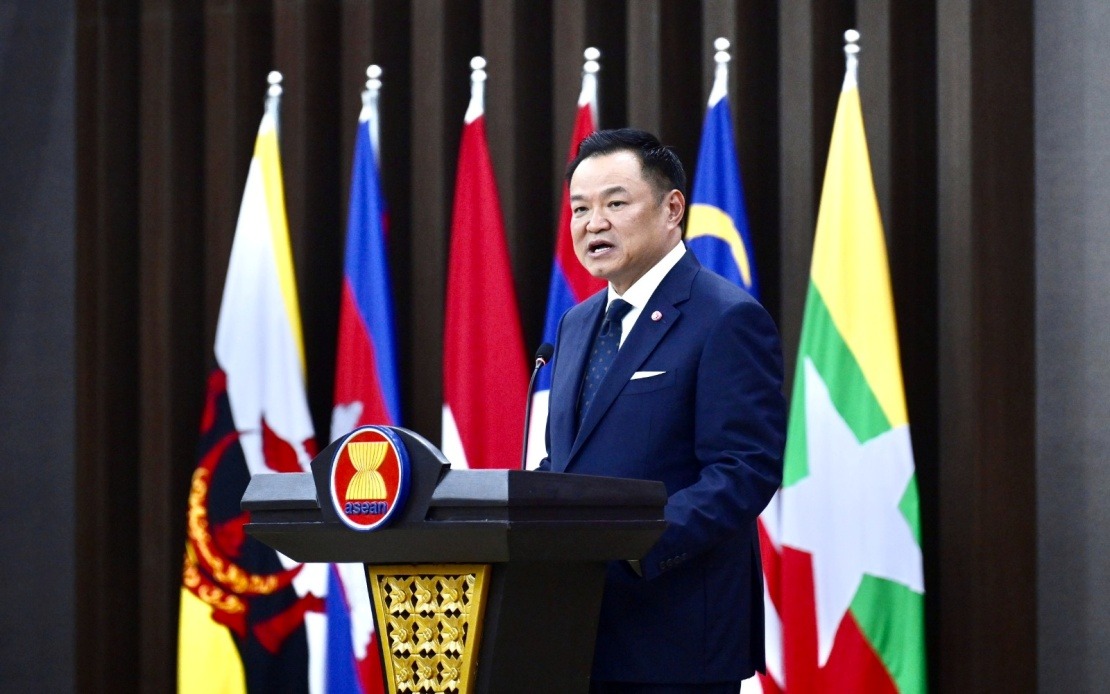
During an address at the ASEAN Secretariat in Jakarta, Thai Prime Minister Anutin Charnvirakul unveiled an ambitious three-part agenda for the regional bloc, underscoring the need for a stronger, more resilient community that places citizens at the heart of its mission. His remarks signal Bangkok's intention to play a more influential role in shaping ASEAN's trajectory as the organisation approaches its 60th anniversary next year.
Anutin's core argument centres on a fundamental premise: no single nation can tackle the multifaceted challenges facing Southeast Asia in isolation. Geopolitical tensions, economic volatility, technological disruption, and transnational security threats transcend borders and demand coordinated action rooted in shared interests. This framing represents a reassertion of ASEAN's foundational principle of collective problem-solving, yet Anutin frames it within the context of an increasingly fragmented global order where regional cohesion has become a strategic necessity rather than merely a diplomatic preference.
The Thai premier's emphasis on strengthening ASEAN's economic fundamentals reflects growing concerns across Southeast Asia about supply chain vulnerabilities exposed by the pandemic and geopolitical competition between major powers. By advocating for consolidated supply chains and enhanced food and energy security, Anutin acknowledges that member states face common vulnerabilities in an era of resource competition and shifting trade patterns. These practical measures would address immediate economic anxieties while building redundancy into critical systems that currently depend on narrow external links.
Digital connectivity emerged as another pillar of Anutin's vision, underscoring Thailand's recognition that technological disparity within ASEAN could exacerbate inequality between and within nations. Accelerating digital infrastructure and preparing younger generations for digital-economy roles represents both an opportunity and necessity as automation reshapes labour markets across the region. This forward-looking agenda positions ASEAN to compete with other regional blocs rather than remaining peripheral to global technology flows.
Crucially, Anutin advocated for a pragmatic recalibration of ASEAN's operational principles. While maintaining commitment to consensus-based decision-making and non-interference, he suggested that greater flexibility would enable the bloc to respond more swiftly to emerging crises. This represents a subtle but significant challenge to ASEAN's traditional consensus requirement, which critics argue has rendered the organisation slow to act on pressing issues. Such flexibility could accommodate diverse member interests while preserving core principles, though it risks reopening debates about the proper balance between unity and individual sovereignty.
The Thai leader's call for proactive, anticipatory governance rather than crisis-reactive responses marks a departure from ASEAN's historical pattern of addressing problems after they metastasise. By advocating that the bloc "prepare in advance" rather than "wait for crises," Anutin implicitly critiques past inaction on issues ranging from maritime disputes to humanitarian emergencies. This preventative approach would require member states to commit resources and political capital to potential problems before they become acute, a challenging proposition in a region where competing national priorities often dominate.
Anutin stressed that ASEAN's legitimacy ultimately depends on delivering tangible improvements to the lives of ordinary citizens. Economic opportunities, enhanced security, and effective suppression of transnational organised crime represent concrete metrics by which regional integration should be judged, rather than abstract diplomatic achievements. This people-centred framing reflects awareness that ASEAN integration remains distant from mass publics across Southeast Asia, who may see limited personal benefit from institutional structures.
On the contentious Myanmar situation, Anutin reaffirmed Thailand's commitment to ASEAN's Five-Point Consensus while promoting what he termed "calibrated re-engagement." This diplomatically coded phrase suggests a willingness to maintain dialogue channels with Myanmar's military leadership rather than pursuing isolationist policies that have characterised some international responses. The recent International Committee of the Red Cross visit to Aung San Suu Kyi, which assessed her health positively, provided what Bangkok views as evidence that diplomatic engagement yields humanitarian results. This positions Thailand as a bridge-builder, though such approaches remain contentious among ASEAN members and international human rights advocates.
Thailand's bilateral relations with Cambodia also featured prominently in Anutin's Jakarta remarks. His emphasis on rebuilding mutual trust and maintaining dialogue reflects ongoing sensitivities in Thai-Cambodian relations, which have experienced periodic tension over border disputes and historical grievances. By framing resolution within international law frameworks while maintaining commitment to ASEAN unity, Anutin attempts to reconcile bilateral interests with collective regional goals—a delicate balancing act that characterises much of Southeast Asian diplomacy.
The timing of Anutin's visit held particular significance as the first official Thai prime ministerial visit to Indonesia in 15 years. Such diplomatic gaps underscore how bilateral relations within ASEAN can cool despite membership in the same institutional framework. Anutin's emergence as Thailand's 32nd prime minister in September 2025 provided an opportunity to reset Thai-Indonesian relations and reassert Bangkok's regional leadership aspirations. Indonesia's role as ASEAN's de facto anchor and largest economy makes cultivating strong bilateral relations essential for any Thai leader seeking influence within the bloc.
The broader implications of Anutin's vision extend beyond Thailand's immediate interests. His calls for economic integration, digital development, and proactive governance reflect challenges facing all Southeast Asian nations grappling with technological disruption, economic inequality, and geopolitical pressures. Whether ASEAN can translate these aspirational goals into concrete mechanisms remains an open question, particularly given the bloc's historical difficulties in enforcing collective decisions against dissenting members.
As ASEAN approaches its 60th anniversary, Anutin's articulation of a strengthened, more responsive regional community offers a blueprint for institutional evolution. Whether member states possess the political will to implement the flexibility, coordination, and resources his vision demands will ultimately determine whether ASEAN becomes a more effective actor in regional and global affairs, or whether it remains characterised by the incrementalism and consensus-paralysis that critics argue has limited its impact.

