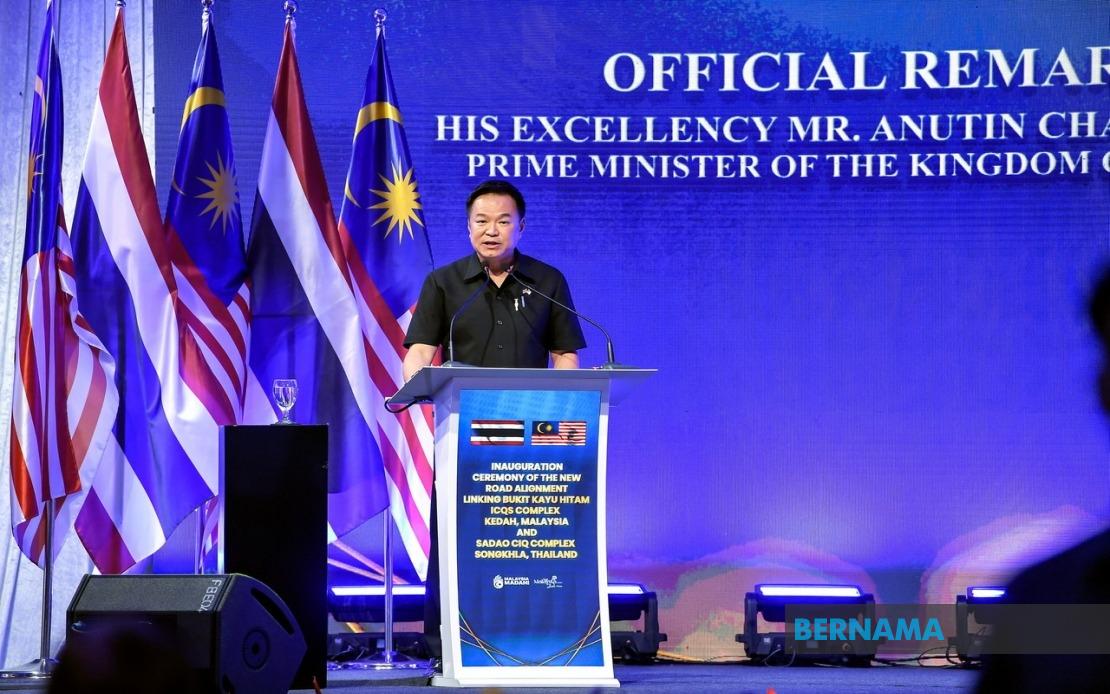
Thai Prime Minister Anutin Charnvirakul has reaffirmed his government's determination to fill critical gaps in the transport network linking Malaysia and Thailand, positioning the improved connections as essential infrastructure for accelerating bilateral trade and deepening regional integration. Speaking at the inauguration of a new road alignment between the Bukit Kayu Hitam Immigration, Customs, Quarantine and Security Complex in Kedah and the Sadao Customs, Immigration and Quarantine Complex in Thailand, Anutin outlined an ambitious vision for seamless cross-border logistics that could eventually extend far beyond Southeast Asia.
The new road corridor represents a tangible outcome of collaborative planning between Bangkok and Kuala Lumpur, addressing congestion challenges at what remains the busiest land crossing along the Malaysia-Thailand frontier. By redesigning the approach to the border checkpoints, both nations hope to reduce delays that have historically hampered commercial efficiency and tourism flows. The project underscores how infrastructure investment at strategic border points can serve as a catalyst for broader economic partnership, a lesson increasingly relevant as Southeast Asian governments compete for regional supply chain advantages.
Anutin articulated an expansive conception of the network's ultimate purpose, extending well beyond Malaysian-Thai commerce. He emphasised that the improved corridors would facilitate the movement of goods originating from Thailand and China through Malaysian territory en route to Singapore and Indonesia, creating what amounts to a continental trade artery. This multilateral perspective reveals how border infrastructure decisions increasingly reflect the interconnected nature of modern Asian logistics, where a single crossing point can influence supply chains spanning multiple countries and serving global markets.
The initiative encompasses more than the Bukit Kayu Hitam improvement alone. Thai and Malaysian officials have identified additional priority corridors requiring development, namely the Songkhla-Kedah, Satun-Perlis, and Narathiwat-Kelantan routes. This phased approach suggests a strategic focus on southern Thailand and northern Malaysia, regions that remain economically underperforming compared to other parts of both countries. Enhanced connectivity in these areas could unlock significant agricultural, tourism, and manufacturing potential, particularly given the cultural and linguistic ties between communities on either side of the border.
For Malaysian stakeholders, the implications are considerable. Improved transport links offer manufacturers and traders quicker access to Thai markets and distribution networks serving Indochina. The northeastern region of Thailand has emerged as an increasingly significant economic zone within Southeast Asia, and better road infrastructure from Malaysian supply points could reposition Kuala Lumpur as a preferred logistics hub for goods moving toward Bangkok and beyond. This positioning has direct relevance for port operators in Penang, Johor, and Kuantan, which could see increased containerised cargo transit volumes.
Anutin's commitment to resolving outstanding border procedures and facilitating easier people movement reflects a broader softening of bilateral relations after periods of tension. The explicit mention of streamlining protocols for cross-border travel suggests both governments recognise that tourism recovery and people-to-people exchange require matching infrastructure investments with administrative simplification. For Malaysian travellers and businesses with operations in Thailand, such reforms could translate into reduced processing times and lower transaction costs.
The geopolitical undertones of this connectivity push merit consideration. Anutin's reference to extending trade corridors toward China and Russia indicates Thailand's ambitions to position itself as a linchpin in continental trade patterns. For Malaysia, this signals opportunities to benefit from Thai-Chinese economic deepening while simultaneously anchoring itself more firmly within regional value chains. The reference to potential Russian trade links, though somewhat notional given current geopolitical conditions, suggests both governments are considering long-term infrastructure frameworks intended to remain relevant across changing political circumstances.
The ceremonial aspects of the inauguration—with both Thai and Malaysian prime ministers present—underscore how border infrastructure has evolved from purely technical matters into symbols of bilateral commitment. Anutin's explicit gratitude toward Anwar Ibrahim and acknowledgment of Malaysia's cooperation indicate that successful cross-border projects require sustained political will at the highest levels. In Southeast Asia's context, where leadership changes can rapidly alter foreign policy priorities, such high-level engagement provides assurance that these initiatives will not languish through bureaucratic delays.
The economic ramifications for communities directly adjacent to improved border crossings deserve attention. Enhanced connectivity typically generates employment opportunities in logistics, warehousing, and transport services, though distribution of such benefits requires deliberate policies ensuring local workers and entrepreneurs can access new opportunities. The Thai government's explicit mention of improving well-being for border populations suggests awareness that infrastructure projects must demonstrate tangible benefits to residents beyond impressive trade statistics.
Looking ahead, the success of these initiatives will depend partly on sustained investment from both sides and the resolution of regulatory harmonisation issues that often prove more intractable than physical infrastructure challenges. Customs procedures, quarantine standards, and vehicle regulations must align reasonably closely to realise the efficiency gains that improved roads theoretically enable. Malaysian authorities should engage proactively with Thai counterparts on these non-physical barriers to trade, as they ultimately determine whether new infrastructure translates into measurable commercial benefits.
The timing of this commitment also reflects broader trends in regional integration. With ASEAN member states increasingly competing for investment and supply chain diversification away from China, improving intra-regional transport networks has become strategically significant. Thailand and Malaysia's investments in better cross-border connectivity position them advantageously for capturing export-oriented manufacturing and logistics investment seeking to diversify geographic risk while maintaining strong pan-Asian connections.
For Malaysian policymakers, the message from Bangkok is clear: border infrastructure development offers substantial economic returns when coupled with serious implementation of supporting measures. The challenge now involves ensuring that Malaysian counterparts match Thai enthusiasm with equivalent resource commitment and institutional capacity, transforming ambitious rhetoric into functional corridors that tangibly improve the movement of people, goods, and capital across one of Southeast Asia's most economically significant borders.

