Thai law enforcement has intensified its assault on what officials describe as an elaborate scheme enabling foreign nationals to circumvent strict property ownership restrictions. During coordinated raids across Hua Hin in Prachuap Khiri Khan province on Monday, police arrested 13 foreign nationals and summoned 39 Thai nationals for questioning as part of the sixth phase of a sprawling investigation into nominee property arrangements. The operation targeted 15 locations and involved over 200 personnel, reflecting the scale and complexity authorities believe these structures have attained.
The detained foreigners comprised three British nationals, four Chinese nationals, and one each from Italy, France, the Netherlands, Austria, the Philippines and the United States. Among them, 45 individuals faced arrest warrants issued by Thai courts, though none had been formally charged at the time of the operation. The investigation focuses on 33 companies suspected of holding valuable real estate ostensibly in the names of Thai shareholders while actual control and beneficial ownership rested with foreign parties, an arrangement that violates Thailand's foreign land ownership prohibitions.
Policemen and officials from multiple agencies descended on Thap Tai subdistrict, where they identified a residential development featuring detached houses and pool villas individually valued at approximately 10 to 20 million baht each. The combined estimated value of properties under investigation across all phases has swelled to roughly 2.539 billion baht, encompassing more than 160 rai or approximately 25.6 hectares. The Hua Hin phase alone identified six companies allegedly employing Thai nominee shareholders, four connected to earlier discovery phases and two others newly identified.
According to investigative findings, foreign property seekers encountered legal challenges attempting direct ownership and subsequently sought alternative routes. They recounted being directed by law and accounting firms toward establishing corporate structures purportedly allowing legitimate property holding within Thai jurisdiction. The foreign nationals believed these arrangements provided legal cover for their real estate investments, though police insist the companies in question conducted no genuine commercial activities beyond serving as property vessels. The specific law and accounting firms remain unnamed in official statements, though authorities indicated they would pursue potential complicity.
Thailand's land ownership restrictions have long frustrated foreign investors seeking direct property acquisition, creating fertile ground for circumvention schemes. Foreign nationals can hold only limited building plots under specific conditions and may not own agricultural land or residential property directly. The nominee arrangement exploits a regulatory gap by channelling foreign capital through Thai corporate shells, fundamentally subverting the spirit and letter of ownership legislation intended to preserve national land control and prevent speculation.
Police revealed that Thai shareholders listed on company registers claimed minimal involvement in the operations. These individuals allegedly received compensation for lending their names but never purchased shares, invested capital, or participated in corporate management. They professed ignorance of financial documents, accounting records or investment evidence, positioning themselves as mere legal figurines serving foreign interests without direct knowledge or responsibility. This pattern, investigators argued, provides the structural architecture enabling foreign control while maintaining facade compliance with Thai corporate law.
The current operation represents an evolution in enforcement strategy rather than isolated enforcement action. Five preceding phases systematically mapped alleged nominee networks across Thailand's principal tourism and investment zones. Initial investigations centred on Koh Phangan in Surat Thani, examining nominee companies and professional service networks suspected of controlling property and hospitality enterprises. Phase 3 expanded geographically to encompass Phuket, Phang Nga and Krabi, where authorities examined 89 properties valued exceeding 1.05 billion baht. Chonburi became Phase 4's focus before investigators targeted 31 companies controlling 29 land plots worth approximately 633 million baht across Chiang Mai in Phase 5.
Cumulative enforcement results across preceding phases demonstrate the investigation's productivity and scale. Thai courts approved 133 arrest warrants from earlier operations, with 20 cases progressing to conviction. However, the sheer number of subsequent suspects and properties suggests investigative capacity may struggle to process cases efficiently, potentially straining court systems and prosecutorial resources. The pattern of discoveries—each phase uncovering substantial additional property holdings and criminal networks—indicates the investigation has encountered deeper layers of organisation than initially anticipated.
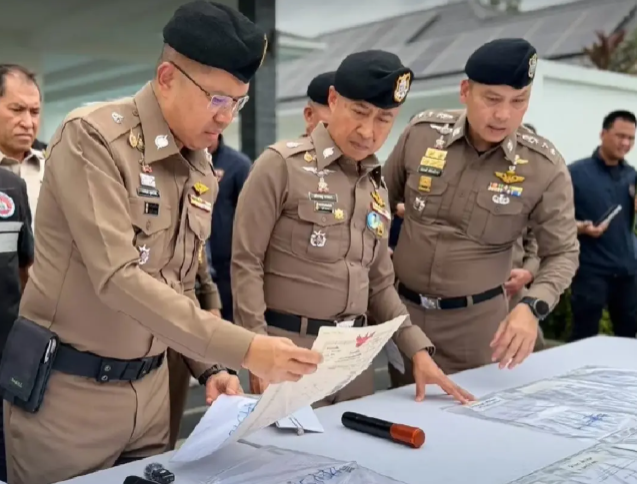
Police command structures overseeing this operation illustrate seriousness at institutional levels. Deputy national police chief Pol Gen Samran Nuanma ordered the operation, while Pol Lt Gen Nopasil Poolsawat, serving at the Office of the National Police Chief, and Pol Lt Gen Phisit Tanprasert, commissioner of Provincial Police Region 7, led execution. Participation from the Prachuap Khiri Khan governor alongside officials from the Department of Business Development and Department of Lands reflected whole-of-government coordination. This inter-agency approach signals enforcement capability beyond standard police investigation.
Authorities seized extensive documentation and digital materials during the raids, including corporate registration files, accounting records, computers, mobile phones and electronic data. Investigators plan detailed forensic examination of these materials, specifically targeting financial transaction traces that might illuminate additional participants, beneficiaries or international networks implicated in these schemes. The inquiry will extend beyond foreign suspects to encompass potential corruption or misconduct by Thai government officials allegedly facilitating or tolerating these activities.
For Malaysian and regional readers, these developments carry particular relevance. Similar nominee arrangements using Thai nationals as fronts for foreign property ownership represent a regional phenomenon affecting multiple Southeast Asian jurisdictions increasingly attracting foreign capital. Malaysia's own foreign property regulations, whilst more permissive than Thailand's, face comparable pressures from investors seeking asset diversification and speculative returns. Thailand's aggressive enforcement posture establishes precedent that neighbouring countries might replicate, potentially affecting foreign investment strategies across the region.
Police explicitly clarified that enforcement targets unlawful nominee structures and foreign-controlled entities operating outside legal frameworks rather than legitimate foreign investors complying with Thai regulations. This distinction matters because it preserves Thailand's appeal to bona fide foreign investors whilst signalling zero tolerance for regulatory circumvention. The authorities encouraged public reporting of suspected illegal foreign business activity through local police stations or the Royal Thai Police hotline operating continuously on 1599.
The ongoing investigation reflects Thailand's determination to preserve constitutional land ownership restrictions whilst grappling with foreign investment pressures and integration into regional and global capital markets. Rather than liberalising land ownership to accommodate foreign investors—a controversial political proposal—authorities have chosen enforcement-intensive strategies against circumvention schemes. Whether this approach proves sustainable given the scale of suspected violations and international business entanglement remains uncertain, though the continuing expansion of investigation phases indicates commitment to comprehensive enforcement.

