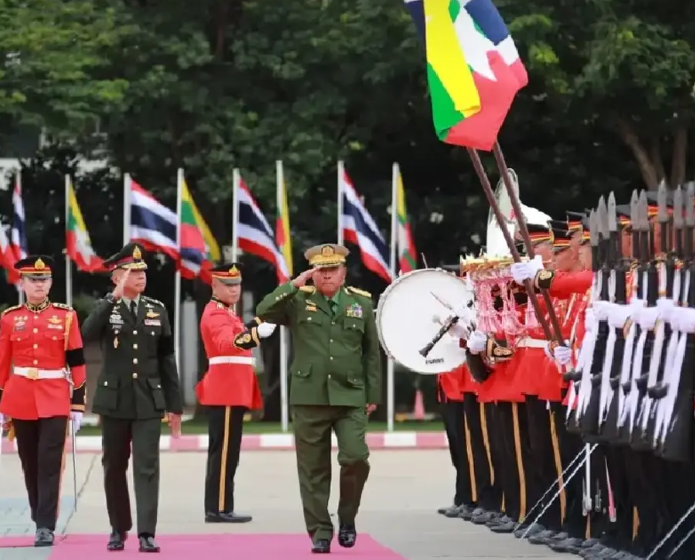
Thailand's senior military leadership extended a formal welcome to Myanmar's armed forces chief Ye Win Oo in Bangkok on Thursday, underscoring a pivotal moment in the region's geopolitical realignment. The visit marks Ye Win Oo's inaugural foreign trip since assuming the military leadership post, a symbolic gesture that speaks to Myanmar's broader attempt to shed its international isolation following years of pariah status after the 2021 coup that toppled an elected government. Thai military chief Ukris Boontanondha hosted the discussions at a Bangkok hotel, with border security and regional stability forming the anticipated centrepiece of their negotiations.
Myanmar's military orchestrated a decisive overthrow of civilian rule in 2021, detaining democratically elected leader Aung San Suu Kyi and precipitating a prolonged civil conflict that has devastated the nation's civilian population. The armed forces have faced sustained international condemnation for documented atrocities during this period, including extrajudicial killings, torture, and the displacement of hundreds of thousands. Yet the junta leadership has pursued a calculated diplomatic strategy to rehabilitate its image, capitalising on a carefully stage-managed electoral process in early 2026 to project a veneer of democratic transition and normalcy to international observers and neighbouring governments.
The electoral exercise, conducted under severe restrictions that excluded Suu Kyi's party and imprisoned opposition figures, enabled the coup's architect Min Aung Hlaing to transition to the civilian presidency while consolidating military control through trusted subordinates. Ye Win Oo, a former intelligence operative within the junta apparatus, now helms the armed forces following this calculated reshuffling of power structures. His appointment represents continuity rather than substantive change, ensuring the military maintains its grip over Myanmar's governance architecture regardless of nominal civilian leadership.
The 2,400-kilometre shared border between Thailand and Myanmar presents persistent security challenges that have intensified during the ongoing civil war. Armed ethnic groups, displacement camps, and cross-border insurgent movements create complex regional dynamics that directly affect Thailand's national security interests. This geographical reality provides the foundation upon which Thailand and other neighbouring states have justified their diplomatic outreach, essentially prioritising practical border management concerns over principled stands on human rights and democratic governance. For Thailand's government, engaging with Myanmar's military leadership offers opportunities to address trafficking networks, refugee flows, and the stabilisation of contested borderlands.
Earlier this month, Myanmar's civilian president Min Aung Hlaing received substantial ceremonial recognition during a state visit to Bangkok hosted by Thai Prime Minister Anutin Charnvirakul, signalling Thailand's deliberate pivot toward normalising relations with the junta. Thai Foreign Minister Sihasak Phuangketkeow articulated the government's pragmatic rationale for this engagement, declaring that diplomatic recognition reflects geopolitical realities rather than implicit endorsement of Myanmar's governance model. This framing attempts to separate engagement from legitimacy, positioning Thailand's approach as necessity-driven statecraft rather than moral compromise.
However, the diplomatic thaw has provoked sharp criticism from human rights advocates and international democracy organisations. The Special Advisory Council for Myanmar characterised Thailand's welcoming stance toward military leadership as a catastrophic abandonment of principled foreign policy, accusing the kingdom of enabling authoritarianism whilst simultaneously damaging its international credibility. The group contended that Ye Win Oo's visit compounds this damage, suggesting Thailand is actively complicit in whitewashing systematic state violence through ceremonial engagement with perpetrators.
Contrary to the junta's rehabilitation narrative, recent United Nations investigative reports document escalating military conduct inconsistent with democratic transition claims. The UN's Independent Investigative Mechanism for Myanmar released findings detailing intensified aerial bombardment targeting civilian populations, systematic arbitrary detention, torture infrastructure, and documented sexual violence perpetrated by military units under Ye Win Oo's command. These contemporary allegations suggest the armed forces are consolidating rather than moderating their repressive apparatus, contradicting any assertion that the 2026 elections represent meaningful democratic progress.
Myanmar's government has categorically rejected UN allegations as unfounded and politically motivated, characterising investigative conclusions as one-sided condemnations rooted in unverifiable information. This defensive posturing reflects the junta's broader strategy of deflecting international scrutiny whilst leveraging regional economic interdependencies to secure diplomatic space. Myanmar's military calculates that neighbouring states will tolerate systematic rights abuses if border security and trade relationships remain stable, a calculation that Thailand's engagement appears to validate.
The international response to Myanmar has fractured significantly along geopolitical lines. Western democracies and human rights-focused organisations have largely condemned the junta's electoral charade as theatrical authoritarianism, whilst regional powers demonstrate increasing pragmatism regarding engagement. ASEAN nations, bound by geographical proximity and shared economic interests, navigate between principled opposition to military rule and practical necessity, often defaulting to sovereignty arguments that insulate Myanmar from coordinated regional pressure. Thailand's hospitality toward Myanmar's military leadership exemplifies this regional pattern, privileging stability over accountability.
For Southeast Asia more broadly, Myanmar's diplomatic rehabilitation carries troubling implications regarding the region's tolerance for military authoritarianism and democratic backsliding. Thailand's own history of military interventions creates additional complexity, as the kingdom's embrace of Myanmar's junta risks normalising extraconstitutional seizures of power across the region. The message conveyed through high-level military visits and ceremonial welcome extends beyond bilateral relations, potentially signalling to aspiring military governments that international isolation is temporary and surmountable through modest cosmetic reforms and strategic engagement with regional allies.
The Ye Win Oo visit ultimately represents a critical juncture in Myanmar's international rehabilitation process. Thailand's decision to provide this platform demonstrates that neighbouring states have concluded that Myanmar's reintegration into the regional system outweighs the diplomatic costs of appearing to accommodate military authoritarianism. Whether this engagement produces tangible improvements in border security and stability, or merely facilitates the junta's continued consolidation whilst facilitating human rights abuses, remains an unresolved question with profound implications for Southeast Asian governance standards and regional accountability frameworks.

