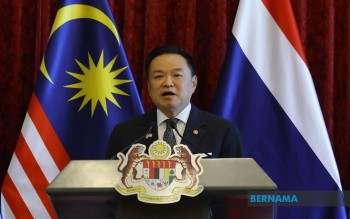
Thailand's Prime Minister Anutin Charnvirakul arrived in Malaysia on an official two-day visit bearing ambitious economic objectives, declaring his nation's confidence in surpassing the US$30 billion bilateral trade milestone by 2027. Speaking at a joint press conference with Malaysian Prime Minister Datuk Seri Anwar Ibrahim following an exchange of memoranda of understanding at Perdana Putra Complex in Putrajaya, Anutin underscored the momentum driving the two neighbouring economies toward this target.
The Thai premier's optimism is grounded in tangible progress. Malaysia currently serves as Thailand's largest trading partner within ASEAN, with bilateral commerce having already approached US$28 billion. This positioning reflects decades of geographical proximity, complementary economic structures, and integrated supply chains that have made cross-border trade a cornerstone of both nations' prosperity. The remaining US$2 billion gap represents an incremental challenge rather than a fundamental restructuring, suggesting the timeline is realistic given existing economic ties.
Anutin's visit, his first to Malaysia since his reappointment as prime minister in March 2026, underscores the diplomatic significance both governments attach to strengthening economic bonds. The official bilateral meeting allowed the two leaders to assess progress on existing arrangements and chart a collaborative course in sectors of mutual strategic importance. Such high-level engagement signals commitment from both capitals to move beyond rhetorical trade targets toward concrete implementation mechanisms.
Looking beyond the immediate 2027 goal, both premiers acknowledged the need for even more ambitious planning. The joint trade committee will convene to establish fresh targets that push bilateral commerce to new heights, recognising that economic partnership is a continuous evolution rather than a destination. This forward-looking posture reflects understanding that regional competitiveness in an increasingly interconnected world demands constant upgrading of trade relationships.
Thailand has identified three strategic pillars to drive future expansion: food security, energy security, and the digital economy including high-tech industries. These sectors align with broader Southeast Asian development priorities and with Malaysia's own economic diversification goals. Food security particularly resonates across the region given climate vulnerabilities and population pressures, while energy cooperation addresses growing demand and transition imperatives. The digital economy focus positions both nations to capture value in emerging technologies and data-driven sectors.
Enhancing regional value chains and supply chains represents another cornerstone of the bilateral agenda. By leveraging the complementary strengths each economy possesses, Thailand and Malaysia can strengthen their collective competitiveness within ASEAN and globally. Thai expertise in certain agricultural and manufacturing sectors, combined with Malaysia's advanced capabilities in petrochemicals, electronics, and financial services, creates natural synergies that multilateral frameworks can amplify. Such integration deepens interdependence, making trade relationships more resilient to external shocks.
Malaysia's commitment to the partnership was emphasised through Anwar's designation of institutional leadership for the effort. The Ministry of Foreign Affairs and the Ministry of Investment, Trade and Industry will spearhead Malaysian participation, ensuring the drive toward the US$30 billion target receives high-level governmental coordination and resources. This institutional allocation signals that trade expansion is not merely a ceremonial objective but an embedded policy priority with dedicated bureaucratic machinery.
Anwar's framing of economic cooperation as foundational to broader bilateral relations reflects sophisticated understanding of modern statecraft. By grounding political goodwill and diplomatic cooperation in tangible commercial benefits, both governments strengthen the constituency supporting close ties at business, worker, and consumer levels. Trade creates millions of daily interactions across borders—truck drivers, traders, manufacturers, and consumers whose livelihoods depend on smooth bilateral commerce become informal ambassadors for cooperative relations.
Tourism features prominently in this broadened partnership vision. Beyond traditional merchandise trade, service sectors including tourism generate significant employment and foreign exchange for both economies. The sector's recovery post-pandemic and potential for further expansion represent low-hanging fruit in bilateral cooperation, particularly given cultural affinities and geographical accessibility between the two nations.
The timing of Anutin's visit reflects the relative stability in both Thai and Malaysian politics following recent transitions. Thailand's political environment has stabilised under his renewed leadership, while Malaysia continues consolidating governance frameworks after its own recent transitions. This convergence of political steadiness in both capitals provides an opportune window for deepening institutional cooperation and pursuing ambitious economic targets without the disruptions that political instability can impose.
For broader Southeast Asia, the Malaysia-Thailand partnership gains significance as a demonstration of intra-ASEAN economic deepening. Successful bilateral trade expansion between two major regional economies creates positive externalities, encourages similar partnerships among other member states, and strengthens ASEAN's collective economic weight in global commerce. This dynamic supports regional integration narratives and demonstrates that ASEAN members can pursue both national interests and collective advancement simultaneously.
The journey toward US$30 billion in annual bilateral trade encapsulates broader themes in Southeast Asian economic development: deepening integration, supply chain interdependence, sectoral diversification, and the harnessing of complementary advantages. Success in achieving this target would validate bilateral approaches to trade expansion and provide momentum for Malaysia and Thailand to pursue even more transformative cooperation in emerging sectors including green energy, semiconductor manufacturing, and digital infrastructure development.

