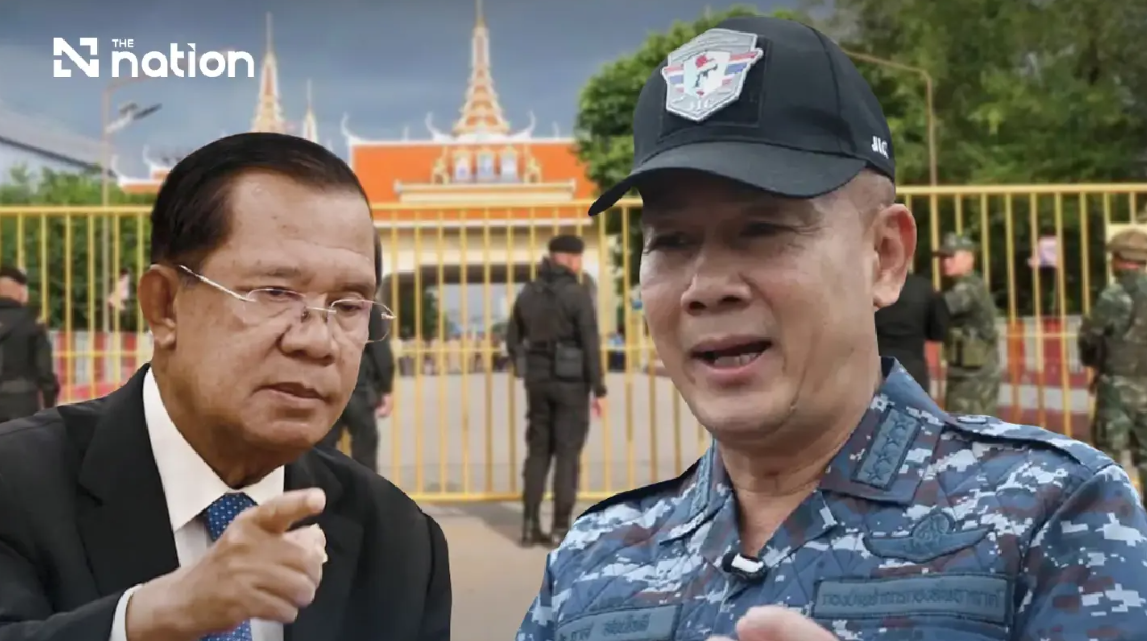
Thailand has firmly disputed allegations from Cambodian Senate President Hun Sen that the kingdom has exploited its crackdown on online fraud as justification for occupying Cambodian territory. Air Chief Marshal Prapas Sonjaidee, heading the Joint Information Centre on the Thailand-Cambodia Situation, made the rebuttal on Friday, characterising Hun Sen's international forum statements as unsubstantiated claims requiring factual grounding rather than rhetorical flourish.
The Cambodian leader had framed Thailand's actions as constituting "modern warfare," a rhetorical escalation that prompted the Thai official to demand greater rigour in how countries make serious allegations on the world stage. Prapas argued that accusations of military aggression carry sufficient gravity that they should rest on evidence capable of independent verification rather than political narrative. This methodological challenge reflects Thailand's broader frustration with what it views as Cambodia's conflation of separate issues—the presence of scam operations and the deployment of military forces—to construct a predetermined conclusion.
Thailand's position hinges on distinguishing between two fundamental questions: whether a location harbours criminal activity and whether that same location serves military purposes. According to Prapas, this distinction is critical to any honest assessment. If territory is genuinely being used to station troops, stockpile weapons, or conduct military operations, then the actual military function of that location must be evaluated according to established legal frameworks and international norms. The Thai official contended that Hun Sen's characterisation deliberately obscures this separation, treating the presence of scammers as equivalent to justification for military occupation.
Underlying Thailand's argument is a chronological claim that fundamentally shapes the dispute's character. Prapas asserted that any examination of armed conflict must begin with what he termed "the first shot," not with the moment one party responds to prior aggression. According to Thai accounts and evidence, Cambodia initiated weapons use in a manner affecting Thai civilian areas, prompting Thailand's defensive response aimed at protecting both military personnel and non-combatants. This sequencing, Thailand argues, is essential to understanding the conflict's actual trajectory rather than accepting a narrative that conveniently begins only when Thailand acted.
The dispute intersects directly with the ceasefire agreement that both nations have ostensibly endorsed, creating a logical paradox in Cambodia's position according to Thai analysis. If both countries committed to maintaining forces at ceasefire positions without advancing toward each other, then Thailand's stationing of troops at agreed locations should not qualify as occupation. Prapas posed a pointed rhetorical challenge: how can nations simultaneously sign agreements requiring force positioning while characterising the other side's compliance with those very agreements as territorial seizure? The implication is that Cambodia is redefining ceasefire compliance as conquest, effectively nullifying the agreement's practical meaning.
Thailand contends that if genuine disagreement exists regarding actual border demarcation, existing bilateral mechanisms—rather than military considerations or international grandstanding—represent the appropriate venue for resolution. Neither military deployments nor media narratives should determine borderlines, Prapas maintained, suggesting that Cambodia's claims about occupation conflate the temporary positioning required by ceasefire terms with permanent territorial disputes. This represents a sophisticated legal argument that distinguishes between the enforcement of short-term military arrangements and the substantive question of sovereignty, which requires different institutional frameworks.
Civilian protection has emerged as another contested dimension of the dispute, with Thailand pushing back against what it characterises as selective concern for Cambodian victims while ignoring Thai civilian casualties. Prapas stressed that humanitarian principles transcend nationality—Thai and Cambodian children deserve equal protection, and schools on both sides require safety. However, he added that honest accounting of civilian harm must examine evidence comprehensively: weapons types, fire directions, coordinates, timing and intended targets across the border, not merely losses sustained by one nation. Thailand's argument implies that Cambodia has weaponised civilian casualty narratives while ignoring comparable Thai suffering.
The information warfare dimension reveals perhaps the most intriguing aspect of the disagreement, as both nations essentially accuse each other of manipulating facts to serve political ends. Hun Sen has alleged that Thailand conducts psychological operations damaging Cambodia's international reputation, yet Prapas responded that the antidote to information warfare is transparency, not counter-accusations. He warned that if both sides present only information supporting their narratives while claiming the other side conducts disinformation, the cycle becomes self-perpetuating and inescapable. This represents an implicit challenge to Cambodia to join Thailand in public disclosure of documentary evidence, timestamps and coordinates that could be independently assessed.
For Southeast Asian observers, this dispute carries significant implications regarding how regional conflicts are characterised and resolved. Thailand's insistence on separating transnational organised crime from territorial occupation reflects broader concerns about how stronger nations might justify military actions through selective issue-framing. Simultaneously, Thailand argues that Cambodia is itself engaging in precisely this conflation, using the scam crisis as rhetorical cover for claims that would otherwise lack merit. The stakes extend beyond bilateral relations to questions about regional norm-setting: whether states can redefine ceasefire compliance as occupation, or whether such basic agreements retain binding meaning.
Thailand's strategic objective, according to Prapas, remains defensive rather than expansionist. The kingdom reportedly seeks no Cambodian territory, harbours no enmity toward Cambodian people, and views scammer suppression as a potential area for cooperation rather than conflict. Thailand's responsibility, however, extends to protecting its own civilians and military from threats, positioning this as compatible with peaceful coexistence provided Cambodia reciprocates restraint. The implicit invitation is for Cambodia to abandon international platforms for competitive narratives and instead engage in systematic, evidence-based dialogue through established mechanisms.
Prapas concluded by reframing the fundamental choice before both nations. Rather than opening what he termed "another battlefield of competing narratives," Thailand proposes that priority should shift toward silencing weapons, clarifying facts through transparent evidence disclosure, and restoring substantive negotiations. This represents less a capitulation than a recalibration of how disputes might be resolved in an era where information and military power increasingly intertwine. For Malaysia and other regional states observing the Thai-Cambodian situation, the dispute underscores how border tensions can metastasise into information warfare, and how distinguishing between legitimate security concerns and territorial aggression requires rigorous, systematic analysis rather than political rhetoric.

