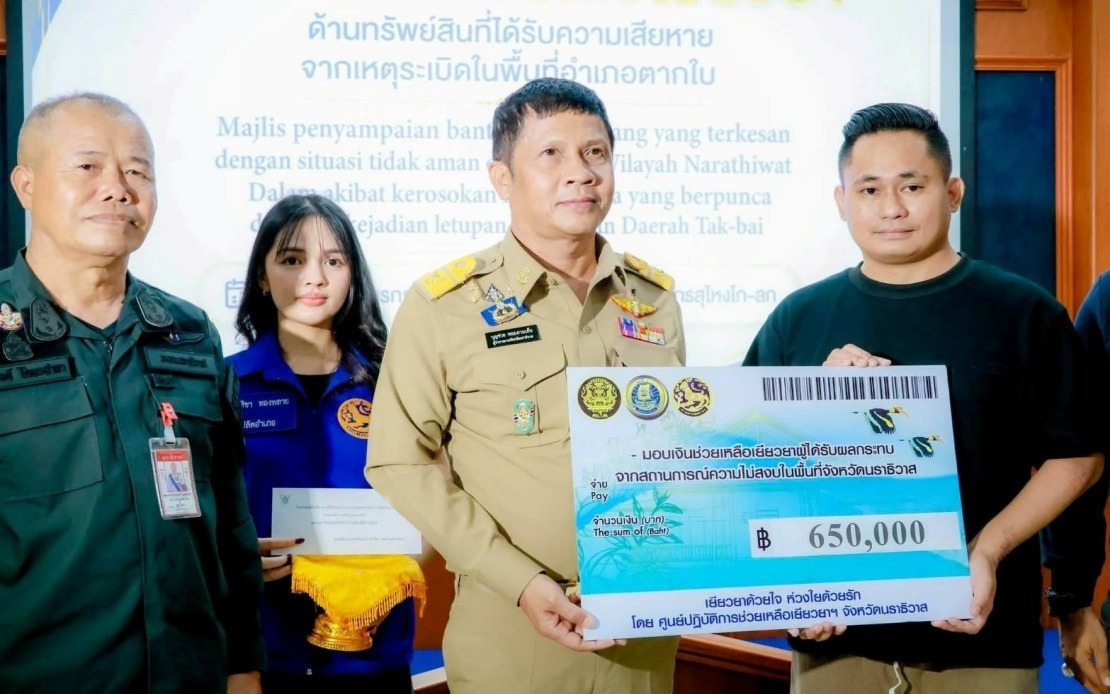
The Thai government has provided financial compensation to a Malaysian citizen wounded in a bomb explosion in the volatile border district of Tak Bai, marking an official acknowledgment of responsibility and a commitment to strengthening security across the southern frontier. On Friday, Narathiwat Governor Boonchuay Homyamyen presented a cheque worth 650,000 baht to Muhammad Yusri Udin, one of two Malaysians caught in the blast, during a ceremony held at the Sungai Golok Customs Office. The payment represents formal assistance from a dedicated Thai government fund established to support victims of security-related incidents, encompassing both injury compensation and reimbursement for property damage.
The incident occurred on June 29 when a homemade explosive device concealed in a roadside drainage channel detonated near Sapom junction in Tak Bai at approximately 11:40 am local time. Muhammad Yusri, aged 38, and Abdullah Syarapi Abd Rahman, 45, sustained injuries from the blast. Preliminary investigations by Thai authorities revealed that the two Malaysians were not the intended targets of the attack, which investigators believe was carried out by elements of a separatist rebel organisation operating in Thailand's southern provinces. This distinction carries significant implications for cross-border relations, as it removes the suggestion that Malaysian nationals were deliberately targeted.
Governor Boonchuay emphasised during the compensation ceremony that the Thai government harbours profound regrets regarding the incident and its impact on the injured Malaysians. His remarks underscored Bangkok's recognition of the need to maintain strong diplomatic ties with Malaysia, particularly given the shared security challenges affecting the region. The governor stressed that Thai authorities would not adopt a passive approach to security threats, pledging instead to intensify protective measures designed to safeguard both local residents and international visitors traversing the area.
The southern Thai border region, encompassing provinces such as Narathiwat, Pattani, and Yala, has endured decades of armed conflict between Thai security forces and militant groups seeking greater autonomy or independence. This persistent instability creates a precarious environment for civilians and cross-border traffic, affecting Malaysian communities living adjacent to the border and Thai nationals engaged in commerce and daily movement across provincial lines. The presence of Malaysian workers and traders in these areas means that unintended civilian casualties from conflict-related violence remain an ongoing concern requiring bilateral coordination.
In the aftermath of the June 29 bombing, Thai security forces accelerated their investigative response. Within days, authorities apprehended a 40-year-old suspect believed to be connected with the attack. Concurrently, Thai military and police units deployed explosive ordnance disposal teams to conduct comprehensive sweeps of the area, while forensic specialists gathered evidence from the blast site. These operational steps reflect standard protocols adopted whenever security incidents affect the border zone, demonstrating the Thai authorities' determination to prevent recurrence.
The compensation mechanism itself illustrates the institutional capacity that Thailand has developed to manage the human costs of its protracted southern conflict. By channelling assistance through a formal government fund rather than ad-hoc arrangements, Bangkok signals both consistency in its approach and recognition of the systematic nature of security-related victimisation. For Malaysian citizens injured in Thai territory, this structured compensation process provides a degree of recourse that might otherwise prove complicated through purely bilateral negotiation or civil litigation.
Governor Boonchuay's statement that the Thai government remains committed to restoring tourist confidence reflects wider concerns about the economic consequences of insecurity in the region. Southern Thailand attracts substantial numbers of international visitors, including many from Malaysia, whose decisions about travel are heavily influenced by perceptions of safety. Incidents such as the Tak Bai bombing, even when victims are unintended targets, generate negative publicity that can dampen tourism flows and harm local economies dependent on visitor expenditure.
For Malaysia, the incident and its resolution touch on several policy considerations. The welfare of Malaysian nationals operating or residing in Thailand's southern provinces remains a legitimate government concern, particularly in border areas where security challenges are endemic. The Thai government's prompt compensation and explicit assurances regarding security upgrades may provide some reassurance to Malaysian stakeholders, though the underlying instability that produced the June 29 bombing continues unresolved. Malaysian citizens planning to travel or work in these regions would be prudent to remain informed about security conditions and exercise appropriate caution.
The bilateral dimensions of this incident highlight the importance of sustained coordination between Malaysian and Thai authorities on security matters affecting their shared border. While the two countries maintain generally cooperative relations, incidents causing injury to citizens of either nation can introduce friction into the relationship if not handled with sensitivity and transparency. The Thai government's approach in this case—swift compensation combined with public assurances about enhanced protective measures—appears designed to minimise diplomatic complications and reinforce the message that Bangkok takes the safety of Malaysian nationals seriously.
Looking forward, the compensation payment and security commitments announced by Governor Boonchuay represent merely immediate responses to a specific incident rather than solutions to the broader instability plaguing Thailand's south. The activities of rebel groups in the region persist despite decades of counter-insurgency efforts, suggesting that military and police operations alone are insufficient to restore durable peace. This reality underscores the importance of continued multilateral dialogue, intelligence-sharing, and coordinated approaches to border security between Malaysian and Thai officials, supported where possible by international actors with interests in regional stability.

