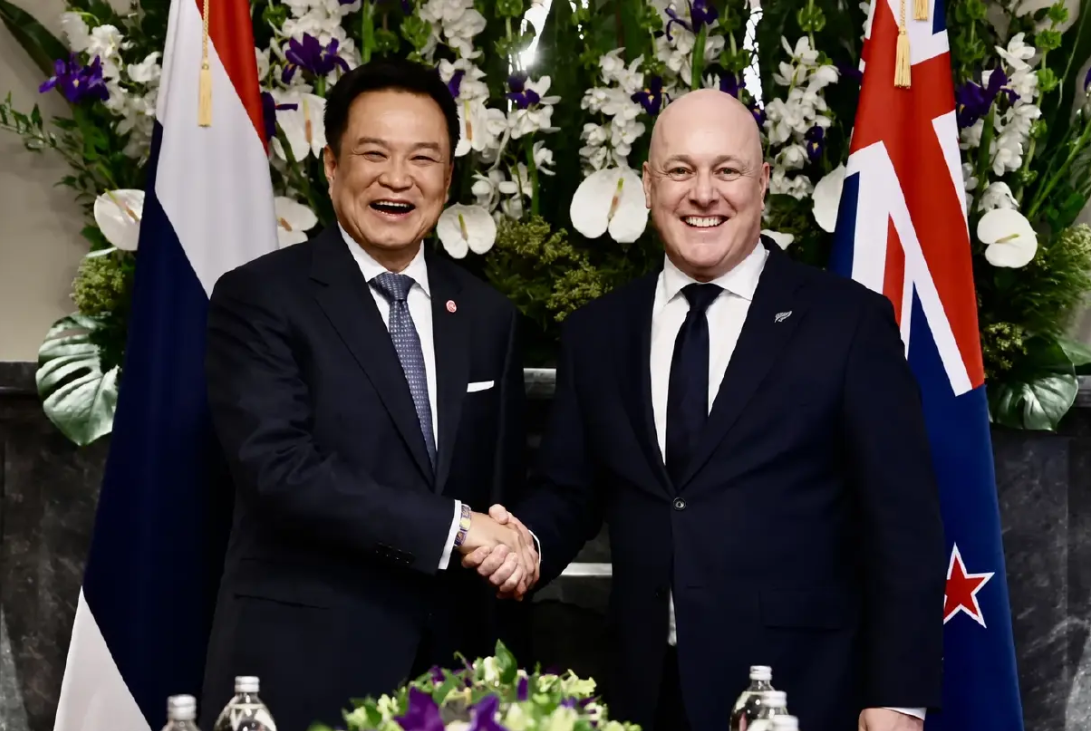
Thailand and New Zealand have formally elevated their diplomatic relationship to a strategic partnership, signalling a significant deepening of engagement between the two nations as they mark seven decades of formal ties. Thai Prime Minister Anutin Charnvirakul and New Zealand Prime Minister Christopher Luxon signed the Joint Declaration on the Strategic Partnership during Anutin's official visit to Wellington on Friday, cementing an ambitious economic agenda that includes tripling bilateral trade to US$7.5 billion—equivalent to approximately 246 billion baht—by 2045. The development carries particular resonance for Southeast Asia, as it reflects New Zealand's sustained commitment to the region and offers Thailand a gateway to deeper engagement with Pacific economies at a time when regional trade architectures are being reshaped.
The signing of the strategic partnership agreement represents more than ceremonial diplomacy. It establishes a comprehensive framework through which the two countries intend to coordinate across multiple dimensions of national interest. Beyond the headline trade target, the two governments have committed to working within the Thailand–New Zealand Joint Plan of Action for 2026–2030, a roadmap designed to translate elevated bilateral relations into tangible outcomes affecting citizens, businesses and institutions in both nations. For Malaysia and other Southeast Asian economies, this development illustrates how individual ASEAN members are pursuing deepened partnerships with dialogue partners, a trend that could influence regional alignment and cooperation mechanisms.
The economic dimension of the renewed partnership addresses areas of mutual vulnerability and complementary strength. Both nations have prioritised innovation, food and energy security alongside green economy transitions and sustainable agriculture—priorities that resonate across Southeast Asia as countries confront climate pressures and food supply uncertainties. The two sides have also committed to further developing the Thailand–New Zealand Closer Economic Partnership (TNZCEP), an existing framework that will be expanded to unlock additional business opportunities. For Malaysian enterprises, particularly those in agribusiness, renewable energy and food processing, the expanding Thailand-New Zealand trade relationship may create new competitive dynamics and potentially open pathways to broader trilateral arrangements.
Security and law-enforcement cooperation forms a critical pillar of the renewed partnership. Thailand and New Zealand have agreed to intensify their joint response to transnational crime, online scams and human trafficking—challenges that cross borders and affect multiple nations in the region. Enhanced information-sharing protocols and closer coordination between Thai and New Zealand police forces will establish a model of bilateral security cooperation that has implications for regional safety. Given Malaysia's own struggles with cybercrime and human trafficking, the mechanisms being established between Bangkok and Wellington merit close study as potential templates for strengthening Southeast Asian responses to similar threats.
Education and cultural exchange will be strengthened through dedicated cooperation agreements. A Memorandum of Understanding signed between Thailand's Office of the Civil Service Commission and Education New Zealand signals intent to expand capability-building and skills development programmes. Simultaneously, a new Cultural Cooperation Agreement provides institutional backing for people-to-people connections. These investments in human capital development and cultural understanding are particularly significant given that regional prosperity increasingly depends on workforce mobility, educational exchange and cross-cultural competence. For Malaysia, which competes for regional talent and educational prestige, the Thailand-New Zealand educational initiatives represent both a partnership opportunity and a competitive consideration.
The planned resumption of direct air services between Bangkok and Auckland in March 2027 carries outsized significance for regional connectivity. Thai Airways' restoration of this route will create direct commercial and passenger flows that have been absent, facilitating tourism, investment flows and people-to-people movement. Anutin indicated willingness to accelerate this timeline if feasible, reflecting the political priority attached to connectivity. For the Southeast Asian region, the reactivation of this route demonstrates continued appetite among regional carriers for long-haul direct services to the Pacific, suggesting confidence in post-pandemic travel demand and economic integration between Asia-Pacific economies.
Geopolitically, the partnership reflects New Zealand's strategic reorientation toward deeper engagement with Southeast Asia and the Indo-Pacific. By formalising ties with Thailand—a country of regional influence and central location within ASEAN—Wellington is positioning itself for broader participation in regional affairs. The two countries have committed to strengthening cooperation through Mekong frameworks, ASEAN-led mechanisms and APEC, language that situates the bilateral relationship within multilateral architecture. This approach offers Thailand enhanced leverage within regional forums whilst providing New Zealand clearer pathways to influence in spaces where it seeks greater voice.
Anutin's explicit request for New Zealand's backing of Thailand's bid to join the Organisation for Economic Co-operation and Development (OECD), and Luxon's immediate expression of support, reveals an additional dimension to the partnership. OECD membership represents economic credibility and alignment with advanced-economy governance standards. Thailand's pursuit of membership has significant implications for the region, as it would mark the first ASEAN member to achieve such status. Malaysia's own OECD engagement and the broader question of how Southeast Asian nations position themselves relative to advanced-economy governance frameworks remain relevant considerations in this context.
The four cooperation documents signed alongside the strategic partnership declaration—covering cultural cooperation, civil service education, police partnership, and private-sector instrument development—demonstrate that the elevated relationship encompasses both state and non-state actors. The inclusion of a private-sector agreement between Chata Instruments Company Limited and Aeroqual Limited illustrates how bilateral partnerships increasingly create institutional pathways for commercial engagement beyond traditional government-to-government channels. This corporate component suggests business communities in both nations have identified genuine commercial opportunities, lending credibility to the ambitious 2045 trade target.
Regional economic groupings and multilateral forums feature prominently in the partnership's stated ambitions. Both countries have emphasised commitment to rules-based international order and multilateral systems supporting peace and sustainable development—language that implicitly addresses concerns about great-power competition and the preservation of predictable trading frameworks. As geopolitical tensions shape regional alignments, Thailand and New Zealand's explicit commitment to ASEAN-led mechanisms and multilateral approaches positions them within an institutional ecosystem that Southeast Asian nations, including Malaysia, depend upon for stability and prosperity.
The timing of this upgraded partnership, coinciding with the 70th anniversary of diplomatic relations, permits both countries to frame the initiative as a natural evolution rather than a new departure. This framing may facilitate domestic political acceptance in both nations. However, the substance—particularly the tripling of trade by 2045 and the comprehensive cooperation framework—represents genuinely ambitious targets. Whether these objectives materialise will depend on sustained political commitment, removal of trade barriers, and active private-sector engagement beyond the initial enthusiasm of formal ceremonies.
For Malaysia and other ASEAN members observing this development, several implications merit attention. First, the Thailand-New Zealand partnership demonstrates the continued attractiveness of ASEAN nations as partners for dialogue countries, particularly those like New Zealand seeking to deepen Indo-Pacific engagement. Second, the focus on green economy, sustainable agriculture and innovation suggests sectoral priorities that will shape regional competition and cooperation patterns. Third, the emphasis on multilateral mechanisms and rules-based order reinforces frameworks that smaller and mid-sized economies depend upon. Finally, the direct air link and investment in connectivity reflect confidence in regional economic integration that transcends bilateral dyads and creates network effects benefiting neighbouring economies.
The strategic partnership between Thailand and New Zealand, whilst celebratory in tone, represents pragmatic statecraft aimed at capturing economic opportunities and managing shared security challenges in an increasingly competitive geopolitical environment. The ambitious trade targets, renewed air connectivity and comprehensive cooperation framework across political, security, economic and cultural domains create multiple vectors for deeper engagement. For the region as a whole, this partnership signals that dialogue partners remain committed to Southeast Asian integration and that bilateral elevation within the ASEAN framework continues to drive economic and political deepening.

