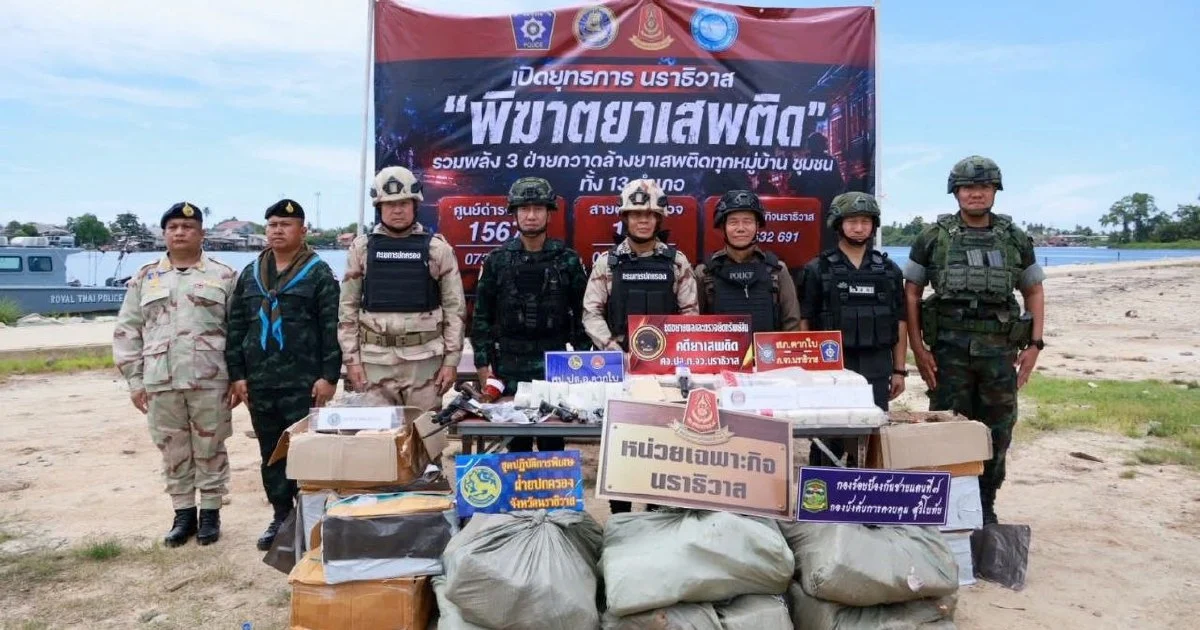
Thai authorities have made significant headway against transnational drug smuggling networks operating in the southern border region, arresting 233 individuals suspected of involvement in organized drug trafficking during an intensive operation spanning Narathiwat province. The crackdown, which represents a substantial enforcement action by regional standards, has exposed operational links between Thai criminal syndicates and trafficking groups believed to operate across the Malaysia-Thailand border, raising fresh concerns about the flow of contraband through Southeast Asian maritime and land routes.
The operation centred on intercepting a major smuggling attempt valued at RM1.2 million, highlighting the substantial financial scales at which these transnational networks operate. Narathiwat, situated along Thailand's southernmost frontier with Malaysia, has long served as a critical transit point for drug shipments moving between production centres in Southeast Asia and end markets across the region. The province's geography, comprising a complex landscape of coastal areas and rural districts, has historically enabled criminal organizations to exploit porous borders and limited enforcement capacity.
Investigators identified connections between arrested individuals and Malaysian-based trafficking organizations, underscoring how drug distribution networks transcend national boundaries with relative ease. These findings align with broader intelligence assessments indicating that Malaysian traffickers have increasingly integrated themselves into regional supply chains, operating not merely as end-market distributors but as coordinating nodes facilitating shipments across multiple jurisdictions. The involvement of Malaysian suspects suggests these networks possess logistical sophistication and cross-border operational capacity that enables them to manage complex smuggling operations spanning thousands of kilometres.
The scale of arrests—233 individuals during a single month-long campaign—demonstrates both the extent of trafficking infrastructure in the region and the manpower investment required to dismantle it. Such operations typically proceed through intelligence gathering, surveillance, and coordinated enforcement activities across multiple police units and administrative jurisdictions. The concentration of suspects within a geographically limited zone suggests either a particularly densely organized criminal ecosystem or targeted police focus on dismantling specific trafficking rings operating in the area.
From a Malaysian perspective, these developments carry significant implications for domestic security and border management. The confirmed involvement of Malaysian nationals in smuggling networks originating from Thai production and distribution centres indicates that contraband continues flowing southward despite enhanced interdiction efforts. Malaysian authorities face mounting pressure to strengthen coordination with Thai counterparts and to disrupt the Malaysian-based components of these networks, particularly the wholesale distribution apparatus and money laundering infrastructure that enable trafficking to remain profitable despite seizure risks.
The RM1.2 million valuation attached to the intercepted shipment reflects typical wholesale pricing for controlled substances in this region, suggesting the attempted shipment comprised either substantial quantities of methamphetamine—the dominant stimulant trafficked through Southeast Asia—or cocaine destined for transnational markets. The financial magnitude underscores why these networks persist despite enforcement actions: profit margins sufficient to absorb regular losses through seizure and enable rapid reconstitution of operations.
Narathiwat's particular vulnerability to trafficking stems from multiple convergent factors. The province sits at the intersection of major regional trafficking routes, possesses a substantial coastline facilitating maritime smuggling, maintains significant Muslim Malay populations with cultural and linguistic ties to Malaysia that can facilitate cross-border movement, and historically has experienced limited government administrative capacity relative to other Thai provinces. These structural conditions have persisted despite decades of focused police efforts, suggesting that supply-side enforcement alone cannot eliminate trafficking without corresponding efforts targeting demand-side factors and underlying socioeconomic drivers.
Cross-border cooperation mechanisms between Thai and Malaysian authorities have expanded substantially over the past decade, including intelligence sharing arrangements and coordinated enforcement operations. However, operational effectiveness remains constrained by resource limitations, bureaucratic coordination challenges, and the need to balance security concerns against the legitimate movement of goods and people across shared borders. The arrests in Narathiwat demonstrate that Thai enforcement agencies maintain capacity for large-scale operations, though questions persist regarding the sustainability and ultimate impact of such campaigns on overall trafficking flows.
The identification of Malaysian connections within this trafficking network aligns with documented patterns showing increasing integration of Malaysian criminal organizations into regional drug markets. Rather than operating exclusively within national territory, these groups have evolved into transnational enterprises capable of managing supply chains spanning multiple countries. This evolution reflects the professionalization and sophistication of Southeast Asian organized crime generally, which has adapted to enforcement pressure through operational decentralization, compartmentalization, and geographic diversification.
Looking forward, these arrests may prompt elevated enforcement activity along the Malaysia-Thailand border as both nations seek to disrupt identified trafficking infrastructure. However, history suggests that such enforcement surges typically generate temporary supply disruptions rather than permanent elimination of trafficking capacity. Traffickers possess financial resources enabling rapid reconstitution of operations through recruitment, relocation, or operational restructuring. Sustainable progress against transnational drug networks requires sustained international cooperation, intelligence integration, and complementary efforts addressing money laundering and chemical precursor trafficking that sustains manufacturing capacity in the region.

