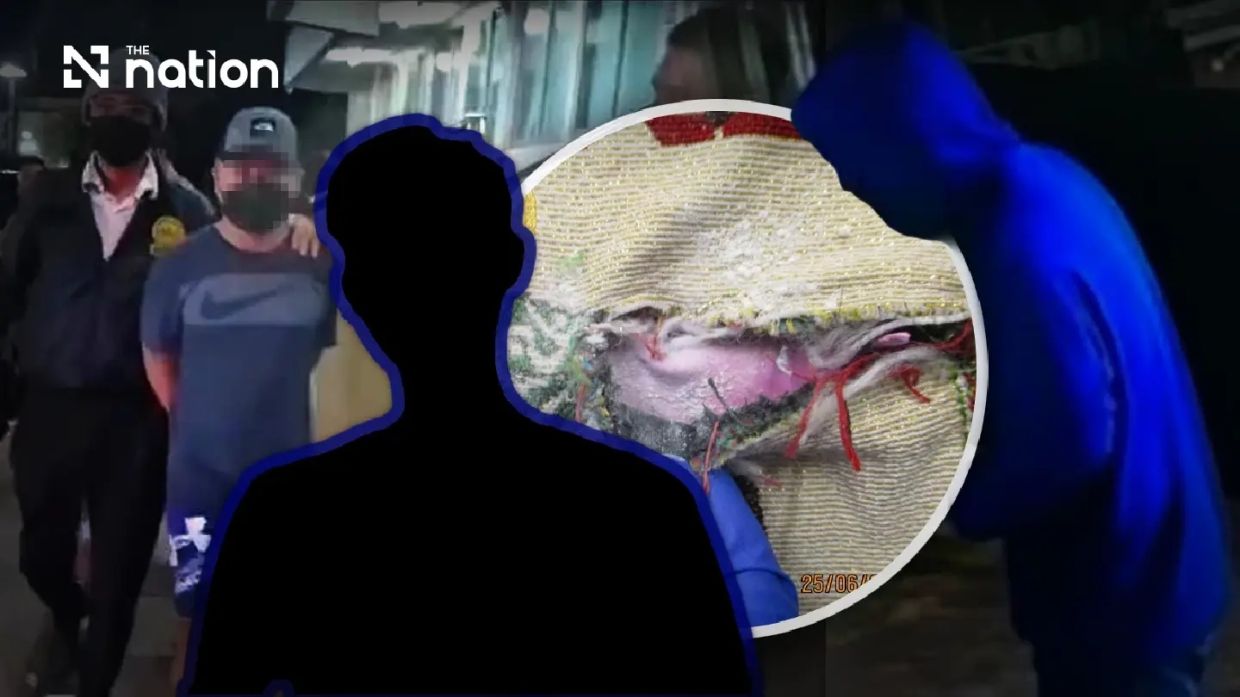
Metropolitan Police in Bangkok have expanded their investigation into a significant international drug-trafficking case after arresting a man identified as Ekkawit in Phayao province overnight. The arrest represents a critical breakthrough in unravelling a complex network allegedly responsible for concealing heroin in an elephant-print fabric bag bound for Australia, according to Pol Maj Gen Theeradej Thamsuthee, deputy commissioner of the Metropolitan Police Bureau. The development signals that authorities believe they are dismantling a professional smuggling operation with multiple layers of insulation between organisers and couriers.
Ekkawit is alleged to have served as a key intermediary connecting the network's upper management with street-level operatives tasked with moving contraband. Police contend that he delivered the heroin-laden bag to a man named Uthai, who had been arrested earlier, before Uthai transferred it to a flight attendant identified as Mina for transport to Australia. The structure of the operation—using disposable couriers, encrypted messaging aliases, and separated payment channels—suggests a degree of sophistication beyond typical opportunistic smuggling. During preliminary interrogation, Ekkawit disclosed that he undertook the task for THB100,000 and claimed he had executed similar assignments between two and three times previously, indicating the network had been operating with some regularity.
Investigators have traced an intricate operational pattern that sheds light on how the network coordinated activities across multiple provinces. According to police reconstructions based on Ekkawit's statements, he purchased the elephant-print bag in Chiang Mai at the direction of someone using the chat alias "Rose Rose." Once obtained, Ekkawit would notify Rose Rose and deposit the bag at a predetermined kilometre marker along a highway. An associate of Rose Rose would then retrieve it and arrange for the heroin to be concealed inside—though Ekkawit claimed this occurred in Laos, a claim authorities regard with scepticism. The compartmentalised nature of each phase meant no single operative possessed comprehensive knowledge of the entire supply chain.
The payment mechanism itself demonstrates how the network maintained operational security while distributing funds. After the heroin was concealed—a process Ekkawit said took one to two days—Rose Rose would arrange for the bag and THB100,000 in cash to be left at another kilometre marker for Ekkawit to collect. Ekkawit would then facilitate Uthai's involvement by depositing THB60,000 through an automated cash machine, ensuring minimal face-to-face contact and leaving sparse transaction trails. This layered payment approach, combined with the use of numbered chat aliases and geographically dispersed collection points, reflects techniques commonly employed by transnational organised crime syndicates seeking to evade detection.
Police have identified Rose Rose as a relative of Ekkawit's from Phayao province, with photographs suggesting the two travelled together regularly. However, investigators do not regard Rose Rose as the network's apex figure. Rather, they believe this person functions as a coordinator operating under instructions from more senior organisers not yet apprehended. The distinction is significant for Southeast Asian counter-narcotics operations, as it indicates that dismantling these networks requires pursuing investigation beyond visible coordinators to the strategic planners who orchestrate trafficking routes and recruit personnel. The discovery that Rose Rose used anonymous messaging accounts to contact and direct multiple associates, including Ekkawit and Mina, underscores how contemporary smuggling organisations exploit digital communications to scale operations while maintaining distance from individual transactions.
Mina, the flight attendant, represented a particularly valuable asset to the network given her legitimate access to international flight routes and reduced baggage scrutiny afforded to airline crew members. Rose Rose specifically contacted her—the mechanism of which police are investigating—to solicit her participation in transporting the bag to Australia. The targeting of airline employees reflects how criminal networks have adapted to modern border controls by exploiting occupational advantages rather than relying solely on concealment within checked luggage. For Malaysian readers, this pattern is particularly relevant given the region's status as a major aviation hub, with numerous international carriers operating from Kuala Lumpur and other hubs, potentially creating similar recruitment vulnerabilities.
Uthai's initial arrest already complicated the investigation, as police encountered resistance when seeking to understand his full involvement. When questioned, he claimed to have carried out similar work between five and six occasions, yet investigators remained unconvinced by his account, suspecting it had been rehearsed beforehand to appear cooperative while obscuring deeper involvement. The discovery that Uthai had rented accommodation in Phra Nakhon Si Ayutthaya province for at least five or six months suggested he may have participated far more frequently than his testimony acknowledged. This discrepancy highlighted the challenges Thai police face when confronting experienced operatives who understand interrogation procedures and maintain disciplined stories under questioning.
Pol Gen Samran Nuanma, deputy national police chief, was scheduled to personally interrogate Ekkawit upon his transfer to the Narcotics Suppression Bureau, indicating the case's elevated priority within the Thai law enforcement hierarchy. The direct involvement of senior police leadership suggests authorities view the operation as part of a broader trafficking network warranting sustained investigation. The heroin's Australian destination is noteworthy given the country's strict penalties for drug trafficking and the high street value of uncut heroin in affluent Western markets. The profitability differential between source countries and destination markets in the West provides powerful incentives for networks to develop sophisticated international logistics.
The investigation reveals operational preferences for northern Thailand and its proximity to borders as assembly and transit points. The use of locations in Chiang Mai, Phayao, and Chiang Kham district, combined with references to Laos as a heroin-processing location, maps onto long-established drug production and trafficking corridors in the Golden Triangle region. For Malaysia's law enforcement community, the case provides instructive lessons in how international networks exploit porous regional borders and cross-border movement patterns to move narcotics. The ability of networks to coordinate across multiple Thai provinces while maintaining contact with personnel in Laos and recruitment of international couriers underscores the transnational scope of Southeast Asia's drug problem.
Thailand's efforts to dismantle this particular network must be understood within the broader context of regional drug control challenges. The country serves simultaneously as a production area, transit country, and consumer market, making it essential for Thai police to balance enforcement with intelligence-gathering that targets higher-level organisers. As authorities expand operations to arrest remaining network members, the investigation will likely yield further insight into how international trafficking organisations have adapted their methods to modern surveillance capabilities and border security technologies. For the region more broadly, the case underscores the persistent sophistication of drug smuggling networks and the necessity for sustained, coordinated law enforcement responses spanning multiple jurisdictions and international borders.

