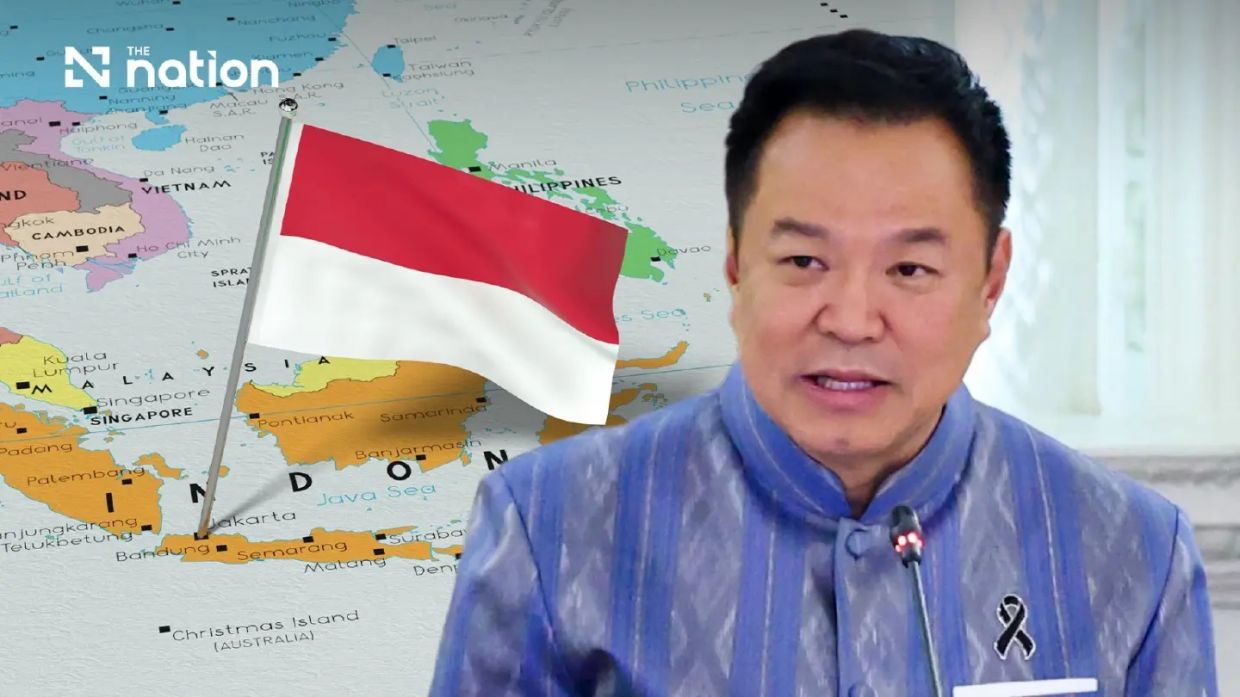
Prime Minister and Interior Minister Anutin Charnvirakul will undertake an official visit to Indonesia from August 3–4, marking what the Thai government characterizes as the first such high-level trip by a Thai premier in over a decade and a half. The two-day engagement represents a significant moment in bilateral relations between the region's two most influential Asean founding members, signalling Bangkok's renewed commitment to deepening connections with its western neighbour and largest regional economic partner.
During his time in Jakarta, Anutin is scheduled to meet with Indonesian President Prabowo Subianto for comprehensive discussions aimed at reinvigorating the Thailand–Indonesia strategic partnership. The talks will cover substantive ground across multiple sectors, with negotiators expected to address trade expansion, foreign direct investment flows, tourism promotion, maritime security cooperation, agricultural and food security initiatives, energy collaboration, educational exchanges, and broader commercial partnerships. This expansive agenda reflects both nations' recognition that their relationship spans far beyond traditional diplomatic courtesy into practical economic integration.
A centrepiece of the visit will be Anutin's address to the Asean Secretariat in Jakarta, where he will articulate Thailand's regional vision and strategic priorities as the kingdom prepares to assume the rotating chairmanship of the 10-member regional organisation in 2028. This platform provides Bangkok an opportunity to signal its policy direction and shape the narrative around Asean's future direction during a period of significant geopolitical transition and economic repositioning across Southeast Asia.
Government Spokesperson Rachada Dhnadirek emphasised that the visit represents more than ceremonial diplomacy, framing it instead as a practical mechanism to advance concrete projects under the existing strategic partnership framework. She highlighted Indonesia's outsized economic significance within Asean, noting the country's 280 million population and status as the region's largest economy by several measures, positioning it as an indispensable market for Thai exporters, a destination for Thai investment capital, and a crucial partner for Thai business expansion.
For Thai enterprises, Indonesia represents enormous untapped commercial potential. Government officials envision the visit catalysing market access expansion for Thai goods and services across the Indonesian archipelago, strengthening supply chain integration between the two economies, and facilitating capital flows in both directions. The visit aims to create pathways not only for Thailand's largest conglomerates but also for small and medium-sized enterprises seeking to establish operations in Indonesia, thereby democratising opportunities across the Thai business ecosystem.
Rachada underscored that anticipated benefits extend considerably beyond government-to-government arrangements. The visit is expected to generate tangible economic returns including wider market penetration for Thai agricultural exports and processed food products, increased bilateral tourism flows, employment creation along supply chain networks, and systematic workforce development initiatives that build human capital in both nations. This approach reflects a broader Thai foreign policy strategy that explicitly links international relations to domestic economic welfare.
Beyond commercial considerations, the visit addresses shared strategic challenges confronting both nations and the wider region. Thailand and Indonesia, as foundational Asean members, bear particular responsibility for maintaining bloc cohesion and ensuring its continued relevance amid shifting global economic patterns, intensifying transnational security threats including human trafficking and drug smuggling, and complex geopolitical developments reshaping the regional balance of power. The bilateral discussions will touch on how Asean can strengthen institutional unity while enhancing its collective capacity to respond to these evolving threats.
The two leaders are positioned to explore economic and security cooperation frameworks, regional infrastructure connectivity projects, food and energy security arrangements, and sustainable development initiatives that align with both countries' development trajectories. Crucially, they will examine policy measures that create a more business-friendly operational environment without compromising the region's foundational commitment to maintaining Southeast Asia as a zone of peace, stability, and prosperity insulated from great power competition.
Anutin's scheduled remarks at the Asean Secretariat will articulate Thailand's vision of a unified, economically robust, and people-centred regional organisation committed to balanced and sustainable development pathways. This messaging serves the dual purpose of outlining Thailand's substantive priorities while simultaneously positioning Bangkok as a thoughtful custodian of Asean interests ahead of its chairmanship assumption. Such framing demonstrates awareness that leadership of the regional body requires projecting stability, inclusivity, and pragmatic problem-solving.
The itinerary reveals careful choreography designed to maximise the visit's diplomatic and economic impact. The first day encompasses formal ceremony, intimate leadership consultations, expanded delegation-level negotiations, and joint public statements. On August 4, Anutin will participate in a business forum co-organised by Indonesia's Chamber of Commerce and Industry and the Thai Chamber of Commerce in Indonesia, directly facilitating commercial networking and deal-making between corporate representatives from both nations. This business-focused engagement acknowledges that sustained bilateral relations ultimately depend on profitable commercial activity and mutual economic benefit.
Anutin will subsequently engage with Asean's secretariat leadership on advancing regional cooperation mechanisms before delivering his organisational address. He is also scheduled to meet with Indonesian private sector representatives, extending engagement beyond governmental channels and embedding relationship-building throughout Thailand's commercial and diplomatic apparatus. This multi-layered approach reflects sophisticated understanding that modern bilateral relations require engagement across government, business, civil society, and institutional sectors.
Government Spokesperson Rachada characterised the visit as embodying a foreign policy philosophy centred on constructing durable strategic partnerships, maintaining equilibrium across Thailand's diverse international relationships, and bolstering the country's economic negotiating position during a period of intensified global competition and systemic uncertainty. The visit thus serves broader Thai strategic objectives beyond bilateral relations with Indonesia, functioning as a component of Bangkok's comprehensive regional positioning strategy.
The timing of this visit carries additional significance given Thailand's preparations for Asean chairmanship in 2028, a responsibility that will require demonstrating diplomatic influence, regional consensus-building capacity, and substantive contributions to collective problem-solving. By investing in high-level Indonesia engagement now, Thailand is essentially laying groundwork for its eventual leadership role and signalling seriousness about leveraging the position to advance both Thai interests and broader regional prosperity.

