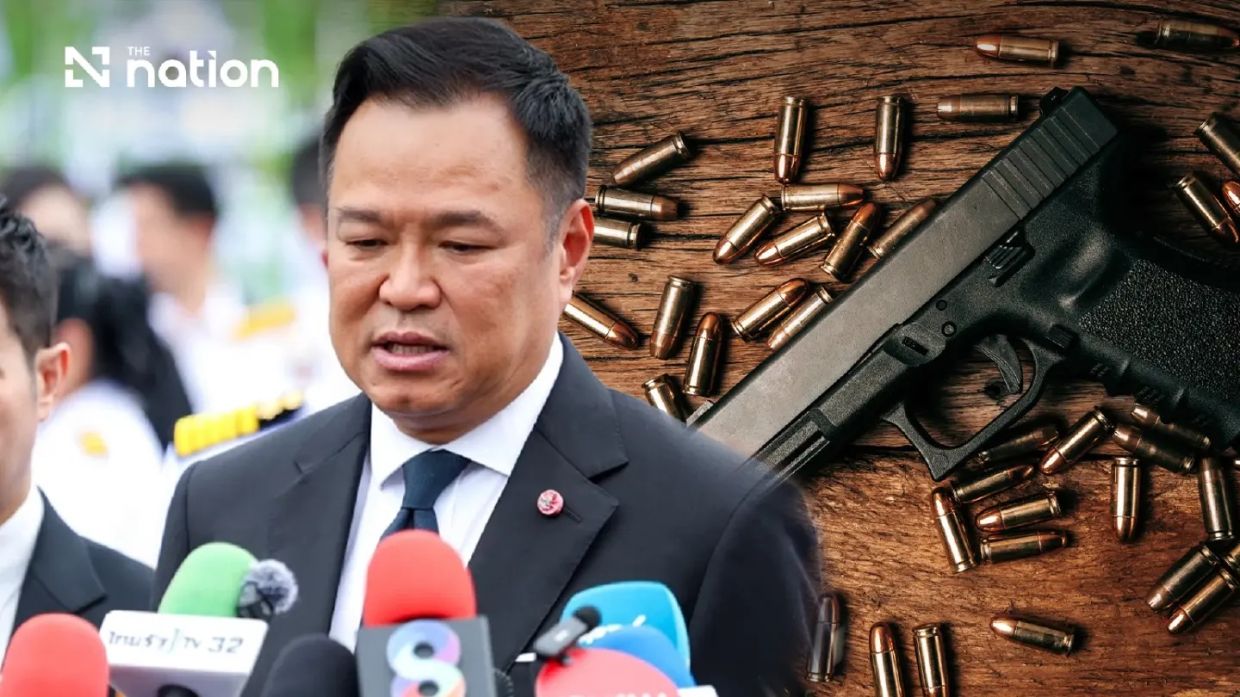
Thailand's Prime Minister Anutin Charnvirakul has intensified the government's response to a devastating mass shooting at Debsirin Nonthaburi School by announcing a sweeping legislative review aimed at tightening controls over civilian firearm possession. Following discussions at Government House with national police chief Pol Gen Kittharath Punpetch and Deputy Prime Minister Pakorn Nilprapunt, Anutin has signalled that stricter regulations will form the cornerstone of his administration's strategy to prevent similar incidents. The shooting has triggered urgent national conversations about gun ownership, school security, and the broader cultural attitudes toward weapons in Thai society.
In a direct rebuttal to suggestions that armed teachers could serve as a defensive measure, Anutin rejected the concept entirely, emphasising that educators lack the legal standing and professional training necessary to carry firearms in educational settings. His position reflects international best practice in school safety, which generally focuses on controlled access, threat assessment, and professional security personnel rather than arming staff members. The Prime Minister's stance signals a clear philosophical direction: the problem is not a shortage of civilian weapons but rather an excess of uncontrolled access to them. This framing aligns Thailand's policy debate with approaches adopted by several developed nations grappling with similar public safety concerns.
The centrepiece of Anutin's strategy involves establishing checkpoint systems and conducting comprehensive inspections to intercept illegally carried firearms in public spaces, vehicles, and private locations where no official duty justifies possession. This enforcement apparatus represents a significant escalation in state monitoring and represents the type of intrusive but targeted intervention that security-conscious governments employ during periods of elevated public alarm. The Prime Minister made clear that individuals found carrying weapons without proper authorisation would face serious criminal charges, suggesting that penalties under existing law might be enhanced through legislative amendments. The severity of his language underscores how the shooting has fundamentally shifted the political calculus around gun ownership in Thailand.
A particularly significant element of the government's approach involves reviving an amnesty programme that would allow citizens to voluntarily surrender illegal or unauthorised firearms without facing prosecution. This carrot-and-stick approach combines enforcement threats with a temporary window for compliance, a tactic designed to remove weapons from circulation while providing an off-ramp for those holding illicit arms inadvertently or through family inheritance. Anutin's emphasis that such a programme represents a genuine opportunity—not a permanent policy—conveys that the window for penalty-free surrender will be limited, creating urgency for participation. However, he was emphatic that weapons surrendered must go through official channels such as the Department of Provincial Administration, police stations, or district offices to create a verifiable record and prevent the black market from recycling confiscated arms.
The Prime Minister's insistence that illegal firearms cannot become legal through any mechanism addresses a potential loophole in amnesty thinking. His assertion that possession of an illegal weapon remains illegal regardless of circumstances represents unambiguous messaging: there is no pathway to lawful ownership of an unlicensed arm, no grandfather clause, and no exception based on length of possession. This absolutist position, while strict, provides clarity for enforcement and eliminates negotiating space that might otherwise be exploited. The dual-liability framework—holding both registered owners and weapons users criminally responsible—extends accountability up the chain of custody and potentially deters negligent storage or lending arrangements that might otherwise facilitate criminal access to lawfully registered firearms.
Regarding the investigation into the shooting itself and theories about the perpetrator's possible exposure to bullying, Anutin urged restraint in public commentary. He advocated for allowing police investigators to complete their work and establish verified facts before the public and media draw conclusions about underlying causes. This cautionary stance reflects awareness that premature narratives about bullying, social exclusion, or other motivations could either inspire copycat incidents or spawn false panics. By compartmentalising the immediate investigation from the broader policy response, Anutin attempted to move forward with legislative action while preserving investigative integrity. The risk, however, is that withholding information could fuel speculation and conspiracy theories that security-conscious citizens might view as government evasiveness.
The enforcement mechanisms outlined by Anutin extend beyond police alone, with directives issued to the Department of Provincial Administration and other authorised agencies to conduct thorough weapons inspections. This whole-of-government approach reflects the scale of the initiative and suggests resource commitments across multiple bureaucratic layers. The breadth of this coordination indicates that the government views the challenge not as a temporary law enforcement issue but as a sustained governance problem requiring sustained institutional mobilisation. For ordinary Malaysians observing developments in a neighbouring country, this model of comprehensive state action offers both a glimpse into potential regional policy trajectories and potential lessons about the practical difficulties of enforcing broad restrictions.
Stored firearms present a particular governance challenge that Anutin addressed through requirements for registration, secure storage, and keeping weapons away from children. These provisions target the vulnerable intersection of lawful gun ownership and household safety, acknowledging that even registered, legally-held weapons pose risks if improperly managed. The requirement for secure storage creates an enforcement point beyond initial purchase authorisation and suggests regular inspections or audit mechanisms. For Malaysia, where gun ownership is substantially more restricted than in Thailand, such regulations might serve as reference points should policymakers face pressure to broaden civilian access or contemplate amnesty programmes for illegal weapons currently in circulation.
The shooting at Debsirin Nonthaburi School represents a watershed moment in Thai public safety discourse, forcing a recalibration of policies that had previously allowed relatively widespread civilian firearm possession compared to neighbouring countries. Anutin's decisive intervention and multi-faceted approach—combining enforcement, amnesty, registration, storage requirements, and legislative amendment—indicates that the political space for permissive gun laws has narrowed considerably. As implementation proceeds, the effectiveness of these measures will depend on sustained commitment from both law enforcement and the public, as well as careful calibration to prevent unintended consequences such as pushing illegal weapons further underground without actually removing them from circulation.

