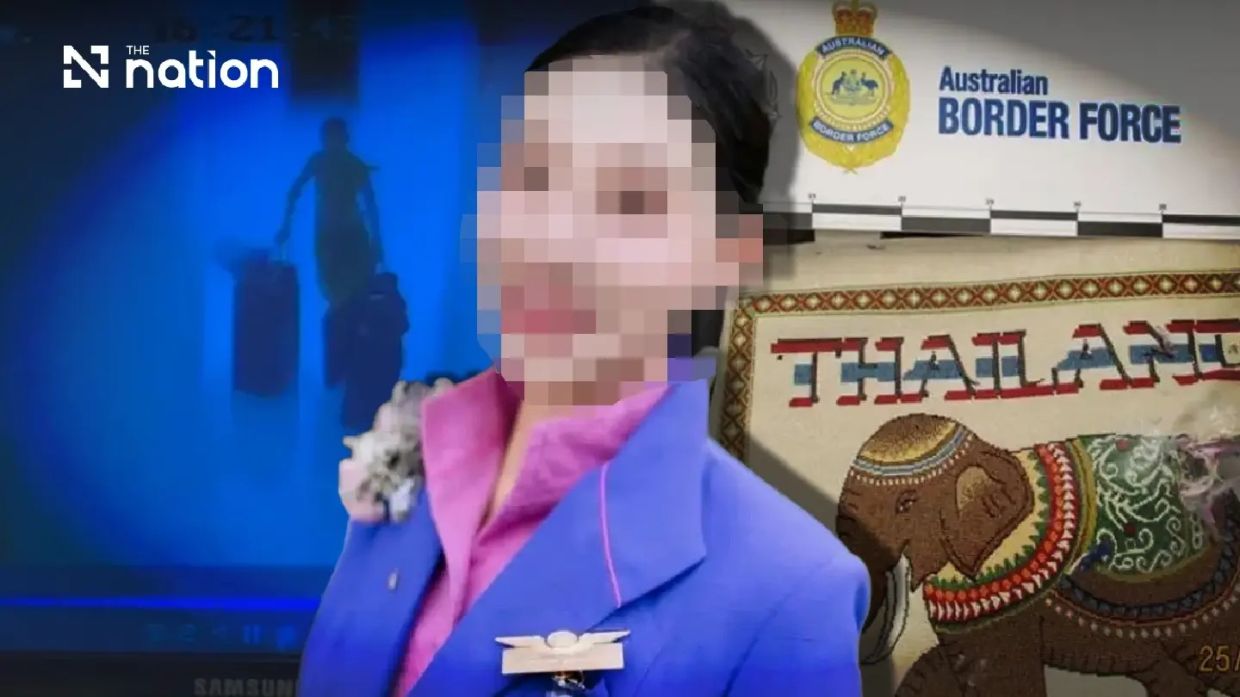
A Thai flight attendant detained after being discovered with 900 grammes of heroin at Melbourne Airport has become the focus of a sprawling investigation that officials believe reveals the operations of a major transnational drug network rooted in the Golden Triangle. The Office of the Narcotics Control Board (ONCB), working alongside multiple security agencies, is treating the case not simply as an isolated smuggling incident but as a window into a sophisticated criminal enterprise that has stretched its tentacles across international borders, particularly targeting airline workers as unwitting or semi-aware couriers.
Critically, Thai authorities have not yet formally accused the flight attendant of any crime, maintaining her status as a detainee while coordinating with Australian police and the Thai embassy to build her legal defence. This procedural distinction carries significant weight, suggesting investigators harbour genuine doubts about her level of culpability and knowledge. Deputy ONCB secretary-general Areepak Ngernbamroong indicated that evidence emerging from the inquiry points toward a disturbing pattern where the woman may have been manipulated by organised criminals into carrying the narcotics without full awareness of what she was transporting.
The investigation has already yielded related arrests in Bangkok resulting in the seizure of more than 26 kilogrammes of heroin, prompting the Department of Special Investigation (DSI) to assume control of the broader case. These parallel operations have exposed the sophisticated nature of the trafficking machinery at work. The network employs multiple delivery mechanisms, ranging from postal services to direct hand-to-hand transfers, and appears capable of recruiting individuals across different professions and nationalities. A delivery rider connected to the case had previously completed similar deliveries on three or four occasions, suggesting a well-established operational template rather than ad-hoc smuggling attempts.
Particularly alarming for Southeast Asian authorities is the revelation that criminal syndicates have adopted elaborate social engineering tactics to recruit couriers. According to Metropolitan Police Bureau deputy commissioner Pol Maj-General Theeradet Thumsuthee, the network creates fake avatar profiles and sends mass messages to flight attendants and frequent international travellers, offering monetary incentives for carrying packages across borders. This approach transforms the recruitment problem into a numbers game where even a small percentage acceptance rate yields multiple operational opportunities. The sophistication of this tactic underscores how traditional trafficking methods have evolved to exploit modern communication platforms.
The Australian side of the investigation has identified a crucial figure operating under the name Dear, a Thai national who has resided in Australia for approximately 10 years and who served as the intended recipient of the heroin shipment. Thai authorities have transferred substantial evidence to the Australian Federal Police linking Dear to previous similar transactions, suggesting this individual operates as a key distribution node within a larger supply chain. The unclear immigration status of Dear raises questions about how such individuals maintain long-term criminal operations while potentially residing within Australian territory.
The mechanics of the smuggling attempt itself reveal calculated precision in packaging and concealment. The flight attendant received a parcel containing elephant-pattern bags delivered by a local rider. According to her boyfriend's statement to investigators, the bags underwent inspection and showed no signs of containing contraband before being packed into luggage. Critically, the suitcase passed through Thai airport X-ray screening without triggering alarms, suggesting the heroin had been concealed with sufficient sophistication to evade initial detection. The Australian authorities only discovered the contraband upon secondary examination at Melbourne Airport, highlighting gaps in interdiction protocols.
The financial dimensions of the case remain murky, with conflicting accounts of compensation offered to the flight attendant. Australian police communications reference a figure of 8,800 baht (approximately US$264), yet Thai investigators have identified separate reports of two 1,700-baht transfers, totalling 3,400 baht. Significantly, bank records do not substantiate these smaller transactions, and the flight attendant's account maintains insufficient balance to credibly support the claimed payments. This discrepancy serves investigators' purpose by potentially suggesting the woman was offered inducements she may not have fully understood or that the delivery occurred under false pretences entirely.
The case illuminates a critical shift in Golden Triangle trafficking patterns, reflecting how intensified Thai law enforcement efforts in northern border regions have forced criminal networks to adapt their routes. Historically, narcotics moved into Thailand via the north; contemporary operations increasingly funnel drugs through the less-monitored northeast frontier bordering Laos. The Mekong River sections demarcating Thailand's boundaries with Laos in provinces including Nakhon Phanom, Bueng Kan, Loei and Nong Khai present enforcement challenges due to geographical constraints and insufficient personnel deployment. The substantial width disparity and considerable border length make comprehensive surveillance logistically demanding, permitting systematic narcotics infiltration.
Involvement of a Lao couple in related Bangkok arrests indicates how regional smuggling operations have become integrated across Southeast Asia. Rather than representing Laotian state negligence, this reflects the transnational character of contemporary drug trafficking, which ignores political boundaries and exploits cross-border communities. Thai and Lao authorities maintain coordination mechanisms and intelligence-sharing protocols; however, the sheer operational scale and increasingly sophisticated methods employed by trafficking organisations consistently outpace enforcement capabilities. Most seized narcotics arrive pre-packaged, suggesting production occurs in remote Golden Triangle zones with minimal scrutiny before entering distribution channels.
Officials acknowledge that the flight attendant case may represent merely one operational strand within a vastly larger enterprise. The network's demonstrated ability to simultaneously recruit couriers, arrange logistics, coordinate international handoffs and manage distribution across multiple countries indicates an organisational sophistication rivalling legitimate international enterprises. For Malaysian authorities monitoring regional drug flows, this case underscores expanding vulnerability as traffickers exploit air corridors and seek courier pathways beyond traditional trafficking hotspots. The targeting of airline workers carries particular significance for Southeast Asian governments given the region's exponential growth in commercial aviation and the corresponding expansion in personnel access to international routes.
The investigation remains fluid, with Thai authorities awaiting further coordination with Australian police to establish conclusive links between Bangkok arrests and the Melbourne seizure. Whether the flight attendant faced genuine coercion, exploitation of her trust, or deliberate deception remains under examination. Thai officials are preparing comprehensive evidence packages for delivery to Australian authorities and diplomatic missions, aiming to support her legal position while simultaneously pursuing the larger criminal apparatus. For regional aviation authorities and law enforcement, the case exemplifies how traditional narcotics smuggling has evolved from crude methods into calculated operations exploiting professional mobility and modern technology.

