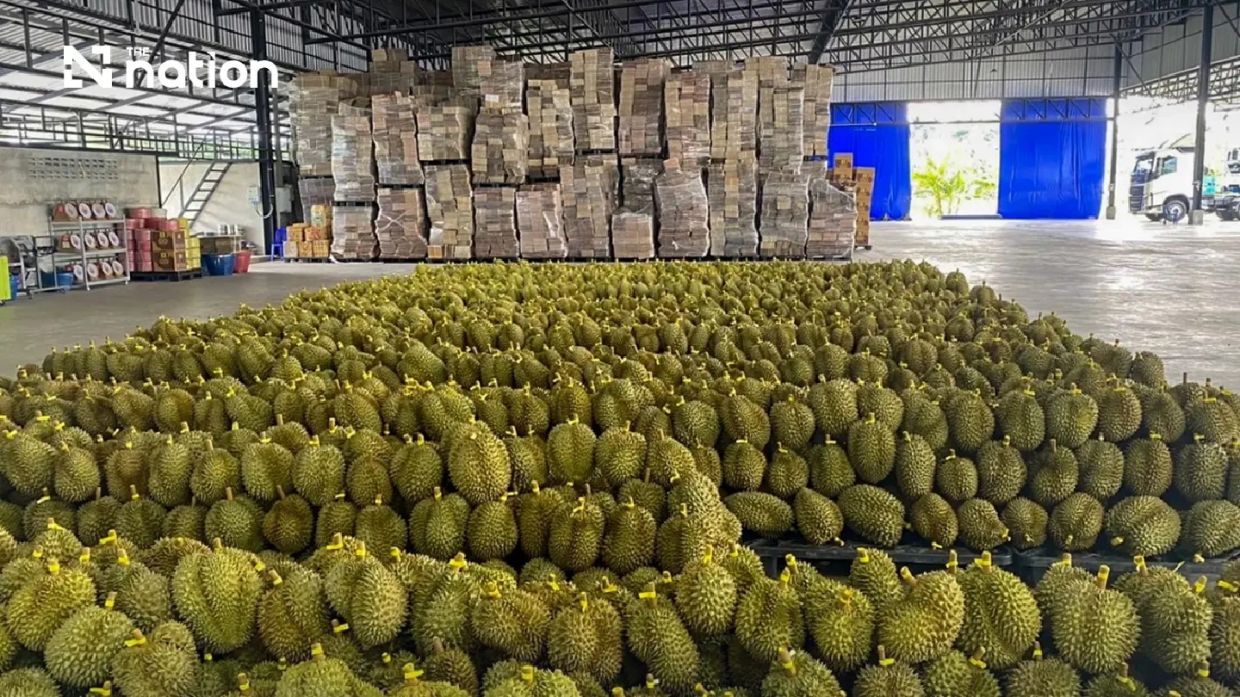
Thailand's fresh durian sector has achieved a significant breakthrough in its largest market, with exports to China exceeding THB100 billion in value during the first half of 2026. The shipment of more than 870,000 tonnes across 53,665 containers represents not merely a numerical achievement but signals a fundamental restructuring of how the kingdom manages its most profitable fruit export. The milestone underscores Thailand's determination to consolidate its position as the world's leading durian exporter whilst addressing longstanding quality and safety concerns that have previously undermined buyer confidence in key markets.
The government's strategic overhaul of its durian export framework has been central to this performance. Under the stewardship of Agriculture and Cooperatives Minister Suriya Jungrungreangkit, Thai authorities have transitioned from reactive, case-by-case problem-solving to proactive, system-wide quality governance. This philosophical shift represents a departure from traditional regulatory approaches and reflects lessons learnt from past incidents that damaged Thailand's reputation and disrupted shipments to China. By implementing coordinated oversight mechanisms that span from farm to port, the Ministry has created infrastructure designed to prevent quality failures before they occur rather than managing crises after the fact.
Central to this transformation is the enforcement of what officials term the "Four Nos" framework: prohibiting immature durians from entering export channels, eliminating pest contamination risks, preventing false origin declarations, and preventing detection of Basic Yellow 2, a synthetic dye that has triggered rejections and market access restrictions. These seemingly straightforward measures actually represent complex operational challenges requiring coordination across multiple stakeholders. Farmers must be trained and incentivised to harvest fruit at optimal ripeness; packing facilities must implement rigorous sorting protocols; transportation networks must maintain cold chain integrity; and testing laboratories must conduct sophisticated analyses to detect adulterants invisible to the naked eye.
The governance architecture mobilised to enforce these standards involves an unusually broad coalition of state agencies and private operators. The Department of Agriculture functions as the primary coordinator, whilst the National Bureau of Agricultural Commodity and Food Standards provides technical expertise in establishing specifications. The Department of Agricultural Extension engages with farming communities to disseminate best practices. Customs authorities manage border compliance. Producing provinces contribute local knowledge and enforcement capacity. Private laboratories conduct independent verification. This multi-stakeholder approach mirrors international best practices in regulatory excellence but requires sophisticated institutional coordination often lacking in developing economies. The willingness of Chinese regulatory authorities to accept Thai certifications hinges upon confidence in the integrity of this entire system.
Technology has become integral to building that confidence. Thailand has implemented a four-layer screening protocol that integrates information from production sources, packing houses, and testing facilities into a unified digital architecture. The electronic phytosanitary certificate system links these datasets, creating transparent, traceable documentation that satisfies China's sanitary and phytosanitary requirements. This technological infrastructure reduces bureaucratic friction by streamlining inspection procedures whilst simultaneously enhancing oversight precision. Goods can move faster because government inspectors have comprehensive data before physical examination, allowing them to prioritise resources toward higher-risk shipments. For exporters and farmers, the system reduces uncertainty and processing delays that previously made shipping to China a time-consuming ordeal.
The achievement of the THB100 billion milestone in the first half of the year positions Thailand to exceed its THB150 billion annual export target, representing approximately 20 percent growth compared to typical annual performance. This projection assumes sustained momentum throughout the second half of 2026, which depends upon several variables beyond Thailand's immediate control. Chinese market demand, influenced by domestic consumption patterns and competitive pressures from other suppliers, remains the critical demand-side variable. On the supply side, Thailand's durian-growing regions must avoid climatic shocks such as unusual rainfall or temperature fluctuations that could impact fruit quality or yield. Nevertheless, the first-half performance demonstrates that when supply chains function effectively, the market rewards quality and reliability with substantial volume increases.
For Malaysia and other regional durian producers, Thailand's success carries both competitive and instructive implications. Thailand's systematic quality approach has erected a competitive moat that makes it increasingly difficult for rivals to gain market share in China simply by underpricing. Malaysian durian producers, historically strong in specific domestic markets and niche export segments, face pressure to adopt comparable quality management systems if they wish to significantly expand Chinese market penetration. The Thai model suggests that Asian agricultural exporters can compete effectively with developed economies not through cost-cutting but through demonstrable commitment to science-based quality assurance and transparency. This represents a potential opportunity for regional agricultural sectors to upgrade rather than race to the bottom on price.
Minister Suriya's articulation of the strategic vision explicitly positions durian export excellence as a foundation for broader agricultural transformation. By demonstrating that system-wide quality governance can succeed in one commodity, Thailand creates a template for managing exports of other agricultural products facing similar sanitary and phytosanitary challenges. Rubber, palm oil, rice, and other commodities have occasionally faced market access restrictions due to contamination, pest residue, or chemical residues. The institutional learning embedded in the durian export system could theoretically be extended and adapted to these sectors, potentially multiplying the benefits of the investment in regulatory modernisation. However, such extension would require political commitment and sustained resource allocation over years, not months.
The role assigned to the Department of Agriculture in this framework merits particular attention. Traditionally, agricultural ministries in Southeast Asia have functioned primarily as extension services or subsidy administrators. The Thai model reimagines the department as a "Smart Regulator" deploying scientific tools, technological systems, and risk-based methodologies to supervise standards across entire supply chains. This reconceptualisation requires training officers in contemporary regulatory science, recruiting staff with relevant technical expertise, and building institutional cultures oriented toward continuous improvement rather than mere compliance. The success of this approach in durian exports demonstrates that regulatory capacity building, though unglamorous compared to infrastructure projects or technology initiatives, can yield substantial economic returns when properly executed.
China's acceptance of Thai durian exports at these volumes reflects deliberate policy choices by Chinese regulators and purchasing institutions. The People's Republic could maintain more restrictive protocols, effectively limiting Thai market access, but instead has permitted imports to grow substantially. This suggests that Chinese officials have confidence in the Thai quality assurance system and that Thai durians have demonstrated reliability in meeting consumer expectations. This confidence, once established, can be leveraged in negotiations around other non-tariff barriers or in discussions regarding agricultural trade arrangements. For Thailand, sustaining Chinese market access requires maintaining the integrity of quality systems even when economic pressures might incentivise cutting corners. A single major contamination incident or detection of false certifications could rapidly reverse years of confidence-building and market access gains.
The implications for Thailand's rural economy extend beyond headline export values. Durian farming is concentrated in specific regions, particularly in the eastern provinces, where it has become intertwined with local livelihoods and regional development. Enhanced market access and premium pricing for higher-quality fruit creates income opportunities for farmers capable of meeting upgraded standards. However, farmers lacking access to training, credit, or modern packing facilities risk being squeezed out of the value chain. The government's coordination with extension services theoretically ensures that quality improvement benefits reach smallholders as well as large-scale operators, but implementation often lags policy intention. Regional inequality within Thailand's durian sector could increase unless quality-related support programmes reach producers across the economic spectrum.
Looking ahead, Thailand's durian export trajectory depends upon maintaining the political and bureaucratic commitment to systematic quality governance. Government officials often celebrate initial successes but struggle to sustain rigorous oversight and continuous improvement over extended periods. The transition from enthusiastic ministry leadership to institutionalised practice represents where many reform efforts founder. Thailand's ability to maintain THB150 billion annual exports and potentially surpass this threshold will ultimately reflect whether quality-focused governance becomes embedded in institutional DNA or remains dependent upon particular ministers' priorities.

