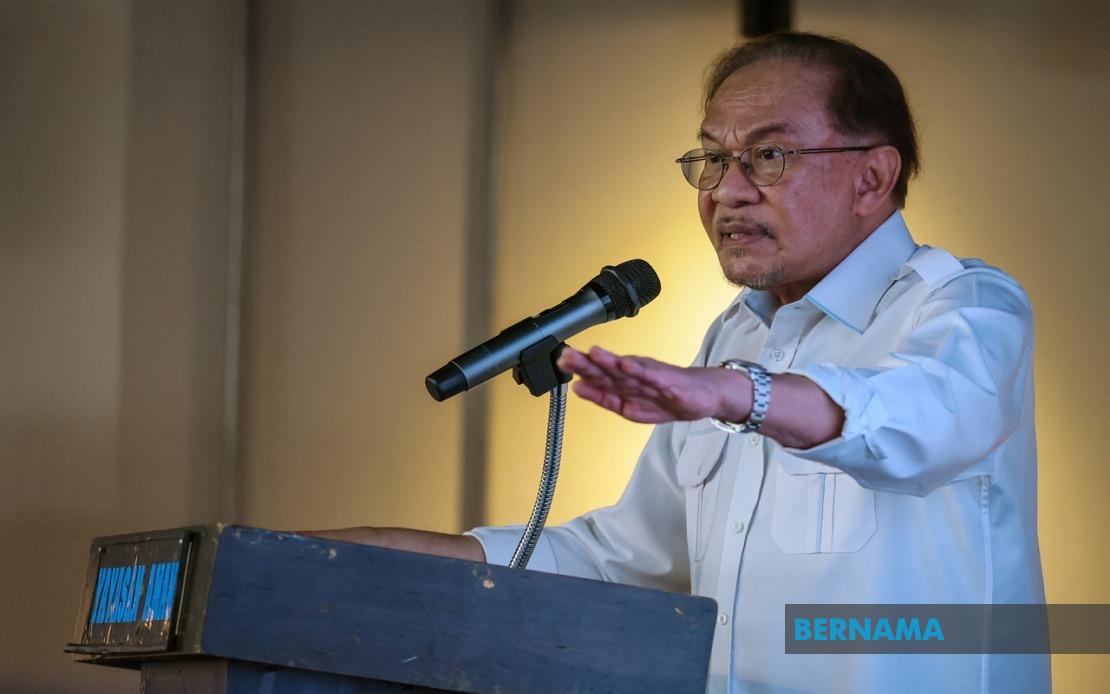
Prime Minister Datuk Seri Anwar Ibrahim has reaffirmed the government's unwavering commitment to pursuing investigations stemming from the Royal Commission of Inquiry Report on Lembaga Tabung Haji, emphasising that such scrutiny remains vital to prevent the country from sustaining additional financial damage. Speaking at the launch of the MADANI Permatang Pauh Usahawan Bangkit Scheme at Dewan Yayasan Aman in Penanti today, Anwar underscored the delicate balance between taking decisive action against wrongdoing and ensuring that all proceedings remain anchored to rigorous evidentiary standards and legal frameworks.
The Prime Minister's remarks come at a time when public attention on the pilgrimage fund's management remains acute, with lingering questions about resource stewardship and accountability continuing to dominate discourse. Anwar articulated a measured approach that acknowledges both the imperative to pursue accountability and the necessity of protecting individuals from unfounded allegations. He stressed that any decisive step taken by authorities must be underpinned by substantive evidence and must navigate the established legal processes that govern administrative action in Malaysia.
An estimated RM12 billion in losses has been associated with Tabung Haji, prompting the inquiry that has since concluded. Anwar posed a series of pointed questions regarding these losses: how the funds disappeared, when the depletion occurred, and crucially, who bore responsibility for the erosion of the pilgrim fund's reserves. These questions, he suggested, form the scaffolding upon which any investigation must be constructed, requiring investigators to methodically trace the path of capital flows and identify culpability based on demonstrated facts rather than conjecture or political positioning.
The Prime Minister acknowledged facing criticism from multiple quarters over his handling of the matter. On one side, detractors contend that insufficient action has been taken to hold individuals accountable for the fund's deterioration. On the other, opponents question whether prosecutorial steps amount to persecution or political vendetta. Anwar expressed bewilderment at this seemingly intractable dilemma, noting that inaction invites accusations of negligence, while action invites allegations of political motivation. This frustration, voiced publicly, reveals the difficulty inherent in navigating complex financial malfeasance cases where both the perpetuation of scrutiny and its cessation carry political ramifications.
The prescribed governance framework that Anwar articulated emphasises sequential procedural steps: investigation must precede accusation; evidence must underpin charges; courts must adjudicate disputes; and judges must render verdicts. This structure, he implied, represents the hallmark of principled administration and the distinguishing feature of a state governed by law rather than arbitrary executive fiat. The contrast implicit in his remarks—between rule-of-law governance and its absence—carries particular resonance for Malaysian audiences accustomed to debates about institutional integrity and judicial independence.
Anwar reiterated that the administration would not prosecute individuals lacking robust evidentiary foundations, a categorical assurance intended to address concerns about the politicisation of law enforcement mechanisms. Simultaneously, however, he signalled that when evidence of malfeasance proves compelling, the government would not shrink from pursuing accountability, regardless of political costs or institutional sensitivities. This dual commitment—to protecting innocence while pursuing guilt—represents the philosophical bedrock of his administration's stated approach to governance.
The investigation's continuation reflects broader preoccupations within Malaysian administration regarding fiduciary responsibility in institutions entrusted with managing citizen assets. Tabung Haji occupies particular cultural and religious significance within the Malaysian context, functioning not merely as a financial institution but as a repository of public trust intrinsically linked to the Hajj pilgrimage, an obligation central to Islamic practice. The mismanagement or depletion of such an institution thus transcends conventional concerns about corporate governance, acquiring dimensions relating to custodianship of communal resources and stewardship of religious endowments.
For Malaysian observers and regional counterparts, the trajectory of the TH investigation carries implications extending beyond the immediate parties involved. The manner in which a government addresses suspected financial wrongdoing within strategically significant state institutions affects perceptions of institutional robustness and administrative credibility. A thorough, evidence-driven investigation that culminates in appropriate legal consequences or exonerations—as warranted by facts—reinforces confidence in institutional mechanisms. Conversely, investigations perceived as stalled, politically motivated, or opaque invite scepticism about the machinery of accountability itself.
The Prime Minister's emphasis on process and evidence, though sometimes perceived as deliberate or measured to the point of seeming indifferent, likely reflects a calculated recognition that Tabung Haji's rehabilitation and public confidence restoration require outcomes perceived as legitimate across constituencies with divergent interests. Civil society actors concerned with financial oversight, politicians and commentators demanding accountability, administrators worried about institutional stability, and affected pilgrims all constitute stakeholder groups with potentially conflicting interests. Investigations that cleave closely to procedural propriety and evidentiary rigor navigate these crosscurrents more effectively than those appearing hasty or politically calibrated.
Moving forward, the success of ongoing investigations will ultimately be measured not by their swiftness or by satisfaction of particular political constituencies, but by whether their conclusions withstand judicial scrutiny and public credibility assessment. Anwar's framing—positioning investigation not as punitive theatre but as necessary governance mechanism—sets expectations that outcomes will emerge from systematic inquiry rather than predetermined conclusions. This framing also implicitly promises that Malaysian institutions retain capacity to investigate their own failings and correct course, a commitment essential for maintaining faith in the administrative apparatus.

