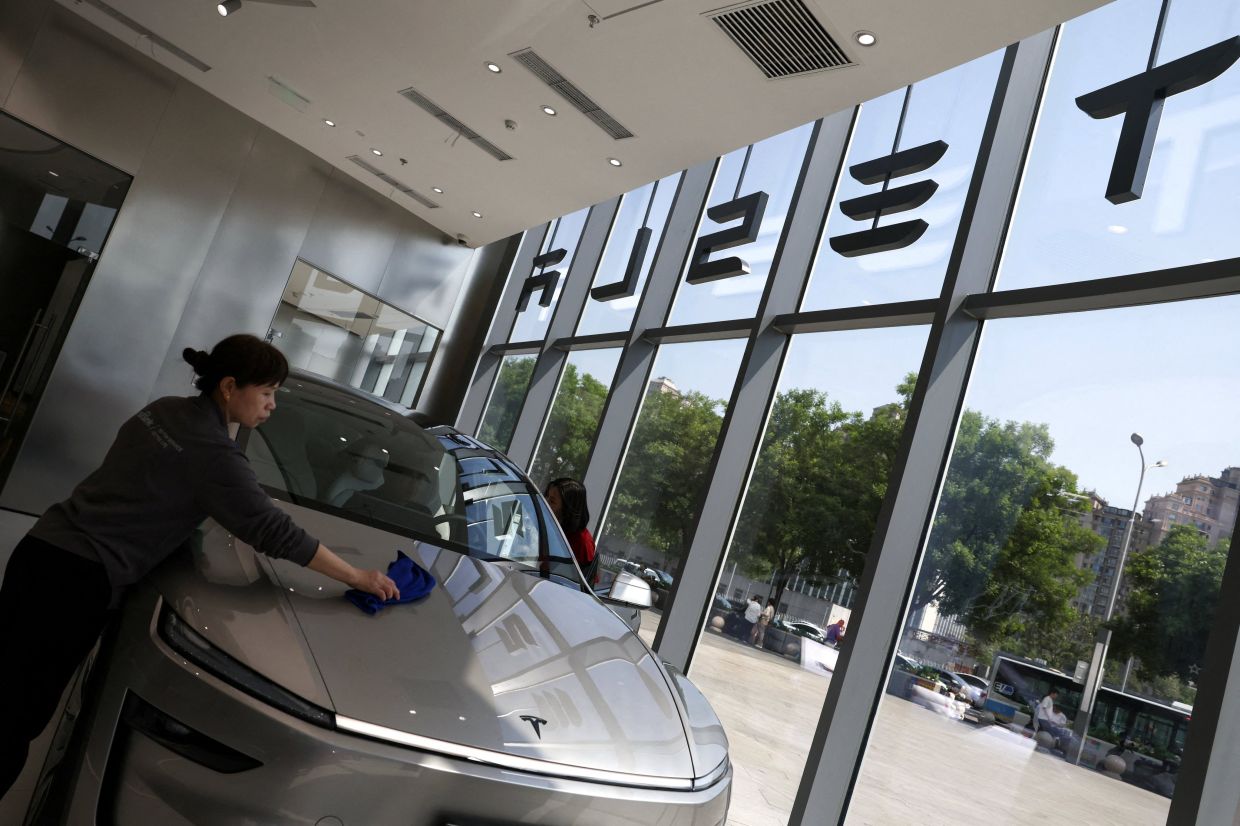
Tesla has undertaken an unprecedented recall spanning nearly three million vehicles in mainland China, marking the biggest product recall ever recorded in the country's electric vehicle sector. The action underscores growing regulatory scrutiny in the world's largest EV market and reflects mounting public concern over vehicle safety design following a fatal accident that exposed critical vulnerabilities in modern car technology.
The Beijing-based regulator's decision to mandate this sweeping recall stems from regulatory momentum to eliminate retractable door-handle systems, a feature that has become increasingly common in contemporary automotive design but now faces elimination due to demonstrated safety risks. Chinese authorities are moving to phase out such mechanisms entirely, requiring manufacturers to ensure that both internal and external door handles remain mechanically functional at all times, regardless of whether the vehicle loses electrical power or sustains collision damage.
The catalyst for this regulatory shift came in October when a Xiaomi SU7 Ultra electric vehicle caught fire in Sichuan province. A 31-year-old driver became trapped inside the burning car, and despite desperate efforts by nearby witnesses to extract him, the doors could not be opened. The tragedy exposed a fundamental design flaw in retractable door systems: their dependency on electronic or powered mechanisms that may fail precisely when occupants most urgently need to escape.
Tesla's massive recall encompasses two distinct initiatives. The first involves 2.98 million vehicles that will receive warning labels on internal door handles beginning September 25, accompanied by an over-the-air software update that automatically lowers windows following a collision—a fail-safe mechanism intended to provide an alternative exit route if standard doors remain inoperable. This addresses the immediate safety vulnerability directly.
The second recall involves 2.74 million Model 3 and Model Y vehicles manufactured at Tesla's Shanghai facility, requiring a separate software update to enhance driver-assistance systems. This update ensures that steering assistance and other automated safety functions engage immediately when drivers fail to respond sufficiently rapidly to impending collisions, potentially preventing accidents altogether.
While Tesla faces the most substantial recall obligations, the company is not alone in confronting this regulatory challenge. Chinese regulators have signaled that other manufacturers employing retractable door-handle technology will similarly face compliance requirements. However, Tesla's sheer production volume means the company bears the heaviest adjustment burden, particularly given that Shanghai's factory represents the lion's share of its global manufacturing capacity.
China's Ministry of Industry and Information Technology formally announced its ban on retractable door handles in February, establishing mandatory compliance timelines that will reshape automotive design standards across the industry. Beginning in 2025, all newly manufactured vehicles must feature mechanically operable door handles on both the interior and exterior, capable of functioning reliably even during power loss or structural damage. This represents a definitive regulatory intervention in product design that will ripple across the entire automotive supply chain.
Shanghai-based automotive maintenance industry professionals have observed that this regulatory response, while stringent, carries broader implications for market quality standards. Zhang Wenjie, who operates a car maintenance workshop in Shanghai, noted that the widespread recalls represent a watershed moment for industry safety consciousness. The accumulation of large-scale recalls by both Tesla and domestic Chinese manufacturers appears positioned to fundamentally reshape how the sector approaches product design and quality assurance, potentially elevating safety standards across the market.
Tesla's Shanghai facility proved particularly significant to the company's global operations during 2025, producing approximately 851,000 vehicles intended for distribution throughout China and international markets. This output exceeded fifty percent of Tesla's total worldwide production for the year, which declined 8.6 percent to 1.63 million units overall. The concentration of production in China underscores both the strategic importance of the Shanghai factory and Tesla's vulnerability to Chinese regulatory decisions.
Geographically, China ranks as Tesla's second-largest market globally, trailing only the United States in revenue and volume importance. This positioning means that regulatory compliance costs and manufacturing adjustments in China disproportionately affect Tesla's consolidated financial performance and operational efficiency. The necessity to retrofit nearly three million vehicles with new components or extensive software patches represents substantial near-term expenses that will ripple through the company's profitability calculations.
Beyond the immediate financial implications, this episode illuminates the evolving relationship between Chinese regulators and foreign technology companies operating within the country's automotive sector. Beijing has demonstrated willingness to impose sweeping, industry-wide requirements when safety failures emerge, without regard to the economic burden such mandates impose on affected manufacturers. This regulatory assertiveness contrasts with some international markets where industry lobbying influences the pace and stringency of safety interventions.
For Southeast Asian automotive markets and consumers, the developments in China carry instructive implications. As regional governments consider their own automotive safety standards and EV market frameworks, the Chinese regulatory response provides a template for how swiftly mandatory requirements can be implemented when safety risks become politically salient. Malaysia and other ASEAN nations may face pressure to harmonize standards with China's new requirements, particularly given the region's growing EV adoption and the likelihood that vehicles initially manufactured for China could eventually reach regional markets.
The recall also signals that as electric vehicles proliferate globally, established automotive design conventions will face increasing scrutiny from regulators and consumers alike. The retractable door-handle issue represents not a minor manufacturing defect but a fundamental design philosophy conflict: the tension between technological novelty and functional safety in emergency conditions. Tesla's massive recall represents a pivotal moment in which regulatory authority prevails over design aesthetics and market preference.

