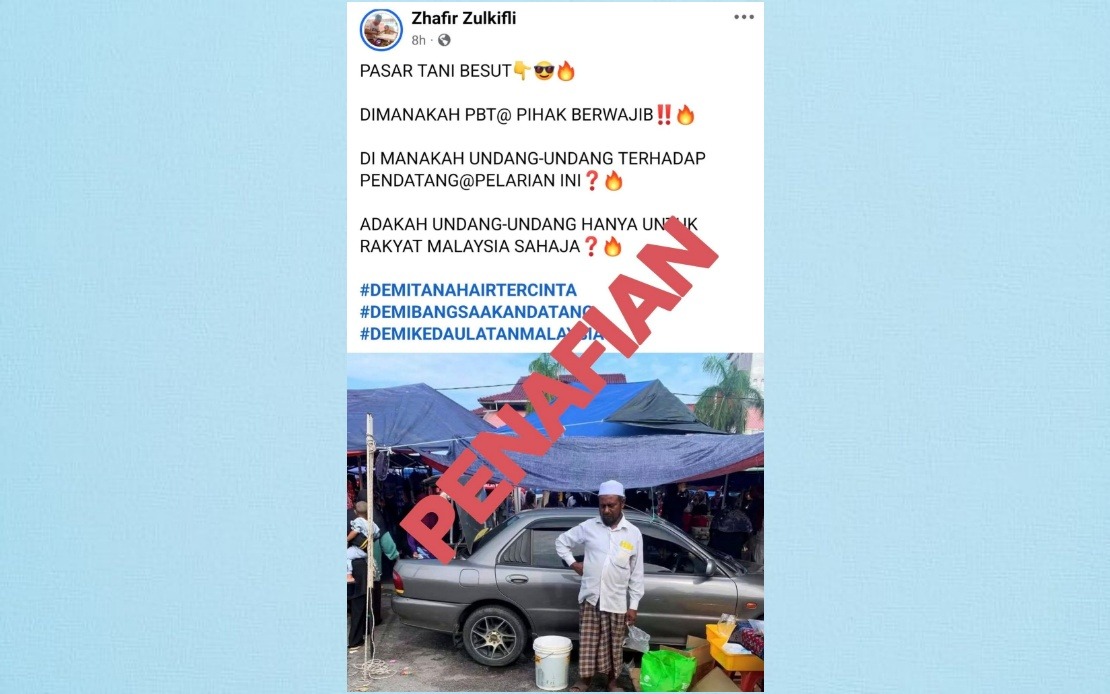
The Terengganu branch of the Federal Agricultural Marketing Authority (FAMA) has moved swiftly to counter allegations that surfaced on social media suggesting foreign nationals have been permitted to trade at farmers' markets under the agency's purview. The denial came via a statement released on August 30 in response to a viral Facebook post that purported to show a foreign seller vending vegetables at a morning market in the Besut district, prompting public concern about market governance and the enforcement of trading regulations.
According to Terengganu FAMA, the crucial distinction lies in administrative jurisdiction. The morning market where the alleged incident took place operates independently and falls outside the regulatory framework managed by the authority. This clarification aims to separate legitimate market operations supervised by FAMA from the uncontrolled or differently managed venue implicated in the social media controversy. The distinction reflects the complex patchwork of market administration across Malaysia, where different bodies oversee different trading spaces, often leading to confusion among the public about which institution bears responsibility for specific markets.
Terengganu FAMA operates two formally recognised farmers' markets within Besut district, each with clearly defined operating hours and management structures. The Jerteh Farmers' Market functions every Thursday between 7 am and 1 pm, while the Alor Lintang Farmers' Market operates on Saturdays during the same time window. Both facilities maintain consistent schedules designed to serve the local community with fresh agricultural produce from registered sellers. These structured operations represent FAMA's approach to agricultural marketing—creating controlled environments where farmer participation is documented and regulated according to established protocols.
The viral social media post that triggered the controversy exemplifies the broader challenge facing Malaysian authorities in an age of instant digital communication. Unverified claims can spread rapidly across Facebook and other platforms, potentially damaging the reputation of public agencies and undermining public confidence in market oversight. The speed with which misinformation circulates often outpaces official responses, allowing false narratives to gain traction among consumers who may already harbour concerns about market practices. FAMA's proactive statement sought to halt further spread of the allegation by immediately addressing the specific factual errors embedded in the post.
The incident also highlights tensions between informal and formal market structures in Malaysia. Besut, like many towns across the country, likely hosts multiple trading venues—some officially regulated, others operating under different management arrangements or with varying levels of oversight. Morning markets in particular often have a long-standing informal character, with traditional vendors who have occupied spaces for decades. These established informal systems can create gaps in documentation and enforcement, making it difficult for authorities to monitor who is trading and from where they originate. When foreign nationals appear in such spaces, questions naturally arise about whether regulations are being properly enforced.
From a regulatory perspective, the distinction between FAMA-supervised markets and other trading venues carries significant implications for accountability. FAMA's denial effectively transfers responsibility for oversight to whichever agency or entity actually manages the Kuala Besut Morning Market mentioned in the viral post. This fragmentation of authority can sometimes result in regulatory blind spots, where no single institution claims clear responsibility. The clarification thus serves a secondary purpose beyond mere reputation management—it establishes a paper trail documenting which authority should have investigated the alleged incident and taken remedial action if warranted.
The concern underlying public anxiety about foreign traders at Malaysian markets relates to broader issues around livelihood protection for local farmers and compliance with trading regulations. Many Malaysians believe that farmers' markets should primarily serve indigenous agricultural producers, and regulations often reflect this principle. When allegations suggest non-citizens are operating in these spaces, it triggers fear that local livelihoods are being undermined and that regulatory frameworks are failing. These anxieties are not unique to Terengganu; similar concerns surface periodically across Malaysian states, suggesting a pattern of either genuine enforcement challenges or persistent public misconceptions about market operations.
Terengganu FAMA's response strategy prioritised factual precision, distinguishing between markets it supervises and those it does not. This approach, while technically accurate, necessarily leaves open questions about the actual market mentioned in the viral post and whether appropriate investigations were undertaken there. Consumers might reasonably wonder who confirmed the identity of the seller in question, what trading permits or documentation that individual possessed, and whether any action was taken to address potential violations. The statement effectively clears FAMA of responsibility but does not fully address the underlying incident, leaving some public concerns unresolved.
For stakeholders in Malaysia's agricultural sector, including farmers, market associations, and consumers, the incident underscores the importance of transparent market governance. Regular communication about trading regulations, vendor eligibility requirements, and enforcement mechanisms could help bridge gaps between public expectations and actual practices. Markets operate most effectively when buyers and sellers alike understand and trust the regulatory framework. When allegations of foreign traders surface without clear investigation outcomes, public confidence erodes, potentially affecting market participation and, by extension, the livelihoods that depend on these trading platforms.
Looking forward, the Terengganu FAMA statement represents a tactical clarification rather than a comprehensive resolution of underlying governance questions. The two officially supervised farmers' markets in Besut—Jerteh and Alor Lintang—continue to operate according to their established schedules, presumably with appropriate documentation and oversight. However, the broader ecosystem of morning markets and informal trading spaces across Besut and Terengganu more generally may benefit from enhanced coordination between various administrative bodies, clearer public communication about regulatory standards, and more visible enforcement presence. Only through such systematic improvements can authorities fully address the legitimate concerns that social media allegations, however inaccurate, bring into sharp public focus.

