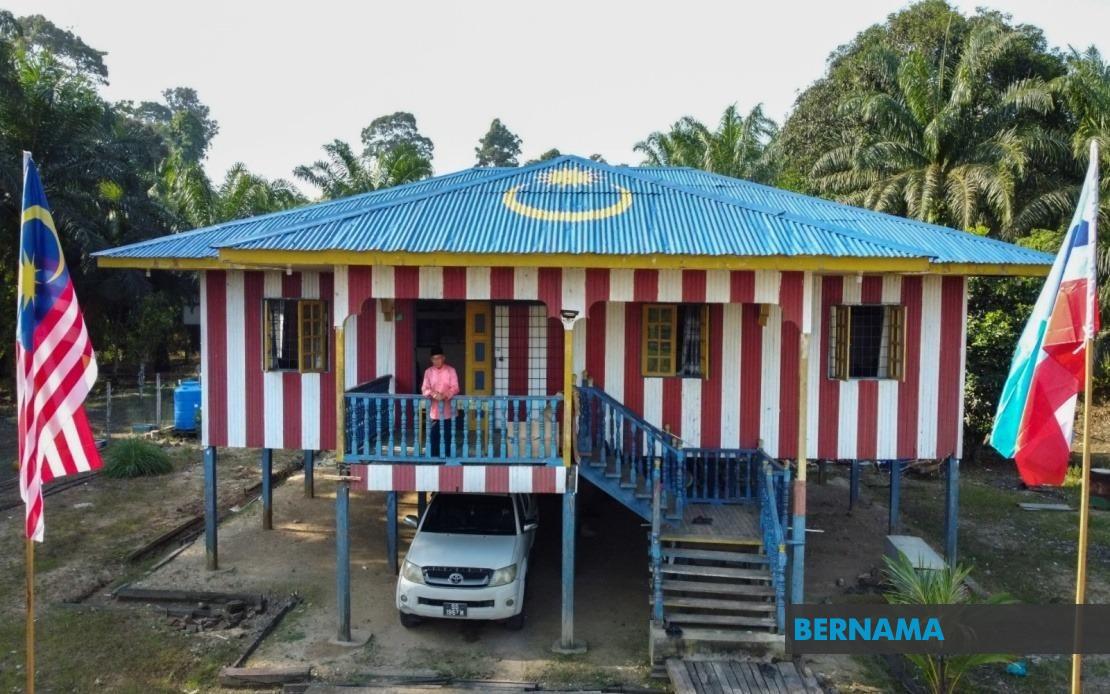
At a modest property in Sandakan's Batu 15 area along Jalan Labuk stands a house that has become far more than a residence—it is a living, breathing declaration of patriotism rendered in red, white, blue and yellow. Mohd Halikin Angga, a 68-year-old entrepreneur, has named his distinctive home Teratak Gemilang, and over two decades he has maintained it as a steadfast symbol of his love for Malaysia, transforming it into a landmark that catches the eye and captures the hearts of passersby, especially during the nation's celebratory months.
The genesis of this remarkable undertaking traces back to 2004, when Mohd Halikin was struck by a particular sadness—the necessity of removing national flags once the National Day festivities concluded. More troubling still was witnessing flags discarded or blown away, landing dishevelled on the ground. This emotional response catalysed his decision to paint his wooden dwelling in Malaysia's national colours, ensuring that the patriotic spirit remained visible every day of the year. The house's deep-blue roof is crowned with a golden-yellow crescent moon and fourteen-pointed star, mirroring the symbolism of the Jalur Gemilang, while the walls display bold red and white stripes with actual flags positioned proudly throughout the compound.
Beyond its exterior brilliance, Teratak Gemilang houses a mini gallery that serves as a repository of Malaysian political history and leadership. Visitors stepping through the threshold encounter a carefully curated collection featuring portraits of the Yang di-Pertuan Agong, the Yang di-Pertua Negeri Sabah, and every Malaysian Prime Minister from the nation's founding father Tunku Abdul Rahman Putra Al-Haj through to the present incumbent. This indoor museum reflects Mohd Halikin's scholarly appreciation for the country's institutional continuity and the individuals who have shaped its trajectory, transforming private walls into a pedagogical space for those who enter.
Among his most prized possessions is a historic photograph documenting Tunku Abdul Rahman's 1961 meeting with twenty North Borneo leaders to discuss Malaysia's formation. The story of acquiring this image is itself revealing—Mohd Halikin encountered it in a newspaper whilst aboard a flight to perform Umrah in 2005 and sought permission from cabin crew to preserve and later frame it. This anecdote illuminates the depth of his commitment; his pursuit of national memorabilia transcends convenience and reflects an almost missionary zeal to preserve and display the founding narratives of Malaysia.
Mohd Halikin's patriotism extends even to the most intimate family domain—the naming of his children. Three of his seven offspring bear the names of prominent national figures and statesmen. His eldest is named after Tun Dr Mahathir Mohamad, his second after Tun Abdullah Ahmad Badawi, and his sixth daughter, Nur Zahirah, is named after the 13th Raja Permaisuri Agong. When asked about these choices, Mohd Halikin articulates a philosophy that transcends mere nomenclature; he views names as vessels of hope and instruments through which successive generations might remember and honour the legacies of Malaysia's leaders. This approach to parenting—imbuing family identity with national consciousness—reveals how deeply the nation's story has permeated his personal worldview.
The emotional wellspring for Teratak Gemilang also flows from familial reverence. Mohd Halikin has repeatedly emphasised that his project constitutes a tribute to his parents, who endured the trials of the colonial era and witnessed Malaysia's hard-won independence. In painting his home with the colours of freedom and sovereignty, he performs a filial honour, acknowledging the sacrifices of the generation that lived through subjugation and helped birth an independent nation. This personal connection to historical struggle adds layers of meaning to what might otherwise be viewed simply as an eccentric home décor choice.
Over more than two decades, Teratak Gemilang has evolved into a de facto tourist attraction, particularly during National Month when patriotic sentiment peaks. Visitors frequently pause to photograph the striking structure, sharing images on social media and thereby amplifying its reach beyond Sandakan's immediate boundaries. The house has become a talking point, attracting attention not merely for its visual boldness but for the philosophy it embodies—a defiant assertion that patriotism need not be confined to prescribed moments or official ceremonies but can instead permeate daily life.
For Mohd Halikin, the decision to maintain Teratak Gemilang in perpetuity represents an unwavering commitment. He has publicly stated his intention to preserve the house in these national colours indefinitely, ensuring that the patriotic message continues to resonate and that his personal affection for Malaysia remains tangible and visible. This permanence carries political undertones—it suggests that national pride should not be ephemeral or cyclical but rather an enduring feature of the Malaysian landscape and consciousness.
The significance of Teratak Gemilang extends particularly to Sabah and the broader Malaysian context of multiculturalism and national unity. Situated in a state that joined Malaysia later than Peninsular states, with its own distinct political narrative and indigenous populations, Sandakan represents a microcosm of Malaysia's diversity. Mohd Halikin has articulated hope that his home will serve as an inspiration for Sabah's multiracial community, strengthening bonds of unity particularly during pivotal national celebrations such as the upcoming National Day and Malaysia Day 2026 commemorations. By making his patriotism so visibly, so unambiguously, and so persistently public, he offers an invitation for others to similarly express their national belonging.
The phenomenon of Teratak Gemilang invites reflection on contemporary expressions of nationalism and civic pride. In an era when patriotism is sometimes dismissed as performative or relegated to state-sanctioned occasions, Mohd Halikin's decades-long project demonstrates a more organic, individualistic approach—one rooted in genuine affection rather than compulsion, expressed through creative aesthetic choices rather than rhetoric. His house stands as testimony to the proposition that national identity can be a source of joy and inspiration rather than obligation or pressure, offering a model for how citizens might authentically engage with their country's symbols and history.

