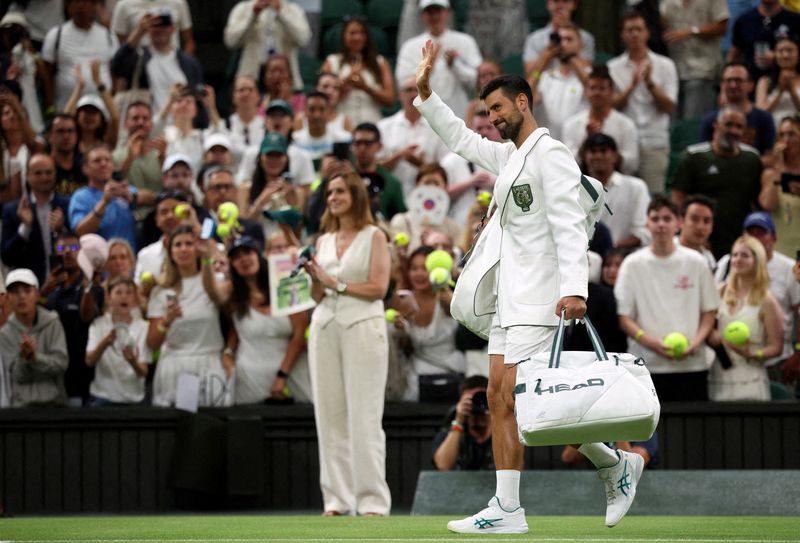
The Wimbledon Championships have become an unexpected fashion runway this year, with elite male tennis players joining their female counterparts in using their courtside entrances as opportunities for high-impact style statements. World number one Novak Djokovic has made his mark wearing a custom Lacoste blazer paired with tailored shorts, while American sixth seed Taylor Fritz has commanded attention in a white Hugo Boss jacket, complemented by formal trousers and a silk scarf. These sartorial choices represent a significant shift in how male athletes approach the sport's most prestigious and restrictive tournament, historically dominated by women athletes in terms of fashion innovation.
Naomi Osaka's appearance in a kimono-inspired outfit—a reference to her iconic "Kill Bill" aesthetic—served as the catalyst that reignited broader interest in Wimbledon fashion beyond traditional match attire. The 14th seed has spent the entire Grand Slam calendar experimenting with designer walk-on pieces, from a Kevin Germanier skirt at the French Open to a layered Nike dress inspired by the Eiffel Tower. Her jellyfish-inspired outfit at the Australian Open further demonstrated how elite players now view these fleeting moments of visibility as canvases for personal expression and brand collaboration. The unprecedented media coverage and social media traction generated by these appearances have not gone unnoticed by male competitors and their sponsors.
Wilson sports brand's chief creative officer Joelle Michaeloff attributes this emerging trend to a confluence of factors: the visibility of female athletes' fashion choices, the growing recognition of walkout moments as marketing assets, and a generational shift in how male athletes perceive self-expression through clothing. Speaking to her experience working with Australian fifth seed Alex de Minaur and Ukrainian 12th seed Marta Kostyuk, Michaeloff emphasized that male players are now deliberately studying historic Wimbledon moments, recognizing that the sport's most exclusive venue has long been a stage for memorable fashion statements. The motivation extends beyond personal style—sponsors are increasingly financing and promoting these coordinated walkout looks as integral components of their athlete endorsement strategies.
The all-white dress code that Wimbledon uniquely enforces among the Grand Slams creates both constraints and opportunities for creative expression. While this restriction eliminates the vibrant colours and experimental cuts possible at other majors, it has paradoxically elevated the prestige of Wimbledon fashion moments, concentrating attention on subtle variations in fabric, cut, and accessorization. The tournament's historical significance is reinforced by Eleanor Thomas, collections lead at the All England Lawn Tennis Club, who curates displays of iconic tennis clothing in the Wimbledon Lawn Tennis Museum. She acknowledged that Osaka's creations this year represent the kind of landmark fashion moments that join the pantheon of memorable Wimbledon style, including Ted Tinling's 1985 white bodysuit and Roger Federer's distinguished jacket appearance in 2007.
Fritz's walkout ensemble carries particular risk for the young American player, who candidly acknowledged the potential downside of high-fashion entrances. "You can't walk out with an outfit and go out in the first round. It just looks so bad," he remarked, highlighting how poor performance can undermine the confident statement made by an elaborate entrance. Fortunately for Fritz, his progression to the third round without dropping a set has allowed him to carry off the visual spectacle without the embarrassment of early elimination. His specially designed trousers feature side seams engineered for rapid removal, enabling him to transition seamlessly from his formal walkout attire to performance-focused match wear. Hugo Boss, his primary sponsor, orchestrated the entire initiative, and Fritz's willingness to participate reflects the increasingly professionalized approach to athlete branding and sponsorship activation.
Djokovic's entrance generated extensive media commentary following his commanding demolition of Stefanos Tsitsipas, with the 24-time Grand Slam champion even engaging in playful banter with golfer Rory McIlroy from Centre Court. The exchange, wherein Djokovic jokingly proposed that his custom Lacoste blazer be weighed against the Masters Tournament's coveted Green Jacket, demonstrates how fashion moments now generate ancillary content and cross-sport conversation. This type of engagement amplifies the original marketing investment, creating layers of visibility that extend far beyond the initial walkout moment. The sophisticated approach to athlete self-presentation reflects how contemporary sports sponsorships operate across integrated marketing ecosystems.
Brand collaboration in these walkout moments has become increasingly strategic and structured. Nike and Osaka's representatives coordinated social media distribution of her kimono-inspired arrival imagery, recognizing that pre-match digital engagement amplifies the tournament experience for global audiences. Similarly, Marta Kostyuk collaborated with Wilson on a specially commissioned iteration of "The Marta Dress" for her Wimbledon appearance. Michaeloff articulated that sponsors now recognize the walkout as a storytelling opportunity, permitting brands to communicate personality and stylistic differentiation both on and off the court. This represents a fundamental recalibration of how athlete sponsorships deliver value beyond traditional equipment provision and appearance fees.
Several male competitors have become actively involved in the design and conceptualization process, departing from passive acceptance of sponsor-provided attire. Russian player Karen Khachanov exemplifies this engaged approach, seeking detailed input on fabric selection, color palettes, necklines, and fit specifications. Khachanov's design advocacy reflects a broader player movement toward ownership of their visual presentation, treating fashion as performance-enhancing rather than purely aesthetic. The tension between fashionability and functionality remains crucial—athletes recognize that an outfit, however striking visually, must ultimately support rather than hinder their competitive objectives. This balancing act between style ambitions and practical performance requirements distinguishes serious athletic fashion from purely theatrical costume.
Not all fashion ambitions receive approval from Wimbledon's notoriously exacting dress code arbiters. Italian player Matteo Berrettini, previously ranked as high as sixth in the world, experienced rejection when tournament officials deemed his proposed outfit insufficiently white. This encounter illustrates Wimbledon's unyielding commitment to its sartorial restrictions, which remain more stringent than any other tennis venue globally. Berrettini's disappointment underscores that while the tournament has increasingly embraced fashion as part of its contemporary identity, boundaries remain firmly established and enforced. The contrast between Osaka and Fritz's successful executions and Berrettini's rejection demonstrates that Wimbledon distinguishes between fashion-forward creative expression and violations of its foundational dress code principles.
Michaeloff contextualized contemporary Wimbledon fashion within broader tennis history, drawing parallels between current male player statements and the visual sophistication of players like Roger Federer, while acknowledging deeper historical roots extending to 1960s and 1970s legends. The trajectory extends even further back to Arthur Ashe, whose distinctive presentation and deliberate approach to appearance preceded modern sponsorship systems yet established templates for how elite athletes could utilize their visual presence as a form of communication. The generational progression from Ashe's intentional styling to Federer's refined wardrobe choices to contemporary coordinated sponsor-backed ensembles traces an evolution in how tennis culture values and commodifies athlete presentation.
Fritz himself acknowledged that female players have traditionally dominated the walkout fashion conversation, treating these moments as coordinated productions with deliberate theatrical components. His observation that "the women have done more with the walk-out outfits, making it into a bit of a production" suggests that male players now recognize they can elevate their own competitive narratives through similar intentionality. The question of whether these early male fashion experiments will sustain as a lasting competitive culture remains open, dependent on continued sponsor investment, player adoption, and audience reception. What remains clear is that Wimbledon's historically conservative aesthetic has accommodated a new form of athlete expression, transforming moments that once emphasized anonymity into platforms for personality, commercial partnership, and strategic brand communication.

