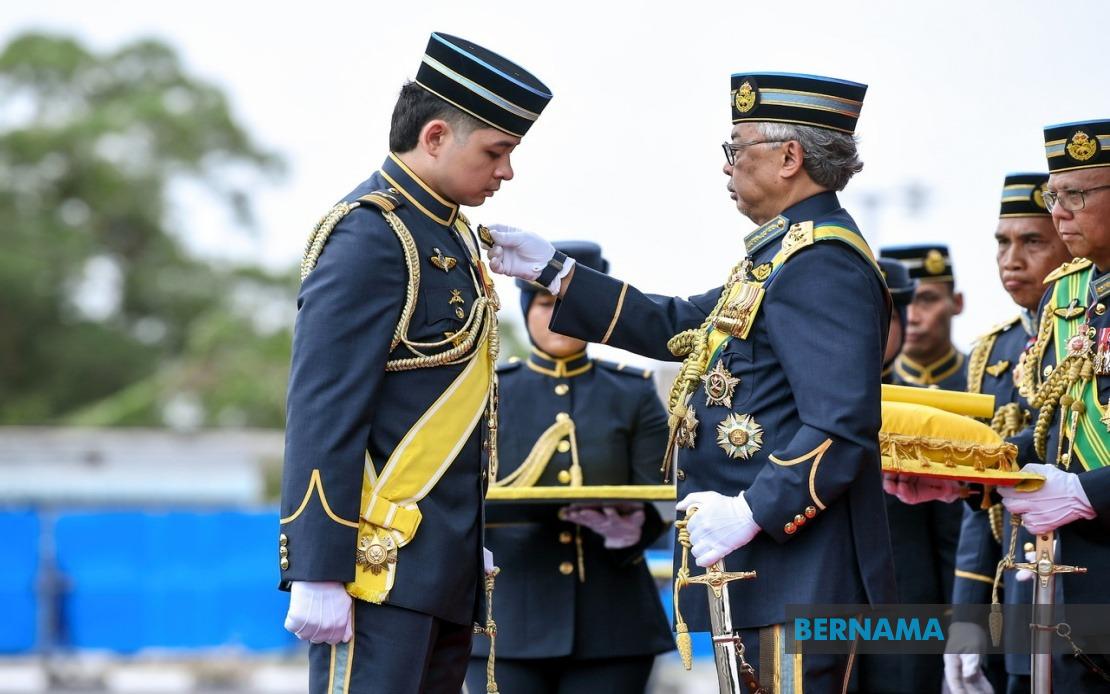
Tengku Hassanal Ibrahim Alam Shah Ibni Al-Sultan Abdullah Ri'ayatuddin Al-Mustafa Billah Shah has etched his name into Malaysia's aviation history by becoming the first member of the Pahang royal household to successfully complete the Royal Malaysian Air Force's Basic Helicopter Flying Course at the Air College in Alor Setar. The milestone achievement underscores a deepening personal engagement with Malaysia's defence establishment by the heir apparent to the Pahang throne, signalling royal commitment to understanding the operational realities faced by the nation's air arm.
The Tengku Mahkota received his flying wings during a formal presentation parade held at the Air College on August 15, where a total of 40 graduates received their coveted insignia. The ceremony was presided over by Sultan Al-Sultan Abdullah Ri'ayatuddin Al-Mustafa Billah Shah, who serves as Colonel-in-Chief of the RMAF and is the Tengku Mahkota's father. This dual role—both as his son's ceremonial superior in the military hierarchy and as the state's paramount ruler—highlighted the formal nature of the occasion and the significance accorded to the achievement within Malaysia's constitutional framework.
The Tengku Mahkota's cohort included 39 other military personnel drawn from Malaysia's three armed services, demonstrating the interagency nature of the Air College's training programmes. Among these graduates were 37 young pilots embarking on their flying careers and two weapons systems officers whose roles encompass the increasingly complex technological demands of modern air operations. The diversity of backgrounds and service branches represented in the graduating class reflects the Air College's role as a centralised training hub for aviation personnel across the Malaysian Armed Forces.
The training syllabus that produced these graduates spanned four distinct flying courses, each targeting different specialisations within military aviation. The Tengku Mahkota attended the 67(A)/26 Basic Helicopter Flying Course, which ran from early June through the final day of July. His cohort operated the EC120B Colibri helicopter, a light utility aircraft favoured for basic rotary-wing instruction due to its responsive handling characteristics and cost-effectiveness. The curriculum subjected trainees to rigorous evaluation across multiple competency domains, including the Basic Handling Test to assess fundamental aircraft control, the Instrument Flying Test for navigation without visual references, the Final Navigation Test to verify route-planning and positioning skills, and the Final Handling Test as the comprehensive culminating examination.
The Tengku Mahkota's successful navigation through this demanding programme speaks to his commitment and aptitude, having excelled across all four assessment categories. In Malaysia's context, where royal family members traditionally maintain ceremonial rather than operational military roles, his completion of practical flying training represents a departure from convention. The decision to undertake and complete the full course rather than receive an honorary or abbreviated variant suggests a deliberate choice to build genuine operational familiarity with helicopter operations, a capability increasingly central to modern military operations ranging from transport and reconnaissance to medical evacuation and combat support missions.
The presentation ceremony itself carried ceremonial weight befitting the occasion. Beyond the distribution of flying wings, six additional awards were conferred upon the graduates demonstrating exceptional performance across multiple dimensions: raw flying ability, theoretical knowledge, adherence to military discipline, and leadership qualities. These supplementary honours recognised that pilot development encompasses far more than stick-and-rudder skills, encompassing the judgment, integrity, and decision-making capacity essential in roles where aircrew decisions carry life-or-death consequences.
General Tan Sri Muhamad Norazlan Aris, the Air Force Chief, delivered remarks contextualising the graduates' achievement within broader military and national frameworks. His emphasis on perseverance, fighting spirit, mental resilience, and discipline acknowledged that helicopter flying instruction demands not merely technical proficiency but psychological robustness and sustained motivation. General Norazlan pointedly noted that family members and parents played instrumental roles throughout training, providing emotional sustenance and logistical support that enabled graduates to maintain focus during demanding phases of instruction.
The General's characterisation of the flying wings presentation as a beginning rather than an endpoint carries particular significance. In military aviation cultures worldwide, the awarding of wings represents formal recognition that a pilot has achieved minimum competency and is ready to assume operational responsibilities. Yet as General Norazlan emphasised, this transition from trainee to winged aviator inaugurates rather than concludes a professional journey. The wings themselves—those small metal insignia worn on the uniform—symbolise far more than personal accomplishment; they represent the honour invested in them by the air force institution, the expectations of the broader military establishment, and ultimately the trust of the Malaysian nation.
For Malaysia's defence landscape, the Tengku Mahkota's achievement resonates on multiple levels. It demonstrates the accessibility of military aviation training to individuals from all backgrounds, including the highest reaches of the social hierarchy, provided they meet established standards. It signals that royal engagement with defence matters extends beyond ceremonial patronage to include substantive participation in training and professional development. For the RMAF specifically, having the Pahang heir apparent complete its helicopter course enhances institutional prestige and potentially strengthens relationships between the military establishment and the state palace.
The broader context of this achievement reflects Malaysia's commitment to maintaining professional standards across its military institutions. The Air College's role in producing qualified aviation personnel across the three services underscores the integration of Malaysia's defence apparatus, with shared training facilities fostering inter-service cohesion and common standards. The presence of weapon systems officers among the graduating class highlights the increasingly technical and systems-oriented nature of modern military aviation, where pilot success depends on effective coordination with airborne and ground-based sensor and weapons specialists.
Looking forward, the Tengku Mahkota's acquisition of flying qualifications positions him to engage more substantively with the operational aspects of military aviation. While specific future deployment or operational roles remain matters of royal household discretion, his successful completion of formal military flying instruction establishes him as a credible participant in discussions regarding helicopter capabilities, pilot training standards, and aviation-related defence policy. In constitutional monarchies with active military traditions, such practical familiarity with defence operations enhances a royal personage's effectiveness in roles spanning state defence, military counsel to political leadership, and institutional representation.
The August 15 ceremony in Alor Setar thus represents more than a routine military training graduation. It marks a notable evolution in how Malaysia's royal institutions engage with the defence establishment, combining ceremonial tradition with substantive professional participation. As the Tengku Mahkota pins on his flying wings and assumes the responsibilities they entail, he joins a distinguished lineage of military aviators while simultaneously expanding the scope of royal engagement with Malaysia's armed forces.

