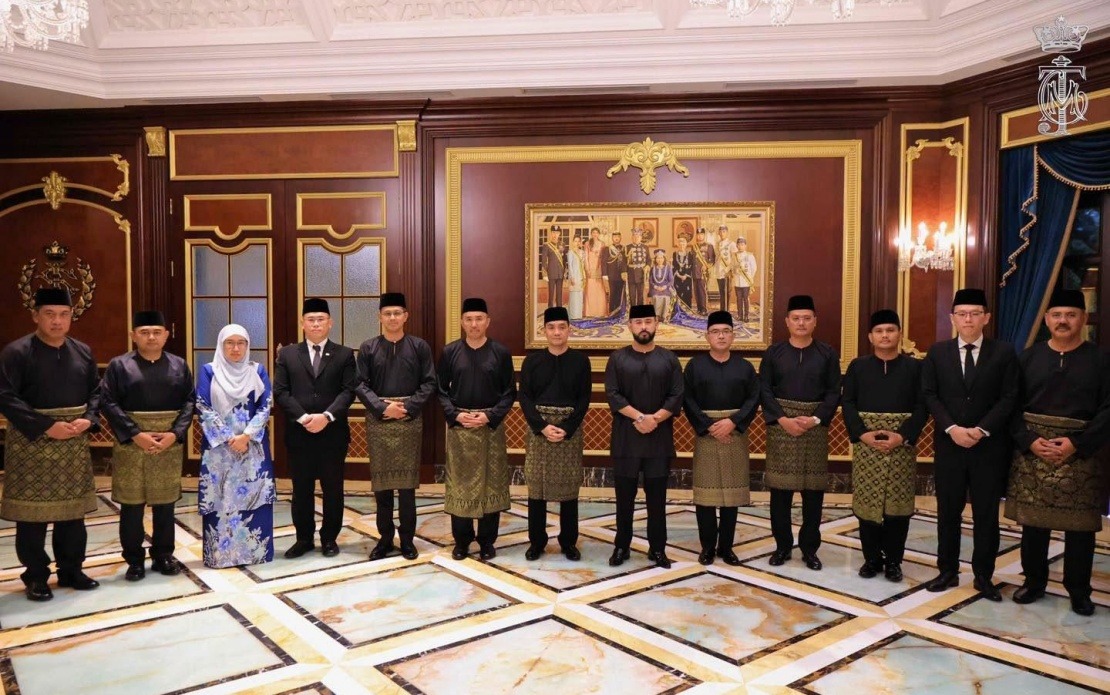
The formal induction of Johor's expanded State Executive Council took place on July 18 when ten assemblymen took their oaths before Tunku Mahkota Ismail at Istana Bukit Serene in Johor Bahru. The ceremony marks the final step in establishing the administrative structure of Johor's new government following the state's recent electoral reshuffling, with all appointees pledging their commitment to serve in their respective portfolios under the leadership of Menteri Besar Datuk Onn Hafiz Ghazi.
The incoming council brings together a mix of experienced legislators and newcomers to the executive table. Among those taking the oath were Mohd Hairi Mad Shah, representing the Larkin constituency, Datuk Mohd Jafni Md Shukor from Bukit Permai, Mohd Fared Mohd Khalid of Semerah, Ling Tian Soon from Yong Peng, Lee Ting Han representing Paloh, and Mohamad Fazli Mohamad Salleh from Bukit Pasir. These six members bring prior experience to the council, having served in previous administrations or held significant positions within their respective communities.
Four members represent a fresh generation of leadership within Johor's executive apparatus. Md Israk Abdullah, who won the Kukup seat, is making his debut on the council alongside P. Pannir Selvam from Perling, Hasrunizah Hassan representing Pulai Sebatang, and Muhammad Naqib Md Ghazali from Panti. Their inclusion reflects a deliberate effort to balance continuity with new perspectives as the state government addresses emerging challenges and opportunities in the rapidly developing Johor economy.
The ceremony was attended by several high-ranking officials, including Royal Court Council Yang Dipertua Datuk Dr Abdul Rahim Ramli and State Secretary Datuk Mohammed Ridha Abd Kadir, underscoring the formal significance of the occasion. The presence of these dignitaries highlighted the constitutional importance of the oath-taking process and the state's commitment to maintaining proper governance protocols.
This council formation follows Menteri Besar Datuk Onn Hafiz Ghazi's own swearing-in ceremony just days earlier, on July 15. Onn Hafiz, who represents the Machap constituency, secured his position for a second consecutive term after winning his seat with a decisive majority of 15,375 votes. His reelection reflects voter confidence in his leadership and the broader direction of the Johor government during this period of transition and consolidation.
The electoral mandate that brought this administration to power was substantial. Barisan Nasional secured 48 of the 56 state assembly seats in the 16th Johor state election, providing a commanding majority that grants the coalition considerable legislative room to implement its policy agenda without the constraints of a closely divided parliament. This overwhelming support gives the new executive council a clear democratic foundation for its governance programme.
For Malaysian political observers, the Johor result carries broader implications. As the largest and most economically significant state in peninsular Malaysia after Selangor, Johor's political stability and administrative effectiveness influence national economic performance and serve as a bellwether for federal-level dynamics. The strong performance by Barisan Nasional reinforces the coalition's grip on traditional strongholds and suggests sustained voter preference for establishment parties in this region.
The composition of the new council reflects strategic considerations about representation and portfolio allocation. The inclusion of representatives from diverse constituencies, including both urban and rural areas, suggests an effort to ensure that government resources and attention are distributed across Johor's varied populations. The balance between Bumiputera and non-Bumiputera members, evidenced by assemblymen from different ethnic backgrounds taking positions, underscores the multiethnic nature of Johor's governance structure.
The appointment of four first-time exco members introduces fresh dynamics to executive deliberations. These newcomers bring grassroots perspectives from their constituencies and may contribute novel approaches to persistent state-level challenges such as infrastructure development, education quality, and economic diversification beyond traditional industries. However, they will also need to rapidly develop working relationships with experienced administrators and other council members to ensure coherent policy implementation.
The executive council's effectiveness will be measured by its capacity to translate Barisan Nasional's electoral mandate into tangible improvements in public services and economic opportunities. With a two-thirds supermajority in the state assembly, the government possesses the legislative power necessary to pass significant bills, including constitutional amendments if required. The challenge ahead lies in converting this political capital into concrete developmental outcomes that justify voter confidence.
For Southeast Asian governance comparisons, Johor's institutional arrangements reflect Malaysia's unique constitutional framework, which vests considerable authority in state executives while maintaining strong federal oversight. The formal oath-taking ceremony before the Regent demonstrates the residual constitutional role of Johor's monarchy in validating and legitimising the executive structure, a feature that distinguishes Malaysian governance from purely republican or parliamentary systems elsewhere in the region.
The new exco's work programme will likely focus on several interconnected priorities that have long occupied Johor government attention: attracting foreign direct investment, upgrading ports and logistics infrastructure, managing rapid urbanisation in key growth corridors, and ensuring equitable development between Johor Bahru and peripheral districts. The balance of experienced and new members may prove useful in addressing these multifaceted challenges with both institutional knowledge and adaptive thinking.
As this council enters its operational phase, stakeholders across Johor will be watching closely to assess whether the administration can maintain the administrative momentum established under Onn Hafiz's first term while addressing accumulated grievances and expanding economic opportunities. The next five years will largely determine whether this government's substantial electoral mandate translates into a genuine transformation of Johor's economic trajectory or represents merely a continuation of existing patterns.

