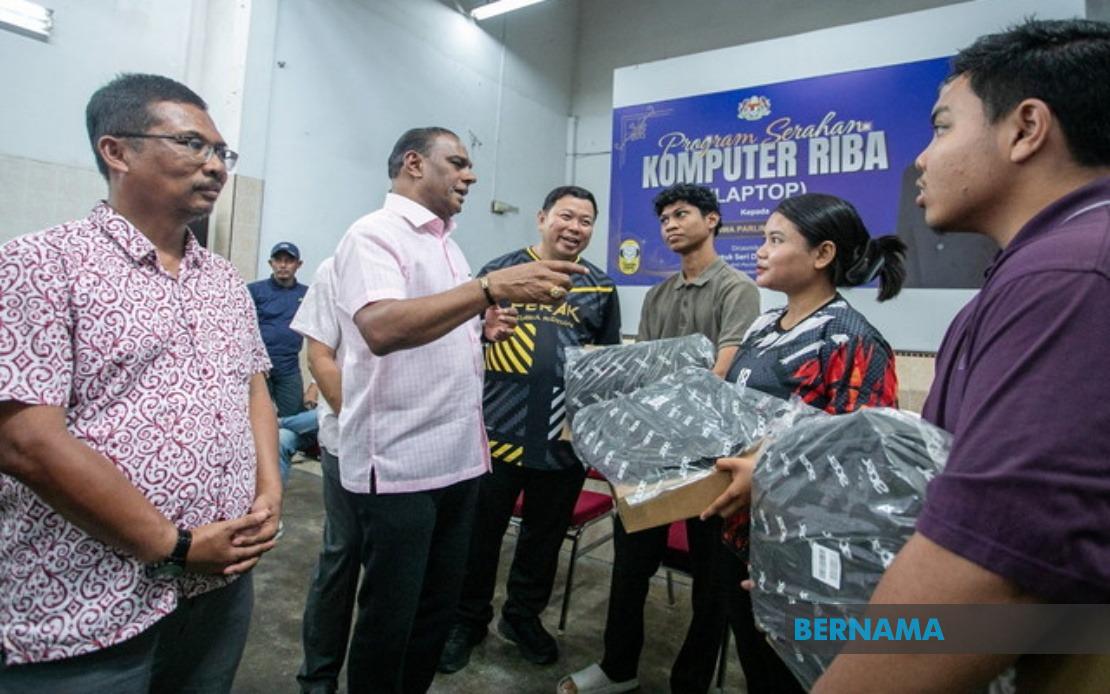
Forty-five university students from economically disadvantaged B40 households in the Tapah parliamentary constituency have been equipped with laptops through an ongoing assistance initiative that has grown to support more than a thousand scholars since its formal launch in 2008. The distribution ceremony, held at Mahatma Gandhi Hall, represents the latest chapter in a sustained effort to bridge the digital divide affecting lower-income students across the region.
Tapah Member of Parliament Datuk Seri M. Saravanan oversaw the handover, explaining that this cohort of recipients comprised a diverse cross-section of educational levels. The group included 30 pursuing diploma qualifications, five enrolled in certificate programmes, four at the matriculation stage, and three pursuing degree courses. The remaining four recipients were distributed across secondary education, pre-university studies, and foundational programmes, illustrating the scheme's reach across multiple educational pathways.
In an era where digital connectivity has shifted from luxury to necessity, Saravanan articulated the critical importance of ensuring financial barriers do not prevent capable students from accessing the tools their education demands. The transition toward technology-dependent learning methods across Malaysian educational institutions means that students without personal computing devices face mounting disadvantages in completing assignments, accessing online resources, and participating in hybrid or distance learning formats. For families already struggling with basic expenses, the cost of acquiring a suitable laptop often becomes prohibitive despite its educational importance.
The selection mechanism for recipients underwent rigorous scrutiny, with a dedicated committee evaluating applications using multiple verification channels. District Education Office records and consultations with grassroots community leaders provided cross-checking mechanisms to authenticate financial need and academic merit, preventing resources from misdirection while ensuring those genuinely facing hardship received priority consideration.
Beyond immediate device provision, Saravanan highlighted the scheme's broader role in expanding educational horizons within marginalised communities. The Tapah constituency includes significant Orang Asli populations, historically underrepresented in higher education and professional sectors. Over two decades, the MP noted, visible progression has emerged as young Orang Asli members increasingly pursue tertiary qualifications and transition into fields such as medicine, law, and other professional disciplines. This visible representation serves transformative psychological value, demonstrating pathways previously invisible to younger cohorts contemplating their own educational futures.
Aidil Iskandar Ramlan, aged 18 and transitioning from SMK Syeikh Abdul Ghani in Bidor, exemplifies the typical beneficiary profile. Beginning a Diploma in Public Administration at Universiti Teknologi MARA Raub campus in Pahang the following month, Aidil recognised the laptop's instrumental role in managing coursework obligations and study-related digital tasks. His family circumstances—a father employed as a school security guard and a mother managing household duties—represent the modest income profiles targeted by the initiative. Without external assistance, laptop acquisition would have absorbed financial resources his household could ill afford to divert from essential expenses.
The economic relief extends beyond the individual recipient to family-level impacts. Aidil articulated how the provision eased household financial burdens, preventing parents from stretching already-constrained budgets to meet equipment costs their children's education required. This cascading benefit effect means the initiative simultaneously serves educational equity and broader household economic stability within lower-income communities.
Ea Endry Iana Aslan, aged 19, pursuing Early Childhood Education qualifications through FELCRA College, similarly reflected on the scheme's material impact on her household circumstances. She acknowledged the laptop's role in reducing family financial pressure while enabling her to concentrate on academic obligations without confronting the practical obstacle of equipment scarcity. Her gratitude toward the MP reflected appreciation for structural support addressing systemic inequalities rather than individual charitable relief.
The Tapah Parliamentary Constituency Student Laptop Handover Programme occupies a distinctive position within Malaysia's education support ecosystem. While federal initiatives provide foundational assistance, constituency-level programmes operated by individual MPs can respond with greater flexibility to local demographic needs and circumstances. The sixteen-year continuity of this particular scheme demonstrates sustained political commitment to addressing digital access barriers in one parliamentary zone, translating into cumulative benefits across multiple student cohorts.
The initiative's relevance has intensified post-pandemic, as Malaysian educational institutions increasingly embedded digital delivery mechanisms into their standard teaching models. Students lacking personal computing devices face material disadvantage in accessing recorded lectures, submitting assignments via learning management systems, and participating in online collaborative projects. For B40 students, this technological gatekeeping effect perpetuates educational inequality unless deliberately interrupted through targeted assistance programmes.
Looking forward, the scheme's sustainability and potential expansion merit consideration as digital necessity rather than convenience becomes universal across educational settings. The demonstrated success in reaching over a thousand students across sixteen years suggests the model merits replication in other parliamentary constituencies facing similar demographic profiles and access challenges. Scaling successful local initiatives into broader policy frameworks could substantially amplify impact while maintaining the community-embedded accountability mechanisms that have characterised the Tapah programme's implementation fidelity.
The laptop distribution ultimately represents more than device provision—it constitutes targeted intervention against cumulative disadvantage affecting students from lower-income families. By removing a specific barrier to educational participation, such programmes contribute to broader social mobility objectives, enabling talent and capability to flourish regardless of family economic circumstances. For recipients like Aidil and Aia Endry Iana, the assistance translates into opportunity previously constrained by financial realities beyond their control or their families' capacity to address.

