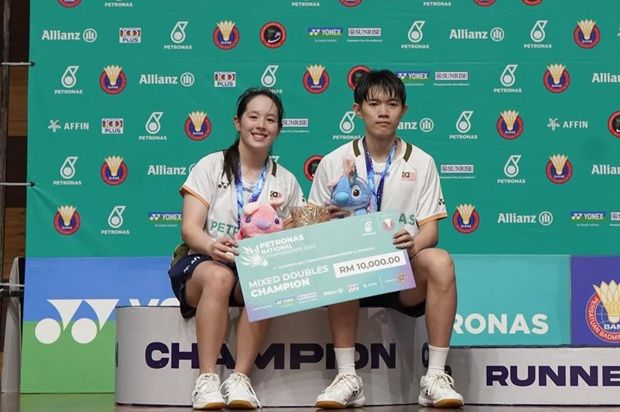
Clarissa San will contest the most significant tournament of her badminton career next week with a steady mantra from her new partner and coaching staff: remain composed and savour the experience. The 20-year-old Malaysian mixed doubles player has secured her spot in the Japan Open following a partnership reshuffle that pairs her with Chen Tang Jie, stepping in after original partner Toh Ee Wei suffered an anterior cruciate ligament injury that has sidelined her in Melbourne for rehabilitation.
The opportunity to compete at one of the BWF World Tour's marquee events represents a major career inflection point for the Selangor-born player. Clarissa has expressed her enthusiasm about the prospect of sharing the court with Tang Jie, whose experience and composure will prove invaluable as she navigates what many top junior players consider a formative moment in their development. Rather than viewing the pairing as a stopgap arrangement, she is approaching it as a genuine partnership with longevity, as the two are scheduled to compete together in at least three or four subsequent tournaments beyond the Japan Open.
Head coach Nova Widianto and Tang Jie have aligned their messaging to keep Clarissa grounded during what could otherwise become an overwhelming debut. The constant reinforcement from both figures—to quieten her doubts, maintain equilibrium, and find satisfaction in each match—reflects a deliberate psychological strategy designed to insulate emerging players from the crushing pressure that major tournaments often exert. Clarissa herself has absorbed this counsel, framing her approach around simple, achievable objectives rather than podium finishes or upset victories.
Her realistic temperament about the scale of the challenge ahead demonstrates maturity beyond her years. Rather than nursing ambitious dreams of deep tournament runs, Clarissa has identified a modest but meaningful target: translating the technical work she has refined during recent training blocks into actual match performance. This approach—focusing on process over outcome—often separates players who eventually flourish from those who buckle under the weight of expectations at critical junctures in their careers.
Clarity on her limitations has become an asset for Clarissa. She openly acknowledges significant gaps in her game that require attention, yet frames these not as insurmountable weaknesses but as areas for continuous improvement. This growth mindset, actively nurtured by Tang Jie's attentive mentorship, creates a productive environment where mistakes become teaching moments rather than confidence deflators. Tang Jie's role extends beyond technical partnership; he functions as both elder statesman and accessible guide, offering corrective feedback and reassurance in a way that alleviates the isolation new players often feel when competing at elevated levels.
The Tang Jie–Clarissa pairing opens their campaign against Taiwan's Yang Po-hsuan and Hu Ling-fang in the first round, a matchup that will provide immediate evidence of their synergy and tactical preparation. This particular opening assignment does not represent the tournament's most daunting draw, offering the partnership a realistic pathway to build confidence and rhythm early.
Malaysia's mixed doubles contingent will be broadly represented throughout the Japan Open draw. Jimmy Wong and Cheng Su Yin will confront Japan's Yuichi Shimogami and Sayaka Hobara in their opening fixture, while the independent pairing of Goh Soon Huat and Shevon Lai Jemie will take on Americans Chen Zhi Yi and Francesca Corbett. Perhaps facing the stiffest opening test are Wong Tien Ci and Lim Chiew Sien, who have drawn China's fifth-seeded combination of Guo Xinwa and Chen Fanghui—a matchup that carries serious implications for their tournament trajectory.
For Malaysian badminton, the emergence of capable mixed doubles pairings holds strategic importance. The discipline has become increasingly competitive at the world level, with Asian nations particularly dominant. Clarissa's integration into a more experienced pairing through Tang Jie provides a development pathway that could yield long-term returns if the partnership demonstrates durability and improvement. The injury to Toh Ee Wei, while unfortunate, has inadvertently created an opportunity for fresh combinations and extended court time for promising young players.
Tang Jie's willingness to assume a mentoring posture speaks to a culture of player development within Malaysian badminton circles. Rather than viewing newer talent as potential competition, established players increasingly recognise their role in elevating the overall quality of domestic partnerships. This collaborative approach, where experience flows downward and fresh perspectives flow upward, creates ecosystems where sustained excellence becomes achievable across multiple tournament cycles.

