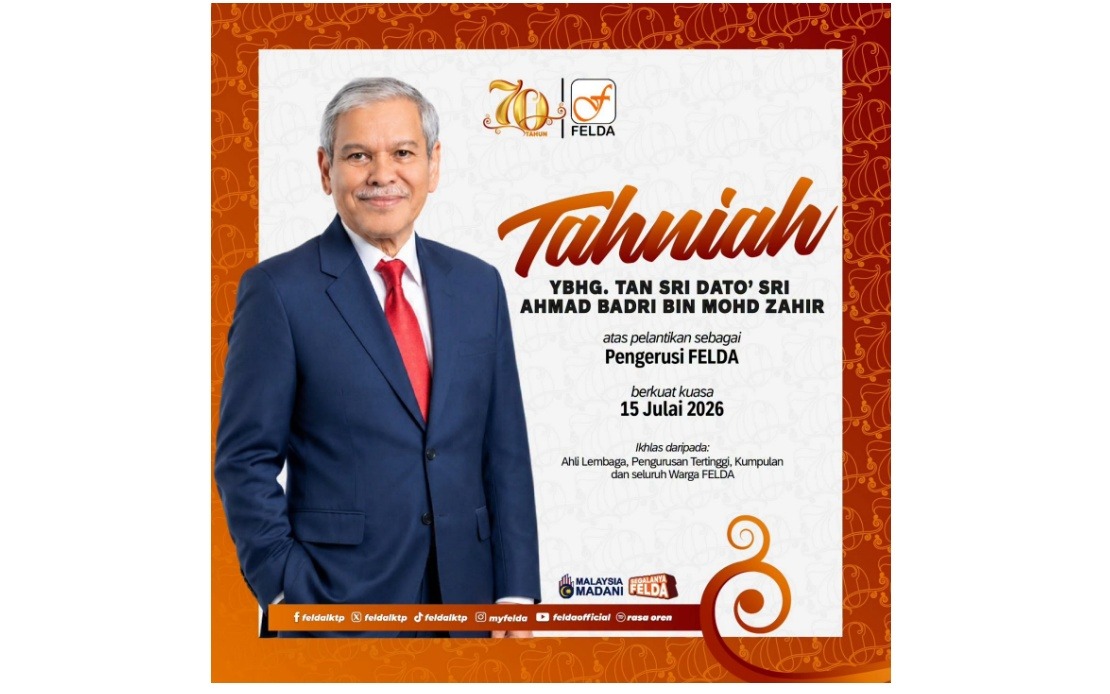
Tan Sri Ahmad Badri Mohd Zahir has been appointed as the new chairman of the Federal Land Development Authority (FELDA), marking a significant leadership transition for the organisation that serves over three million settlers across Malaysia. The appointment, announced on July 15, reflects government confidence in his track record of steering major institutions through periods of change and his demonstrated commitment to advancing the nation's economic interests.
The incoming chairman brings formidable credentials accumulated over more than three decades navigating both the public service and corporate sectors. His career trajectory began in 1989 when he joined the Ministry of Finance, a tenure that would see him progress through increasingly senior positions and ultimately reach the Treasury, where he served as Secretary-General from 2018 until 2020. This experience at the heart of Malaysia's fiscal machinery positions him well to understand the economic complexities facing an organisation as substantial and systemically important as FELDA.
Beyond his Treasury role, Ahmad Badri has accumulated extensive board experience across Malaysia's most significant institutions. He previously held the position of chairman at the Employees Provident Fund, the nation's largest retirement savings vehicle managing trillions in member assets, a role that demanded mastery of long-term wealth management and stakeholder stewardship. His presence on the boards of Bank Negara Malaysia, the central bank, as well as Permodalan Nasional Berhad and Tenaga Nasional Berhad underscores his standing among the country's financial and strategic elite.
Currently, Ahmad Badri maintains an active portfolio across multiple institutions. He chairs RHB Bank Bhd, one of Malaysia's major financial institutions, and heads the Malaysian Rubber Board, positioning him at the intersection of finance and commodity sectors vital to the regional economy. His concurrent membership on the Sime Darby Bhd board connects him to one of Southeast Asia's largest conglomerates, demonstrating ongoing relevance across diverse industries from plantation to manufacturing.
His educational background reflects international exposure combined with grounding in Malaysian institutions. Ahmad Badri holds an MBA from the University of Hull in the United Kingdom, providing formal exposure to Western business thinking and management methodologies, while his bachelor's degree in Estate Management from Universiti Teknologi MARA establishes foundational knowledge particularly relevant to FELDA's core business of land development and agricultural operations.
FELDA itself occupies a singular position in Malaysia's institutional landscape. Established as a poverty-alleviation mechanism in the post-independence era, the organisation has evolved into a complex entity managing vast land resources and serving a settler population that remains economically and socially significant. The appointment of Ahmad Badri signals the government's intention to deploy sophisticated financial and strategic management practices to address contemporary challenges facing the organisation, particularly in balancing settler welfare with commercial sustainability.
The official statement emphasising Ahmad Badri's expected contributions to governance and management excellence reflects the government's prioritisation of institutional modernisation. FELDA, like many statutory bodies established in earlier decades, faces the perennial tension between its social mission and commercial viability. Ahmad Badri's background in managing large, complex organisations with multiple stakeholder interests positions him to navigate these tensions strategically.
His appointment also carries implications for FELDA's transformation agenda alignment with broader Malaysian development goals. The reference in official statements to sustainable and inclusive development suggests the government's expectation that Ahmad Badri will reshape FELDA's operations to address contemporary environmental and social concerns while maintaining financial health. This reflects shifting priorities within Malaysian policymaking toward sustainability frameworks and inclusive growth models.
For the three million plus FELDA settlers, Ahmad Badri's stewardship will likely mean renewed focus on generating value and ensuring long-term prosperity within the settler community. His experience managing large pools of invested capital and navigating complex stakeholder environments suggests capacity to innovate around settler benefits while maintaining organisational solvency. The challenge will be translating his corporate and financial experience into tangible improvements for communities whose relationship with FELDA often reflects historical expectations and contemporary economic pressures.
The appointment also reflects broader patterns in Malaysian governance, where individuals with proven competence in managing large financial institutions and public bodies are rotated through senior positions across government-linked companies and statutory authorities. This practice creates networks of experienced administrators capable of deploying consistent management philosophies across the institutional landscape, though it sometimes faces criticism regarding board representation and fresh perspectives.
Looking forward, Ahmad Badri's early months will likely focus on understanding FELDA's operational realities, engaging with settler representatives, and articulating a vision for the organisation's evolution. His success will be measured not merely by financial metrics but by his ability to strengthen settler economic outcomes, improve governance transparency, and position FELDA as a competitive force in Malaysian agriculture and land-based sectors facing regional and global pressures. The appointment reflects institutional commitment to combining experienced stewardship with transformational ambition.

