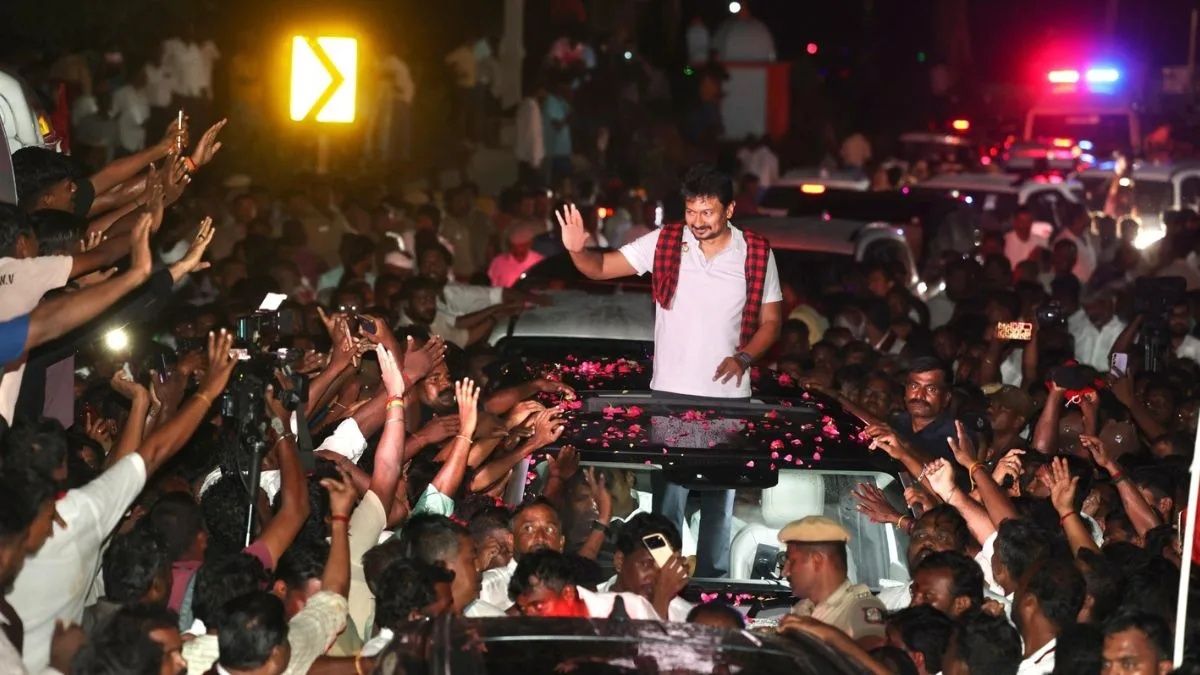
Udhayanidhi Stalin, the Leader of Opposition in Tamil Nadu, walked free on station bail late Tuesday evening after spending several hours under police interrogation. The former deputy chief minister's release came in connection with remarks he made during a recent public gathering that have ignited a fierce political dispute in the southern state. Hundreds of DMK party workers assembled outside Sengipatti police station to greet him, their presence underscoring the intense polarisation the incident has triggered across Tamil Nadu's political landscape.
The controversy centres on comments Stalin made during a DMK protest held in Thanjavur district. While addressing supporters regarding water-sharing disputes with Karnataka and the neighbouring state's proposed Mekedatu dam project on the Cauvery River, someone in the crowd shouted the name of Trisha, a prominent Tamil cinema actress who is widely perceived to have close ties with Chief Minister Vijay. In response, Stalin paused, smiled, and remarked, "Wherever water comes, whether it comes or not, water should come there." The statement's ambiguous phrasing prompted allegations that it carried double meanings perceived as sexually suggestive, transforming what Stalin characterised as commentary on agricultural concerns into a flashpoint for political accusation.
The ruling TVK party lodged a formal complaint with the police, contending that Stalin's words amounted to verbal harassment and the objectification of a woman. The party further escalated the matter by approaching the National Commission for Women with a separate petition. Police subsequently arrested Stalin at his residence in Chennai, initiating the interrogation process that extended throughout the day.
In a statement delivered at a press conference following his release, Stalin vehemently rejected characterisations of his remarks as disrespectful toward women or carrying malicious undertones. He positioned his arrest as a deliberate distraction tactic deployed by the ruling administration to divert public attention from substantive governance issues. Stalin emphasised that his original intention was exclusively focused on advocating for farmer welfare and water security, not on making innuendos of any nature. He repeatedly denied that his words contained double meanings, asserting that his statement possessed a singular, straightforward interpretation unrelated to the allegations levelled against him.
Staling's defence highlighted what he characterised as the arbitrary nature of the ruling government's approach to opposition figures. He contended that whenever DMK legislators face scrutiny from the TVK administration, arrests frequently follow, suggesting a pattern of political persecution rather than pursuit of genuine public grievance. His comments reflect the intense acrimony that has developed between the DMK and TVK since the latter's electoral triumph, which brought Vijay to the chief minister's office and fundamentally altered Tamil Nadu's political dynamics.
The incident underscores growing tensions within Tamil Nadu's political ecosystem, where personal reputation and public conduct have become weaponised in inter-party rivalry. For Malaysian observers, the case demonstrates how regional Indian politics increasingly mirrors global patterns where statements made in public forums undergo intense scrutiny for potential unintended meanings, and where opposition figures face potential legal jeopardy from interpretations of their remarks that they contest. The mobilisation of state institutions, including police and quasi-judicial bodies like the National Commission for Women, reveals how accusations of impropriety—particularly those involving gender—can rapidly escalate into serious legal confrontations.
The Cauvery water dispute remains a persistently contentious issue in South Indian politics, with Tamil Nadu and Karnataka locked in longstanding disagreement over equitable resource distribution. Karnataka's proposed Mekedatu project represents a lightning rod for Tamil Nadu's political establishment, as any construction that might reduce water flow to the agriculturally dependent state triggers alarm among political leaders who fear agricultural output and rural livelihoods would suffer. Stalin's invocation of this issue during his Thanjavur address reflected genuine concerns among Tamil Nadu's farming communities, yet the controversy surrounding his phrasing has overshadowed substantive discussion of water security challenges.
The timing of this incident occurs amid broader realignment within Tamil Nadu's political landscape following Vijay's emergence as a significant political force. Previously dominated by the DMK and AIADMK, Tamil Nadu's political field has become increasingly competitive and volatile. Vijay's TVK party, having secured electoral success, now competes directly with the DMK for political dominance. The intensity with which both parties now engage suggests that personal conduct, rhetorical choices, and potential misstatements will continue serving as ammunition in electoral and legislative contests.
For Southeast Asian observers monitoring Indian political developments, the Stalin case illustrates how accusations regarding respect for women, while addressing genuine societal concerns in many contexts, can become entangled with partisan political calculations. The apparent ease with which authorities responded to the TVK's complaint, coupled with the intervention of a national-level women's commission, demonstrates how political majorities at state level can mobilise institutional mechanisms to pressure opposition figures. Such dynamics carry implications for broader questions regarding institutional independence and equal application of legal frameworks across political divides.
Staling's release on station bail rather than formal arrest represents a procedural distinction that suggests police may have found insufficient evidence to proceed with formal charges. Nevertheless, the investigation remains ongoing, and the case could develop further as authorities continue examining whether Stalin's remarks violated any specific legal provisions. The political temperature in Tamil Nadu will likely remain elevated as this case proceeds, with both the DMK and TVK using the controversy to mobilise their respective support bases and frame narratives around governance, respect, and political ethics.

