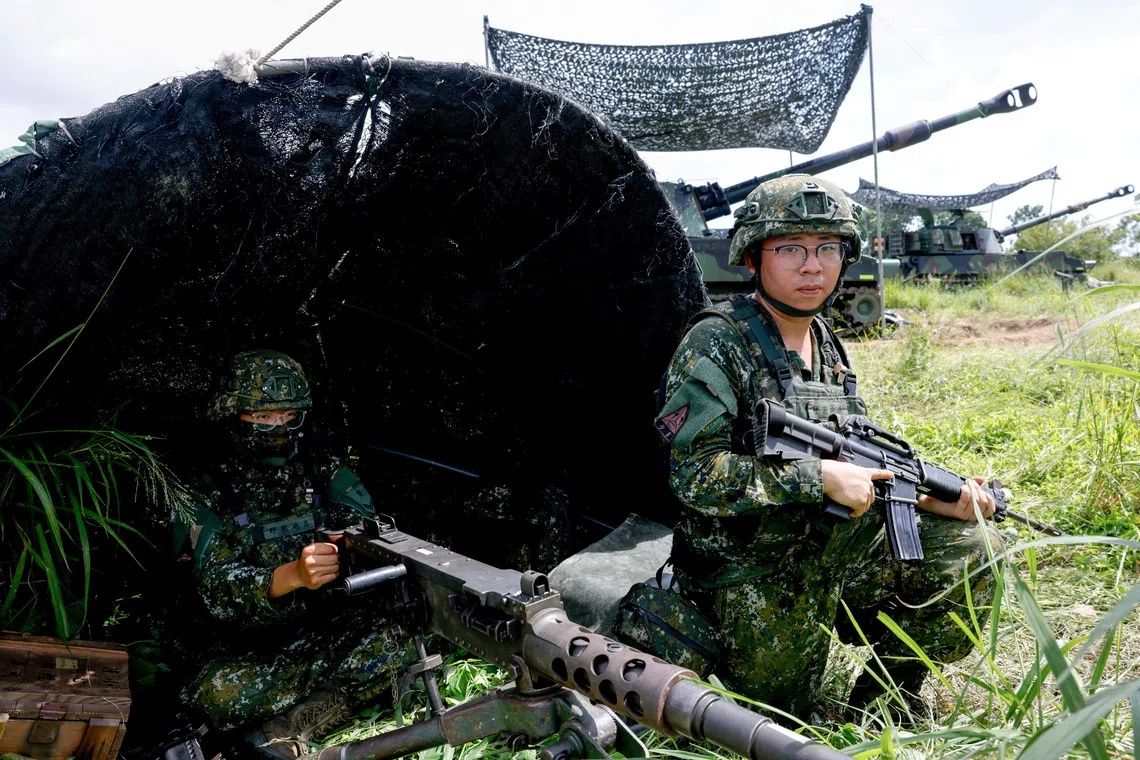
Taiwan has commenced its most comprehensive military exercise in years, with officials implementing measures designed to simulate authentic wartime conditions more closely than ever before. The Han Kuang drill, which began on Wednesday and will run for ten days until August 14, represents a significant evolution in how the island nation prepares its armed forces and civilian population for potential conflict. The scale of involvement is substantial, with over 20,000 troops mobilised, including approximately 5,000 reservists drawn from the civilian population. This expansion of personnel reflects Taiwan's strategy to ensure that resilience and readiness extend beyond the professional military into the broader defence infrastructure.
Among the most striking innovations introduced this year is the deliberate throttling of mobile internet speeds across the island for the first time. Rather than disrupting communications entirely, the authorities are simulating the bandwidth constraints that would characterise a genuine attack scenario, allowing both military and civilian populations to practise functioning under degraded connectivity. This approach acknowledges a crucial vulnerability in modern warfare: the dependence on digital networks for coordination, information dissemination, and civilian morale. By subjecting the population to controlled conditions rather than theoretical exercises, planners hope to identify gaps in contingency planning and build institutional muscle memory for crisis response.
The exercise originates from an order issued by an underground command centre located in Taipei, a facility designed to remain functional even during direct attacks on conventional military headquarters. This centralised direction then cascades into distributed combat readiness measures, including the dispersal of fighter jets to alternative airfields and the deployment of naval assets to new positions. Such movements test not only the mechanical aspects of military reorganisation but also the communication pathways and decision-making chains that connect strategic command with tactical units in the field. The exercise thus serves as both a rehearsal and an evaluation mechanism for the complex interplay between centralised direction and decentralised execution.
A critical addition to this year's drills is the adoption of a "backbrief" methodology borrowed from United States military doctrine. Under this system, junior officers receiving orders restate the mission details and their understanding of the commander's intent back to their superiors before execution begins. This practice, seemingly simple on the surface, addresses a fundamental vulnerability in military organisations: the gap between what commanders intend to communicate and what subordinates understand. By building in this confirmation loop, Taiwan aims to reduce the fog of war that naturally emerges during crisis situations, ensuring that operational intent cascades accurately through multiple levels of command even as circumstances evolve unpredictably.
The substantive focus of the exercise reflects Taiwan's assessment of the most plausible threat vectors in a potential conflict with China. Rather than emphasising large-scale pitched battles between equivalent forces, the drills concentrate on scenarios in which China attempts to achieve strategic objectives through rapid strikes against critical infrastructure. Command centres, ports, logistics hubs, and defence manufacturing facilities represent the nervous system and arteries of Taiwan's wartime economy and military response capability. An adversary seeking to achieve capitulation without prolonged conflict would logically target these nodes early, hoping to create chaos, disrupt coordination, and degrade the island's capacity to sustain resistance. Taiwan's exercise design therefore treats the protection and functional redundancy of these systems as paramount.
The inclusion of civilian factory mobilisation within the drill scenario underscores an important strategic calculation: Taiwan cannot prevail through military means alone if its economy becomes non-functional. The integration of civilian manufacturing capacity into wartime planning represents an extension of total-war thinking, acknowledging that modern conflicts require the sustained productive output of the entire society. By conducting drills that exercise the mechanisms for commandeering civilian industrial capacity and redirecting it toward military production, Taiwan practises the kind of whole-of-society mobilisation that would be necessary in any prolonged conflict scenario. This reflects lessons learned from historical conflicts where industrial capacity ultimately determined endurance.
Naval escort drills conducted off Taiwan's Pacific coast address a distinct strategic concern: the vulnerability of supply lines connecting the island to its allies, particularly the United States and other democratic partners in the region. Should China succeed in threatening sea lanes to the east and north, Taiwan would face strangulation despite possessing adequate defensive capabilities. These escort exercises practise the maritime coordination and force protection measures that would be essential to maintaining critical supply flows. The focus on Pacific-side operations also reflects geographic realities; Taiwan's supply line to the west faces the entire breadth of the Taiwan Strait and China's overwhelming naval superiority, whereas eastward routes benefit from greater distance and the protection of the wider Pacific.
Defence officials acknowledge that previous iterations of the Han Kuang exercise, which has run annually since 1984, have sometimes fallen short of genuine realism. The characterisation of past drills as "laboratory-like exercises in a vacuum" suggests that ritualistic elements and predetermined outcomes had sometimes superseded the imperative to test actual capabilities against genuine uncertainty. This year's emphasis on "unexpected scenarios" and field commanders forced to improvise when conditions defy initial planning represents a deliberate correction of that trajectory. By injecting genuine unpredictability into the exercise parameters, planners aim to expose weaknesses that would remain hidden in more controlled settings and to build the psychological and institutional capacity for adaptation.
The introduction of an "embedded reporter" mechanism within the exercise structure reflects understanding that modern conflicts are simultaneously information wars. By practising how to manage frontline communications, shape narratives, and counter disinformation during the stress of actual military operations, Taiwan acknowledges that the battle for international and domestic legitimacy runs parallel to kinetic operations. This mechanism also serves to train both military personnel and civilian journalists in the specific protocols and constraints that would govern information release during wartime, reducing the likelihood of inadvertent disclosure of sensitive operational details.
The broader context for these military preparations is the sustained intensification of Chinese military activities around Taiwan. The People's Liberation Army has conducted increasingly frequent and assertive exercises in the waters and airspace surrounding the island, demonstrating capabilities while simultaneously signalling resolve and intent. Taiwan's response through enhanced readiness exercises reflects not an escalatory posture but rather a calculated effort to raise the cost and risk of any military adventure while simultaneously improving the genuine capacity to defend itself. The defence establishment's framing of these drills as part of a series of "toughening exercises" suggests a multi-year program aimed at progressive improvement rather than a panic response to imminent threat.
For Malaysia and other Southeast Asian nations observing these developments, Taiwan's military preparations carry significant implications. The region's stability and economic prosperity depend substantially on freedom of navigation through critical sea lanes and the maintenance of the current strategic balance that has underwritten decades of economic growth. Any military conflict in the Taiwan Strait would have cascading consequences throughout Southeast Asia, affecting supply chains, investment flows, and regional security architecture. Taiwan's demonstrated commitment to credible self-defence thus represents a stabilising factor, as it increases the costs of any potential aggression and reinforces deterrence.
The evolution of Taiwan's exercise regime also demonstrates how smaller nations facing asymmetric threats can leverage technological sophistication, strategic thinking, and whole-of-society mobilisation to compensate for numerical disadvantages. The emphasis on coordination, realistic scenarios, and civilian integration offers lessons applicable to other nations in the region confronting their own security challenges. As Taiwan moves from theoretical planning to increasingly realistic field conditions, it implicitly challenges the notion that military preparedness requires either matching an adversary's scale or accepting vulnerability. Instead, it suggests that thorough preparation, realistic training, and institutional resilience can significantly alter the calculus of potential conflict.

