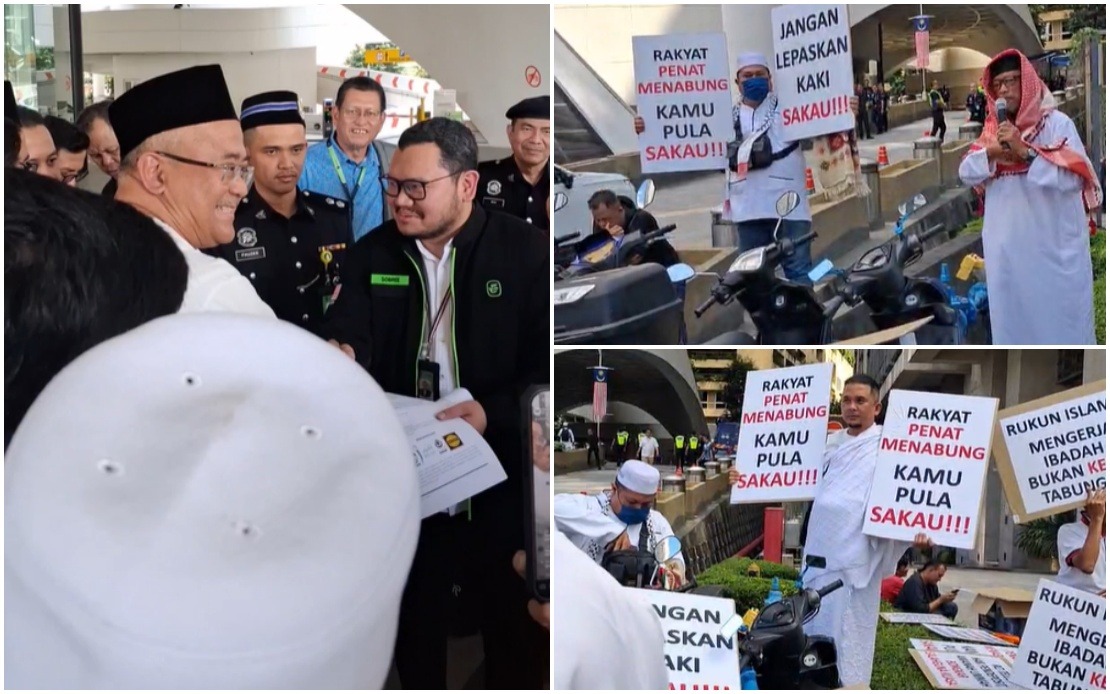
The leadership of Malaysia's Islamic civil society movement has issued a forceful call for the investigations stemming from the Royal Commission of Inquiry into Lembaga Tabung Haji to proceed along strictly legal lines, insulated from political considerations. Speaking at a gathering in Kuala Lumpur on Wednesday, Amir Zuhair Abdull Khalid, chairman of Daie MADANI, emphasised that the proper authorities must be allowed to conduct their work without hindrance. The RCI's examination of TH operations during the 2014-2020 period unearthed serious governance failures that now demand rigorous legal scrutiny, he argued.
The Tabung Haji case has become a flashpoint in Malaysian public life because of the sums involved and the identity of those affected. The hajj savings body manages contributions from millions of Muslim Malaysians preparing for their pilgrimage to Mecca, making it an institution of profound spiritual and financial significance. When governance lapses occur within such an entity, the breach of trust resonates far beyond ordinary corporate misconduct—it strikes at the heart of how religious institutions steward community resources. This dimension explains why Amir Zuhair framed the matter as transcending conventional political debate and touching instead on the foundational integrity of Malaysia's Islamic institutions.
The RCI's conclusions included allegations of political meddling in the selection of board members and broader interference in TH's governance structures during the period under review. These findings carry substantial implications for how Malaysia's public institutions are managed and accountable. The commission's work, spanning several years and examining voluminous documentation, pointed to systemic vulnerabilities that allowed political actors to exert improper influence over an organisation that should have operated at arm's length from partisan considerations. Such structural weaknesses, if unaddressed, create pathways for mismanagement that can recur under different political administrations.
Amir Zuhair's intervention reflects growing concern within the Islamic civil society sector that the investigation process could become entangled in Malaysia's fractious political environment. He made an explicit appeal to the government and all relevant authorities: allow the Malaysian Anti-Corruption Commission and the court system to function without pressure or interference. By invoking the Prime Minister's authority on this matter, he sought to anchor the process in the government's commitment to institutional integrity. The call for non-interference is particularly significant because it acknowledges the risk that powerful figures implicated in the RCI findings might attempt to shield themselves through political channels or personal connections.
The question of guilt and innocence, Amir Zuhair emphasised, cannot be resolved through public disputation or political manoeuvring. Only the courts possess the institutional legitimacy to make binding determinations about whether individuals bear responsibility for governance failures. This reflects a broader principle of the rule of law that Malaysian democracy depends upon—that accusations, however well-founded in fact-finding processes, must pass through adversarial proceedings where the accused can mount a defence and judges can weigh evidence according to established legal standards. Predetermining guilt outside the courts, even on the basis of commission findings, would undermine this fundamental process.
Multiple Islamic organisations coordinated their advocacy around the TH RCI matter, submitting a ten-point set of demands through the Malaysian Islamic Movement Coalition (HIKAM) and its partner organisations. The coalition encompasses WADAH, IKRAM, HALUAN, and ABIM—representing a significant swathe of Malaysian Islamic civil society and grassroots activism. Their unified position carried weight precisely because these organisations represent constituencies of ordinary Muslims whose savings are at stake. When such bodies speak, they articulate not merely elite opinion but the sentiments of millions of depositors and their families. The government cannot dismiss such expressions as narrow political gestures.
Those demands extended well beyond calling for investigations. The coalition insisted on immediate legal action against culprable parties, the recovery of losses and misappropriated assets, implementation of the RCI's recommendations regarding governance reform, and sustained institutional change under the current MADANI administration. Together, these elements constitute a comprehensive accountability framework—investigation, prosecution, restitution, and systemic reform. The breadth of these demands reflects an understanding that investigating past misconduct serves little purpose unless it generates concrete improvements in how TH operates going forward. Malaysians have observed enough institutional scandals to understand that without binding reforms, vulnerable institutions can slide back into old patterns.
The timing of these calls holds significance for Malaysia's ongoing effort to rebuild institutional credibility after years of high-profile corruption cases and governance failures under previous administrations. The current government explicitly positioned itself as committed to anti-corruption and institutional reform when it took office. The TH RCI investigation provides a test case of whether these commitments translate into action or remain rhetorical. Should the process become mired in political delay, selective prosecutions, or unexplained decisions to drop cases, it would send a devastating signal that the anti-corruption agenda lacks genuine substance. Conversely, demonstrating that independent institutions can investigate, prosecute, and reform with political neutrality would strengthen public confidence in Malaysia's governance trajectory.
For Malaysian Muslims specifically, the TH matter carries additional weight because the institution occupies a unique space between religious and state functions. The hajj itself represents one of Islam's five pillars, and Tabung Haji facilitates this religious obligation for ordinary Malaysians of limited means. When state-managed religious institutions fail in their stewardship, it creates a complex blend of institutional and spiritual crisis. This explains why religious organisations mobilised around the RCI findings—not purely as a political act, but as a defence of religious community interests. The hajj savings entrusted to TH represent not merely financial assets but expressions of religious commitment, making any breach of that trust a matter of genuine community concern.
The broader Southeast Asian context also matters here. Malaysia's approach to investigating the TH case and implementing accountability will serve as a regional barometer of whether institutions in the area can effectively combat corruption and hold power-holders accountable. Neighbouring countries facing similar governance challenges look to Malaysia's experiences as potential models—for better or worse. If the TH investigation succeeds in delivering transparent processes and appropriate legal consequences, it strengthens the case for institutional integrity across the region. Conversely, if political considerations derail accountability, it reinforces cynicism about whether Southeast Asian institutions can genuinely check the abuse of power.
Moving forward, the MACC and prosecutorial authorities face the technical challenge of converting RCI findings into courtroom evidence capable of withstanding legal challenge. This process typically involves meticulous investigation, witness interviews, document analysis, and legal strategy—work that proceeds at its own pace rather than according to political timelines. Public impatience must be balanced against the reality that building airtight cases requires time and professional care. The appeal from civil society leaders and the government should therefore include patient commitment to this process even as it maintains pressure for action. Proper investigations cannot be rushed without risking conviction reversals or mistrial outcomes that would ultimately serve no one's interests.
The underlying principle animating calls from Islamic civil society—that institutions must operate free from political interference—extends far beyond Tabung Haji. It encompasses the entire architecture of Malaysian governance and the challenge of building a state where rule of law genuinely constrains even the most powerful actors. Malaysia has the institutional mechanisms to achieve this outcome: independent investigative agencies, courts with substantial professional autonomy, and now a civil society vocal enough to demand accountability. Whether those institutions will function as intended remains the central test facing Malaysia's democratic project.

