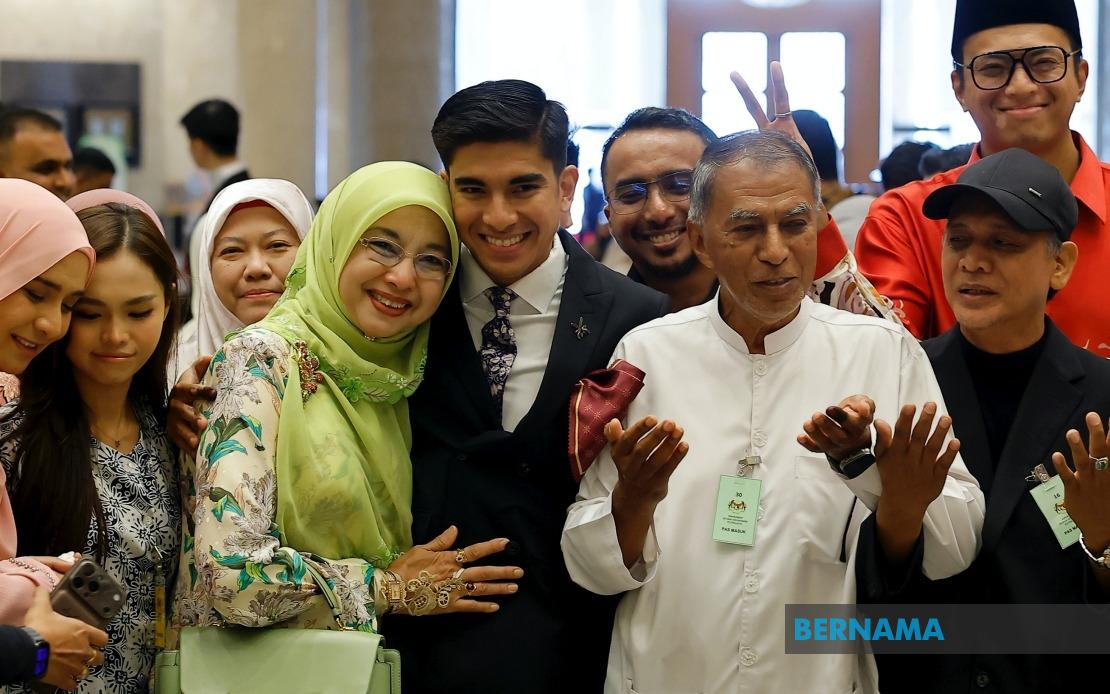
Muar Member of Parliament Syed Saddiq Syed Abdul Rahman emerged victorious from the Federal Court today after a gruelling six-year legal battle, expressing profound gratitude that his faith in Malaysia's justice system had ultimately been vindicated. The 33-year-old politician, who performed a sujud syukur—a prostration of gratitude—alongside his family immediately following the court's pronouncement, was cleared of all four charges relating to criminal breach of trust, misappropriation of property, and money laundering. The accusations had centred on funds belonging to Angkatan Bersatu Anak Muda, the youth movement commonly known as Armada.
At a packed press conference in the Palace of Justice lobby in Putrajaya, Syed Saddiq reflected on the profound personal and political toll that nearly half a decade of legal proceedings had exacted on himself and those closest to him. He characterised the ordeal as a pivotal moment that had crystallised his convictions about the Malaysian judicial system, which he described as fundamental to the nation's institutional resilience. The former youth and sports minister conveyed his unwavering belief that principled individuals who maintain their integrity through adversity will ultimately be vindicated, framing the court's decision as affirmation of this philosophy rather than merely personal exoneration.
Syed Saddiq emphasised that the protracted legal process had fundamentally shaped his political consciousness and deepened his understanding of institutional independence. He articulated a sophisticated vision of Malaysia's strength as being rooted not merely in economic indicators or military capability, but in the integrity and autonomy of judicial institutions that guarantee fair redress for all citizens regardless of status or political affiliation. This framing suggests the politician views his acquittal through a broader constitutional lens, positioning the decision as reinforcing democratic norms beyond his individual circumstances.
The significance of the Federal Court's decision cannot be understated within the Malaysian political context. Syed Saddiq's legal travails occurred during a period of considerable political turbulence in Malaysia, with questions repeatedly raised about whether legal proceedings were being wielded as political weapons. His eventual acquittal on all charges provides some measure of reassurance that institutional checks and balances can function even in contested political environments, though the six-year duration of the case raises questions about the efficiency of Malaysia's appellate system.
In his remarks to journalists, Syed Saddiq counselled perseverance in the face of overwhelming circumstances, suggesting that citizens should never abandon principles or compromise integrity even when resolution seems impossibly distant. His language carried echoes of broader struggles for institutional credibility within Malaysian governance, extending beyond the specific context of his own case. He called explicitly for sustained commitment to defending the independence of Malaysia's judicial institutions, framing this as central to the nation's future stability and prosperity.
However, Syed Saddiq announced an intention to temporarily step back from frontline political activities to reconstruct his personal life and allow his family to recover from the prolonged emotional strain of the legal proceedings. This decision reflects the genuine human cost of extended litigation, particularly when it intersects with political prominence. The politician indicated he would remain an MP for Muar and attend parliamentary sittings, but signalled that substantive political strategising and leadership activities would be deferred pending personal consolidation. He also disclosed that his parents had granted approval for him to proceed with wedding plans, suggesting the family unit is ready to transition from a defensive posture to normalcy.
Syed Saddiq's continued affiliation with MUDA, the political party he founded, remains technically intact, though his statement about taking time away from politics introduces ambiguity about his future trajectory within that movement. This development carries implications for Malaysian opposition politics more broadly, as Syed Saddiq had positioned himself as a representative of younger, reform-minded voices within the political landscape. His partial withdrawal, even if temporary, represents a loss of momentum for generational change narratives that had animated MUDA's emergence.
Hisyam Teh Poh Teik, counsel for Syed Saddiq, expressed gratitude toward the judicial panel and acknowledged the trust placed in his legal team throughout the proceedings. The defence team's extended commitment to the case, which consumed six years of intensive legal work, underscores the resource-intensive nature of criminal appeals in Malaysia's court system. The composition and competence of Syed Saddiq's legal representation almost certainly influenced the trajectory of his case, raising questions about whether access to elite legal counsel represents a critical determinant of acquittal outcomes in Malaysia's justice system.
The prosecution, through Deputy Public Prosecutor Datuk Wan Shaharuddin Wan Ladin, acknowledged the court's decision with apparent acceptance, though the DPP left open the possibility of filing a review application pending guidance from the Attorney General. This measured response avoids the perception of defiance toward judicial determinations, yet the potential for appellate challenges from the prosecution side remains theoretically possible, introducing lingering uncertainty despite today's acquittal. The prosecution's cautious statement suggests internal deliberation continues regarding whether to prolong the case further or accept the Federal Court's judgment as final.
The broader implications of Syed Saddiq's acquittal extend beyond individual vindication to encompass questions about political accountability, institutional credibility, and the trajectory of Malaysia's governance. The case had become emblematic of post-2018 Malaysia's political volatility, when transitions in government power and shifting factional alignments created environments where legal proceedings could be perceived as extensions of political competition. That a figure of Syed Saddiq's prominence and visibility ultimately secured complete acquittal suggests, at minimum, that Malaysian courts retain capacity to deliver decisions perceived as independent of executive pressure or factional interests, though the extended timeline raises legitimate concerns about procedural efficiency.
For Malaysian and Southeast Asian observers, Syed Saddiq's case illuminates both the strengths and vulnerabilities of Malaysia's judicial institutions. The ultimate acquittal demonstrates that credible appellate review remains possible; conversely, the six-year duration underscores persistent challenges in case management and expeditious justice delivery. These structural issues transcend Syed Saddiq's particular circumstances and point toward systemic reforms that multiple governments and legal professional bodies have identified as necessary for institutional modernisation.

