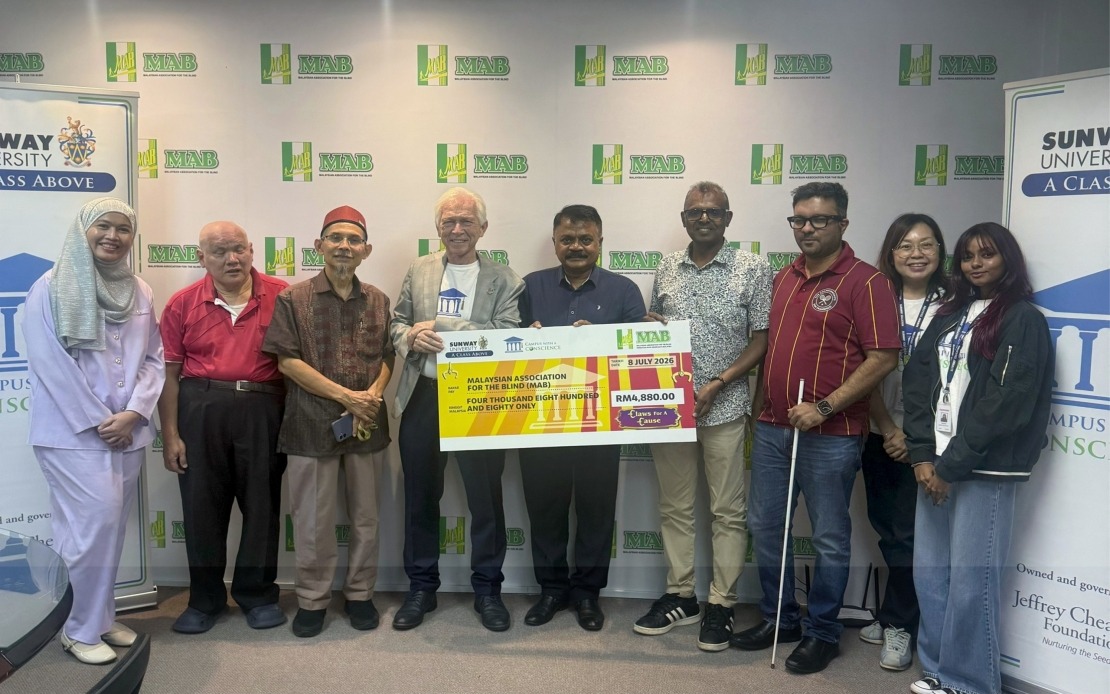
Sunway University has successfully mobilised its student and staff community to contribute RM4,880 towards the Malaysian Association for the Blind, leveraging an innovative fundraising concept that transformed a common arcade game into a vehicle for social impact. The "Claws For A Cause" initiative, which ran as a week-long event on the university's Kuala Lumpur campus, represents a growing trend of Malaysian educational institutions channelling campus activities toward meaningful charitable outcomes.
Delivered under the umbrella of Sunway University's established Campus With A Conscience programme, the fundraiser centred on a claw machine game that was converted into an interactive donation activity. Throughout the week, members of the university community—both students and administrative staff—participated in the game, with proceeds directed entirely to support MAB's mission of assisting individuals living with visual impairments. The simplicity of the concept proved instrumental in its success, as the familiar game format encouraged broad participation across diverse age groups and departments within the institution.
The collaboration with entertainment company Space Panda underscores a strategic approach to community fundraising that has gained traction across Southeast Asia. Rather than relying solely on traditional donation mechanisms, institutions increasingly seek to embed charitable giving within experiential and entertainment-driven activities that naturally encourage participation. This partnership model transforms what might otherwise be a routine corporate social responsibility obligation into an engaging social event that builds institutional culture while advancing charitable objectives.
Professor Sibrandes Poppema, the university's President and Vice-Chancellor, contextualised the initiative within the institution's broader mission statement, emphasising that Sunway University's mandate extends considerably beyond delivering academic programmes to encompassing community development and social welfare. His remarks reflected a philosophical positioning increasingly common among Malaysian universities, particularly those operating within the private education sector, which seek to differentiate themselves through demonstrable commitment to societal benefit alongside educational delivery.
The emphasis on collective action evident in Poppema's statement carries particular resonance in the Malaysian context, where institutional fundraising campaigns have historically struggled to mobilise sustained community participation. By designing an activity that required minimal monetary outlay from individual participants—each person simply played a game—the initiative removed financial barriers that might otherwise discourage involvement. This democratisation of charitable giving potentially extends support beyond those with disposable income, creating more inclusive engagement mechanisms.
Space Panda's participation as a corporate partner highlights the commercial sector's increasing willingness to align business activities with social causes, particularly those affecting vulnerable populations. The company's decision to support an organisation dedicated to individuals with visual impairments demonstrates sector-specific recognition of particular social needs. Within Malaysia's evolving corporate social responsibility landscape, such targeted partnerships allow businesses to build brand equity while addressing genuine community requirements rather than distributing charitable resources indiscriminately across numerous organisations.
The Malaysian Association for the Blind, as the beneficiary organisation, serves a population facing distinct challenges within Malaysia's social infrastructure. Despite national development progress, individuals with visual impairments continue navigating significant barriers related to accessibility, employment, education, and social integration. Resources directed toward MAB directly support advocacy work, rehabilitative services, educational programmes, and community awareness initiatives that remain chronically underfunded relative to demonstrated need. The RM4,880 raised, while modest in absolute terms, reflects hours of community engagement and represents tangible recognition of this population's requirements.
The broader significance of this initiative lies in its demonstration of how academia and industry can productively collaborate to advance social objectives without requiring substantial financial commitment from either institutional partner. Sunway University provided venue and organisational infrastructure; Space Panda contributed equipment and expertise; participants delivered both the entertainment value and the financial contribution. This distributed model of responsibility offers potential scalability for other Malaysian institutions seeking to expand their community engagement impact without proportionally increasing budgetary allocation to charitable activities.
From a Southeast Asian perspective, the initiative reflects regional trends toward institutionalising corporate-academic partnerships as mechanisms for social development. Countries across the region increasingly encourage such collaboration through tax incentives, regulatory frameworks, and public recognition programmes. Malaysia's position as an education hub and business centre positions it well to develop such models further, potentially establishing templates that other ASEAN nations might adapt. Universities operating within competitive regional markets benefit from demonstrating tangible social impact, particularly when such impact extends beyond their immediate campuses into broader community contexts.
The event also carries implications for disability advocacy and social inclusion discourse within Malaysian higher education. By elevating the Malaysian Association for the Blind's profile among a university community, and by framing visual impairment support as an appropriate focus for institutional charitable engagement, the initiative normalises disability-related causes within campus discourse. This cultural shift, replicated across multiple institutions, gradually constructs broader societal awareness of disability-related challenges and reframes support for affected populations as ordinary institutional responsibility rather than exceptional philanthropy.
Looking forward, the success of "Claws For A Cause" suggests potential for replication and adaptation across other Malaysian universities seeking engagement mechanisms that generate both social impact and campus community participation. The model's transferability—requiring minimal specialised expertise or resource commitment—positions it as accessible even for smaller institutions with constrained fundraising budgets. Should multiple universities adopt similar initiatives across different charitable causes, the cumulative social impact could significantly enhance Malaysia's institutional response to community needs that currently rely heavily on government provision and established non-governmental organisations.

