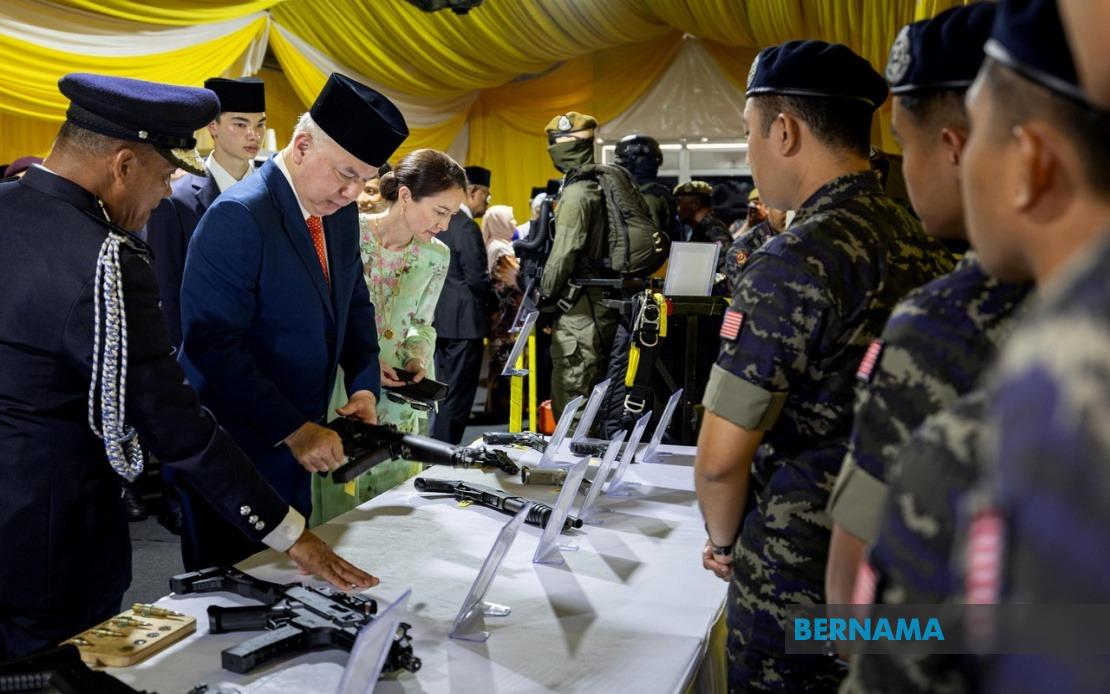
Sultan Nazrin Shah, the ruler of Perak, presided over the official opening of the Sultan Nazrin Shah 69 Commando Camp in Ulu Kinta on July 7, an occasion that brought together members of the royal family and senior government officials. The ceremony underscored the monarchy's continued role in affirming significant national infrastructure projects, with the Raja Permaisuri of Perak, Tuanku Zara Salim, alongside Raja Muda Raja Jaafar Raja Muda Musa and Raja DiHilir Raja Iskandar Dzurkarnain Sultan Idris Shah, gracing the event with their presence. The gathering also included Perak's chief minister and key federal security apparatus representatives, reflecting the importance attached to the inauguration at both state and national levels.
Home Minister Datuk Seri Saifuddin Nasution Ismail used the occasion to articulate the government's broader strategic vision for Malaysia's security infrastructure. He characterised the new facility not merely as a physical structure but as a tangible manifestation of the administration's dedication to equipping the nation's defence and law enforcement agencies with contemporary capabilities. The minister's remarks positioned the camp within the MADANI Government's governance framework, suggesting that investments in security infrastructure form a cornerstone of its policy platform. This framing carries particular significance in a regional context where Southeast Asian nations are intensifying their security posture amid evolving transnational threats.
Malaysia's international standing in security matters featured prominently in the minister's address. Saifuddin Nasution highlighted the country's ranking of 12th out of 163 nations in the most recent Global Peace Index, positioning this achievement as a source of national pride and validation of the security forces' effectiveness. The metric serves as a barometer of Malaysia's stability in a region where several neighbours face more pronounced security challenges. For Malaysian readers, this ranking underscores how the country's relative peace and stability translate into tangible socioeconomic benefits, from investor confidence to tourism prospects.
The 69 Commando unit's operational history formed a critical dimension of the ministerial narrative. Established in 1969, the unit has accumulated an extensive portfolio of deployments spanning five decades. Its involvement in suppressing the communist insurgency positioned it as a foundational force in Malaysia's post-independence security narrative. More recent operations, including the Al-Maunah incident in 2000, Operation Daulat in Lahad Datu, Sabah in 2013, and involvement in the international search operations following the MH17 tragedy in 2014, demonstrate the unit's evolution into a multi-purpose special operations force. Each operation represents a chapter in Malaysia's contemporary security challenges, from internal insurgency threats to transnational incidents with global implications.
The scale of investment in the new facility reflects governmental prioritisation of elite unit capabilities. Constructed at a cost exceeding RM206 million across a 338-hectare expanse in Ulu Kinta, the camp represents a substantial capital allocation to security infrastructure. The financial commitment signals confidence in the unit's strategic importance and anticipated operational demands over coming decades. For a country balancing development spending across multiple sectors, such an investment demonstrates the government's assessment that specialised security capabilities constitute an essential element of national infrastructure, comparable in priority to major transport or energy projects.
The development timeline reveals the meticulous planning undergone before the facility's completion. Designed to harmonise operational imperatives with modern facilities standards, the camp underwent extensive preparation before being transferred to the Royal Malaysia Police in 2024 as a fully functional complex for operations, training and administration. This transition to police control rather than remaining under military jurisdiction reflects Malaysia's constitutional framework and the evolving institutional arrangements governing elite security units. The timing also suggests the project's long gestation period, indicating how complex infrastructure initiatives navigate planning, funding and construction cycles.
Minister Saifuddin Nasution characterised the camp as a generational investment, one intended to amplify the 69 Commando's operational capabilities well into the future. His language emphasised the facility's role in nurturing successive cohorts of personnel who will inherit and advance the unit's operational traditions. This succession planning dimension proves especially relevant given the specialised expertise required for commando operations and the institutional knowledge embedded in elite units. The camp thus functions as both a physical asset and a mechanism for preserving and transmitting institutional capability across generations of personnel.
The symbolic weight attached to naming the facility after Sultan Nazrin Shah carries institutional significance beyond mere ceremonial recognition. By naming the camp after the reigning sultan, the government anchored the facility within the constitutional framework of Perak's monarchy, reinforcing traditional sources of legitimacy for security institutions. This practice, common across Malaysia's security establishment, reflects the continued integration of monarchical authority with modern state functions. For regional observers, such arrangements illustrate how Malaysia maintains traditional institutions within contemporary governance structures.
The minister's closing remarks positioned the camp as a multi-functional strategic asset serving purposes beyond immediate operational training. He described it as a centre for consolidating expertise, fostering fighting capability and facilitating strategic cooperation among security partners. This broader conception suggests the facility may accommodate interagency coordination and potentially regional security cooperation activities. Such functions reflect evolving security challenges in Southeast Asia that frequently require coordination across multiple agencies and sometimes across international borders.
The confluence of royal patronage, ministerial commitment and substantial capital investment sends clear signals about institutional priorities during a period of evolving security threats. The commando unit's prospective operations—ranging from counter-terrorism to maritime security to disaster response—position it as a versatile asset addressing the full spectrum of contemporary security challenges. The 69 Commando's operational scope, from the Malacca Strait to Sabah's maritime zones, encompasses some of Malaysia's most strategically sensitive areas, reinforcing the importance of maintaining elite capability in these regions.
For Malaysian observers and regional analysts, the camp's opening represents a deliberate governmental decision to strengthen specialised security capabilities at a time when transnational security challenges are intensifying. The investment demonstrates how Malaysia allocates significant resources to maintain its competitive advantage in regional security matters and preserves its position as a stable nation within a more turbulent region. The facility embodies the institutional memory of past operations and positions the 69 Commando to meet future operational demands with enhanced infrastructure and training capacity.

