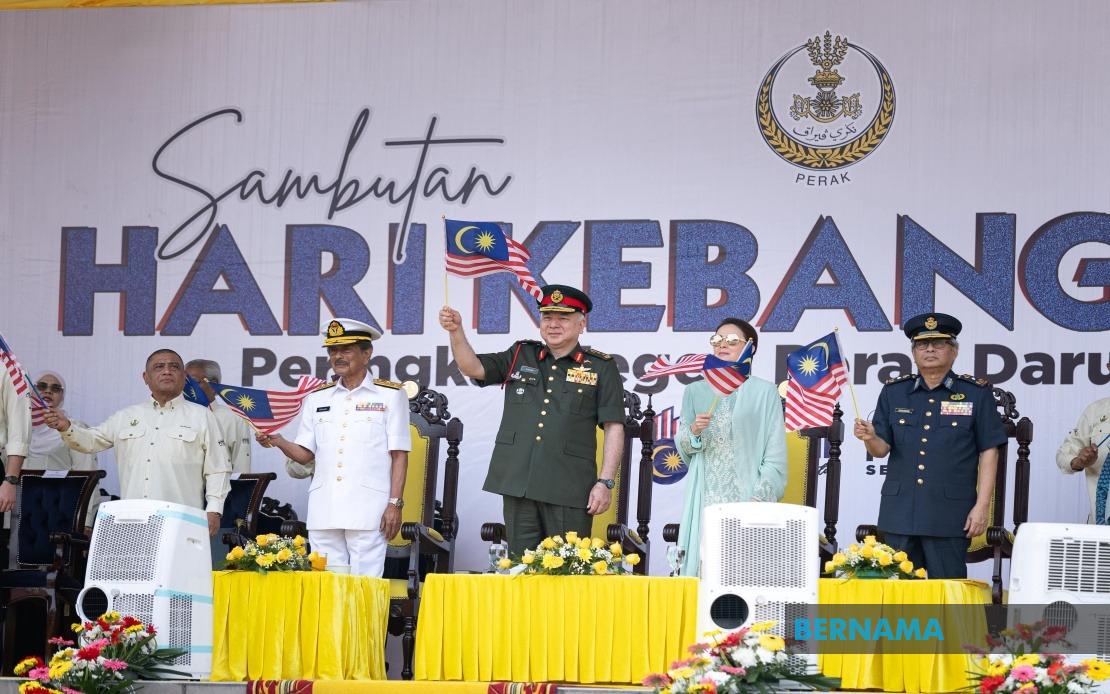
Sultan Nazrin Shah and Raja Permaisuri Tuanku Zara Salim presided over Perak's National Day 2026 Awards Presentation Ceremony at Dewan Bandaran Ipoh on August 31, where the Perak monarch formally recognised the exceptional service and personal sacrifices of 11 national heroes drawn from the security forces. The occasion drew together senior state officials including Menteri Besar Datuk Seri Saarani Mohamad, State Secretary Datuk Ahmad Suaidi Abdul Rahim, and members of the State Executive Council, alongside Raja Muda Raja Jaafar Raja Muda Musa and Raja DiHilir Raja Iskandar Dzurkarnain Sultan Idris Shah, underlining the ceremonial significance accorded to the presentation.
Each recipient received RM1,000 in monetary recognition together with a certificate of appreciation, a modest but symbolic gesture honouring their commitment to safeguarding Malaysia's territorial integrity and security apparatus. The awardees comprised six personnel from the Malaysian Armed Forces, two from the Royal Malaysia Police, and three from the Royal Malaysian Navy, reflecting the breadth of sacrifice across Malaysia's frontline defence institutions. These individuals were selected from a larger pool of candidates nominated throughout Perak, demonstrating the ongoing commitment to recognise those whose contributions often go unheralded in public discourse.
Among the most compelling cases recognised was Warrant Officer 2 Mohamad Razali Din, who suffered devastating injury during Operation Naga in Banding when he stepped on a landmine, resulting in the amputation of his left leg below the knee. His recognition at this state-level ceremony serves as a poignant reminder of the physical toll exacted on those who serve in operational theatres, particularly in legacy counter-insurgency campaigns that continue to shape Malaysia's security landscape decades after their official conclusion. Such cases exemplify the often-invisible burden borne by servicemembers and their families, as they navigate life after debilitating combat injuries sustained in service to the nation.
Warrant Officer 2 Megat Abdullah Megat Othman earned particular commendation for his exceptional operational performance during Operation Batu Kawah in Sri Aman, where he successfully neutralised three communist terrorists. In recognition of this significant combat achievement, he was presented with a commando knife alongside his certificate, a distinction that acknowledges both the danger he faced and the strategic value of his actions in maintaining security within Perak's borders. This award category highlights the continuing relevance of counterterrorism and counter-insurgency operations to Malaysia's security considerations, even as the nature of threats has evolved.
The remaining Malaysian Armed Forces recipients—Staff Sergeant Idris Ismail, Corporal Mokhtar Sulaiman, Lance Corporal Khairul Anuar Abdul Hamid, and Lance Corporal Alias Abd Wahab—represented various ranks and specialisations within the military structure, reflecting the distributed nature of security responsibilities across the defence establishment. Their recognition, while less detailed in the official announcement, nonetheless signifies their contribution to collective defence objectives and operational readiness. The Royal Malaysia Police contingent included retired Sub-Inspector Omar Jayus and retired Sergeant Major Abdul Malek Nordin, whose long careers in law enforcement had spanned decades of service to civilian security. The Royal Malaysian Navy contributors were retired First Admiral Mohamad Imran Abd Hamid, retired Commander Mohd Akhbar Mohd Yusof, and retired Warrant Officer 2 Ahmad Safwi Shaari, collectively representing the maritime dimension of Malaysia's defence posture.
Beyond the security personnel awards, Sultan Nazrin also distributed prizes to winners across multiple categories associated with the National Day 2026 observance, including competitions for the National Month parade and community beautification initiatives. These ancillary awards broadened the scope of recognition beyond military and police achievement to encompass civilian participation in national celebrations, reinforcing the inclusive character of Malaysia's Independence Day observances and encouraging grassroots engagement with national commemorative events.
In his address to the gathering, Menteri Besar Saarani articulated a philosophical framework for understanding Malaysia's social cohesion, arguing that the nation's foundation rested upon deliberate choice by a demographically diverse population to coexist as a unified polity rather than upon homogeneous cultural or ethnic foundations. This conceptualisation carries particular resonance for Malaysian policymakers and observers who contend with ongoing debates regarding national unity, social integration, and the sustainability of Malaysia's constitutional pluralism. Saarani emphasised that Malaysia's constitutional framework, national language, and the institution of the Malay Rulers collectively functioned as binding mechanisms that transcended ethnic and religious boundaries, positioning these institutions as fundamental pillars of national coherence.
Crucially, Saarani cautioned against complacency regarding social unity, arguing that the bonds holding Malaysian society together remained fragile and vulnerable to erosion when citizens permitted divisive categorisation to supersede recognition of shared humanity. His warnings reflected concern that an incremental process of social fragmentation could occur when neighbours cease being perceived as neighbours, and friendships become subordinated to considerations of racial, religious, or communal affiliation. This observation carries contemporary salience in Malaysia, where discourse increasingly bifurcates along communal lines and where political mobilisation frequently operates through identity-based appeals.
The Menteri Besar's articulation of this concern suggested that the distance between communities expands gradually, with the unifying elements of national identity becoming progressively obscured as particularistic identities acquire greater prominence in social interactions and political calculations. His framing implied that national unity represented an active achievement requiring sustained commitment rather than a passive condition that could be taken as permanent or irreversible. For Malaysian observers, this represents a significant acknowledgement that the social contract underlying Malaysia's plural democracy demands continuous cultural and political investment to remain viable.
The Perak National Day ceremony exemplified how state-level observances function as venues for articulating national values whilst honouring those whose service instantiates those values in concrete form. The recognition of military and police personnel alongside speeches emphasising social cohesion and constitutional unity created a symbolic narrative linking security provision with democratic governance and intercommunal harmony. For Perak specifically, the event reinforced the state's ongoing engagement with security matters through its geographic proximity to historical and contemporary operational zones, whilst positioning the Perak monarchy as an active participant in civic ceremonies that celebrate both national defence and civilian life.
For Malaysian readers and regional observers, this ceremony offers insight into how subnational political actors employ ceremonial occasions to reinforce narratives of national identity and institutional legitimacy during a period when such narratives face persistent challenge from competing centrifugal forces. The award recipients themselves embodied the lived reality of Malaysia's security apparatus, with their individual histories of sacrifice and service providing grounded counterweight to abstract discussions of national resilience. Their recognition by the Sultan of Perak represented not merely personal commendation but an institutional affirmation that those who serve in defence and security sectors merit prominent acknowledgement within Malaysia's civic culture.

