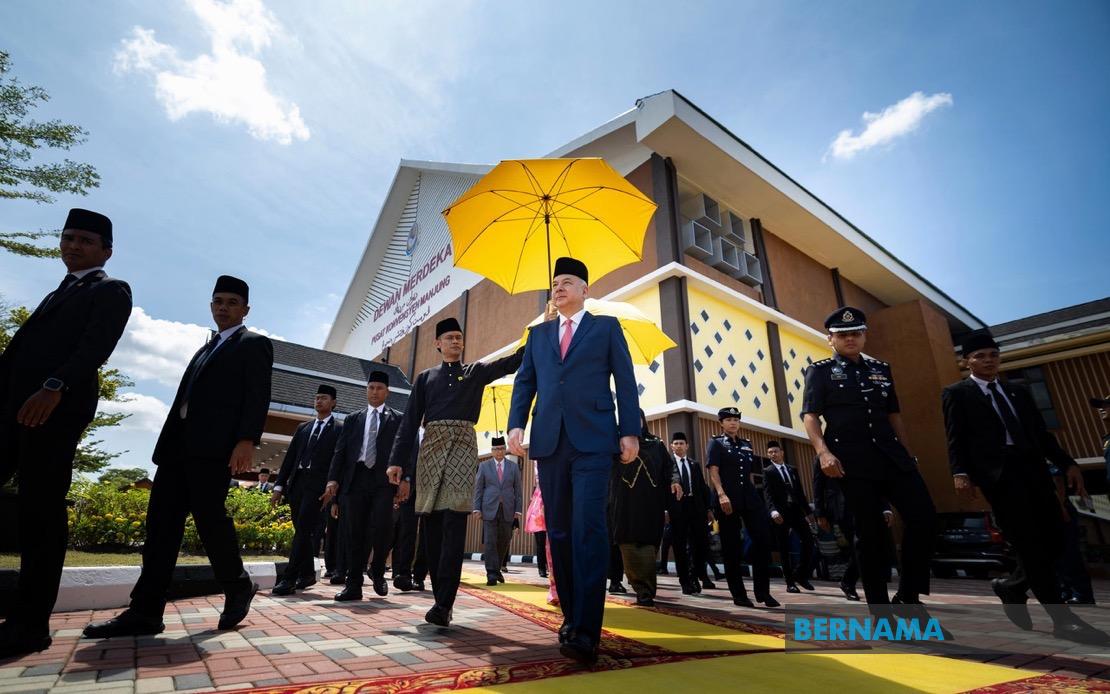
Sultan Nazrin Shah, the reigning monarch of Perak, formally inaugurated the Merdeka Hall belonging to the Manjung Municipal Council in Lumut on August 4, marking a significant infrastructure milestone for the district. The ceremonial opening was attended by the Raja Permaisuri of Perak, Tuanku Zara Salim, and the Raja Di Hilir of Perak, Raja Iskandar Dzurkarnain Sultan Idris Shah, alongside Perak Menteri Besar Datuk Seri Saarani Mohamad and federal Higher Education Minister Datuk Seri Dr Zambry Abd Kadir. The gathering underscored the symbolic importance placed by both state and federal governments on the venue's completion.
The newly constructed hall represents a convergence of three major developments for Manjung district. Perak Menteri Besar Saarani highlighted that the opening fulfilled a vision initiated approximately a decade prior, while simultaneously celebrating the municipal council's silver jubilee—25 years since its elevation to municipal status in 2001. More significantly, the facility anchors the district's strategic pivot toward becoming a recognized Tourism and Maritime City, a designation targeted for achievement within the next six years. This temporal alignment between infrastructure completion and long-term development objectives reflects deliberate governance planning at both state and federal levels.
The RM12.7 million investment produced a venue equipped to accommodate 2,500 people, transforming Manjung's capacity to host large-scale official functions, international conferences, and community gatherings. Prior to this facility, the district operated with significantly constrained public assembly space, a limitation that hindered both economic development and civic engagement. Saarani articulated that the hall transcends its function as mere bricks and mortar, positioning it instead as a catalyst mechanism for broader district development. This framing indicates local leadership's understanding that infrastructure enables ecosystem development—attracting conferences attracts business visitors, which strengthens hospitality sectors and marine-related industries.
The genesis of the Merdeka Hall project traces back to 2016, when the previous Menteri Besar championed the necessity for facility reconstruction. This extended timeline—approximately eight years from initial advocacy to completion—reflects standard bureaucratic and procurement processes for major state projects in Malaysia. Saarani emphasized that the project's successful execution demonstrated governance continuity across leadership transitions and close coordination between Putrajaya's allocation mechanisms and Ipoh's implementation capacity. Such messaging carries particular weight in Perak, a state where federal-state relations have occasionally experienced friction, making demonstrable cooperation a political asset.
The nomenclature chosen for the facility carries nationalist resonance. Saarani stressed that the Merdeka designation serves as a perpetual reminder that national independence represents a sacred trust requiring constant safeguarding. This interpretive layer suggests authorities view the hall not as a neutral civic space but as an inherently patriotic venue where fundamental values undergird all subsequent activities. The framing subtly reinforces the importance of institutional loyalty and the preservation of constitutional arrangements, messaging that extends beyond purely operational considerations.
Manjung's municipal history contextualizes the hall's significance. The council originated as a district council on January 1, 1980, before being upgraded to municipal council status on August 1, 2001—a promotion reflecting its economic importance and population density within Perak's landscape. This 25-year tenure as a municipality positions Manjung among Perak's more substantial urban centers, competing with better-known counterparts. The silver jubilee celebration embedded within the hall's opening suggests local administration views this moment as validating Manjung's claim to regional prominence and justifying investments in capacity building.
The Tourism and Maritime City 2030 vision reveals Malaysia's broader regional development strategy within Perak. Manjung's geographic location along the Strait of Malacca and proximity to established maritime industrial zones creates plausible foundations for such branding. The Merdeka Hall positions itself as supporting infrastructure for this transition—hosting tourism board meetings, international maritime conferences, and cultural events that reinforce the district's positioning. For Malaysia's tourism sector recovery post-pandemic, leveraging secondary cities like Manjung as conference destinations diversifies visitor economy opportunities beyond Kuala Lumpur and Penang.
The hall's capacity to host 2,500 attendees places it in the mid-to-large range of Malaysian convention venues. Regional competitors—particularly in Selangor and Perak's neighboring states—have invested similarly in convention infrastructure to compete for meeting, incentive, conference, and exhibition (MICE) tourism revenue. Manjung's positioning of this facility as foundational to its MICE strategy indicates realistic ambitions to capture overflow demand from saturated urban centers. The RM12.7 million investment suggests cost-conscious design prioritizing functional capacity over architectural grandeur, a pragmatic approach for a district still establishing its tourism reputation.
Saarani's articulation of the hall's aspirational role in nurturing knowledge, strengthening understanding, and fostering consensus reflects broader governance philosophies prioritizing institutional consensus and stakeholder engagement. This rhetorical emphasis on the hall as a gathering place for deliberative processes suggests authorities envision it functioning beyond mere event hosting—conceptualizing it as infrastructure for democratic deliberation and community consensus-building. For Malaysian local governance contexts, where community participation in development planning remains unevenly distributed, explicit positioning of civic infrastructure as fostering such participation represents a meaningful governance signal.
The involvement of federal-level representation through Higher Education Minister Dr Zambry's attendance suggests potential utilization of the venue for educational and knowledge-sharing initiatives aligned with federal priorities. This ministerial presence indicates the federal government's stake in the facility's success and possible future programming involving higher education institutions, research initiatives, or technology-focused conferences. Such cross-level government engagement demonstrates how Malaysian infrastructure projects function simultaneously as local civic assets and components of national strategic positioning.
For Southeast Asian regional observers, Manjung's positioning mirrors broader dynamics across ASEAN economies where secondary cities increasingly compete for knowledge economy and tourism investments historically concentrated in capital regions. The Merdeka Hall exemplifies this trend—Malaysian state governments increasingly recognize that competitive positioning requires mid-tier infrastructure investment. Similar patterns appear across Thailand, Vietnam, and Indonesia, where provincial cities develop convention capacity as economic development strategy. Manjung's approach thus reflects regional adaptation to competitive dynamics rather than exceptional innovation.
The project's completion within federal budgetary constraints indicates successful alignment between state ambitions and federal resource allocation mechanisms. Malaysia's federal-state financial relationships often create friction around project funding, making Saarani's emphasis on cooperative federal-state execution a meaningful political achievement. This demonstration effect potentially facilitates future infrastructure approvals for Perak and signals to other state administrations that organized, sustained advocacy through multiple electoral cycles can achieve federal capital allocation for developmental projects.

