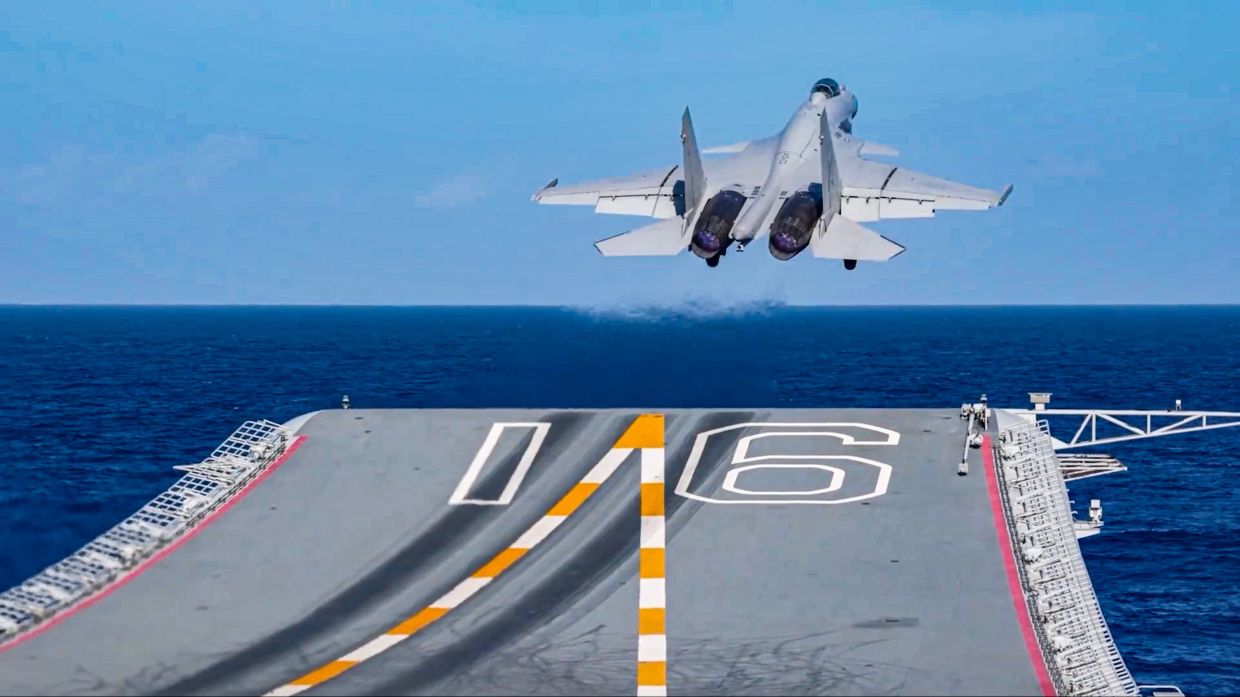
China's accelerating development of aircraft carrier capabilities masks a critical vulnerability that could fundamentally constrain the operational effectiveness of Beijing's maritime forces in any major regional conflict. Defence strategists increasingly view submarine ambushes as the most potent threat to Chinese carrier groups, particularly as these high-value assets venture beyond protected coastal waters into contested waters where detection and protection become exponentially more difficult.
A comprehensive strategic assessment from Washington's Centre for Strategic and International Studies has articulated a detailed "cost-imposition" framework for countering Chinese carrier operations. This approach encompasses land-based strike networks, satellite-guided long-range aerial attacks, cyber and electromagnetic warfare capabilities, and coordinated drone swarm operations. However, among these layered defensive mechanisms, submarine-based interdiction emerges as the component where Chinese naval forces face their most acute technological and operational disadvantages. The underlying logic is straightforward: US attack submarines operating throughout the western Pacific possess capabilities to threaten carrier strike groups at ranges and with stealth advantages that China's current sensor networks struggle to counter.
The geographical configuration of the Asian maritime domain compounds this vulnerability substantially. Strategic waterways such as the Taiwan Strait, Malacca Strait, and passages between the Philippines and Taiwan create natural chokepoints where carrier formations must transit predictably. These confined passages offer ideal environments for submarine forces to establish ambush positions. While China maintains numerical superiority in many conventional naval categories, the qualitative advantages possessed by US and allied submarine fleets—particularly their acoustic stealth—tilt the operational calculus decisively in favour of subsurface adversaries during high-stakes encounters.
Examining this dynamic more closely, Christopher Sharman, director of the China Maritime Studies Institute at the US Naval War College, acknowledges that undersea detection represents a persistent weakness for the People's Liberation Army Navy, though he cautions against treating it as immutable. The fundamental challenge stems from China's comparative disadvantage in oceanographic knowledge. Chinese military researchers have themselves acknowledged that their nation's meteorological and oceanographic intelligence capabilities lag significantly behind American counterparts, particularly regarding the ability to predict submarine operations beyond the first island chain. This knowledge deficit directly translates into tactical uncertainty—Chinese anti-submarine forces cannot effectively track or predict subsurface threats in the complex ocean environments where future conflicts would likely unfold.
Recognising this strategic vulnerability, Beijing has launched an ambitious technical programme to remediate its undersea detection deficit. The Transparent Ocean initiative, conceived over a decade ago, envisions an integrated observational network spanning the western Pacific, South China Sea, and Indian Ocean through coordinated deployment of satellites, oceanographic research vessels, autonomous underwater gliders, buoys, and seafloor-mounted sensors. Official Chinese sources explicitly frame this programme within national security parameters, with the Ocean University of China reporting that hundreds of deep-sea monitoring systems have already been established. The scale of this investment underscores how seriously Beijing treats the submarine threat to its carrier operations.
Simultaneously, the PLA Navy has pursued aggressive modernisation of its anti-submarine warfare arsenal. Defence analysts have documented the service's expanding fleet of maritime patrol aircraft equipped with advanced sensors, newly introduced Type 927 ocean-surveillance ships fitted with sophisticated towed-array sonar systems, and upgraded detection equipment integrated across helicopter and fixed-wing platforms. These incremental enhancements represent meaningful steps toward closing capability gaps, yet they address symptoms rather than fundamental structural disadvantages. The acoustic superiority of American submarines, combined with the United States' superior oceanographic database, means Chinese anti-submarine forces operate at an inherent disadvantage that hardware modernisation alone cannot entirely eliminate.
The strategic importance of resolving these undersea warfare challenges extends beyond carrier protection to encompass the broader architecture of Chinese military strategy. Within the first island chain, effective submarine operations form the cornerstone of the PLA's wartime sea control objectives. Beyond this boundary, extending into the Indian Ocean, undersea capabilities assume even greater significance as China seeks to counter American naval dominance and complicate potential third-party intervention in Taiwan-related scenarios. Beijing's military theorists view undersea warfare not as ancillary but as foundational to their strategic options across multiple contingency scenarios.
The Taiwan factor inevitably colours this analysis. China regards Taiwan as territory that remains subject to potential military reunification, though it has maintained strategic ambiguity regarding when or how such an operation might occur. The United States, while not formally recognising Taiwan's independence, maintains a legal obligation to provide defensive armaments and has signalled its opposition to any forced military solution. Should conflict occur, Japan's potential involvement would dramatically escalate complexity, as Tokyo maintains among the world's most capable anti-submarine forces and possesses both geographical proximity and strategic motivation to interdict Chinese naval movements threatening Japanese territory. This multiplicative threat environment makes carrier deployment an exceptionally risky proposition for Chinese commanders.
Timothy Heath, head of the defence research firm Perceptum, articulates why carriers represent a particularly vulnerable investment given the layered submarine threat. American attack submarines rank among the world's quietest, meaning they can approach targets with minimal acoustic signature. Japanese submarines, similarly advanced, could establish interdiction zones around Chinese carrier groups. Against this threat backdrop, deploying carriers far from the Chinese coast appears strategically irrational, despite their obvious symbolic and operational value. Heath suggests that China's land-based intermediate-range ballistic missiles provide superior options for threatening adversary shipping throughout the western Pacific, offering greater range, survivability, and cost-effectiveness than carrier-based systems that would be exposed to submarine attack.
This asymmetry creates a strategic paradox for Beijing: as China expands its carrier fleet to project power regionally, the increasing vulnerability of these vessels to submarine attack may paradoxically constrain their utility compared to less conspicuous but operationally more robust alternatives like long-range cruise missiles and ballistic systems. Carriers remain psychologically potent symbols of great power status and provide visible deterrence value, yet their operational deployment in contested waters increasingly resembles an unacceptable risk wager against capable adversaries.
The implications for regional stability merit careful consideration from Southeast Asian capitals. Chinese carrier operations inevitably transit waters fundamental to regional commerce and security architecture. Should submarine-based threats force China to retain carrier groups in protected areas proximate to home ports, this creates space for other regional powers to operate more freely in contested waters. Conversely, if China successfully closes its undersea detection and anti-submarine warfare gaps, carrier operations would become increasingly viable at greater distances, potentially shifting the maritime balance in ways affecting freedom of navigation and the strategic calculations of regional states. The trajectory of China's submarine vulnerability—whether it widens or narrows in coming years—therefore carries implications extending far beyond naval technicalities to encompass regional geopolitical stability itself.
American and allied defence planners have drawn explicit conclusions from this analytical framework. The Centre for Strategic and International Studies report specifically recommends increased American and allied investment in torpedo systems, undersea drone capabilities, and coordinated missile production with Japan and Australia. These recommendations reflect a conscious strategy to exploit and perpetuate Chinese undersea vulnerabilities rather than allow Beijing to successfully close the capability gap. The submarine dimension thus emerges as a critical frontier in the evolving technological and strategic competition shaping the Indo-Pacific region.

