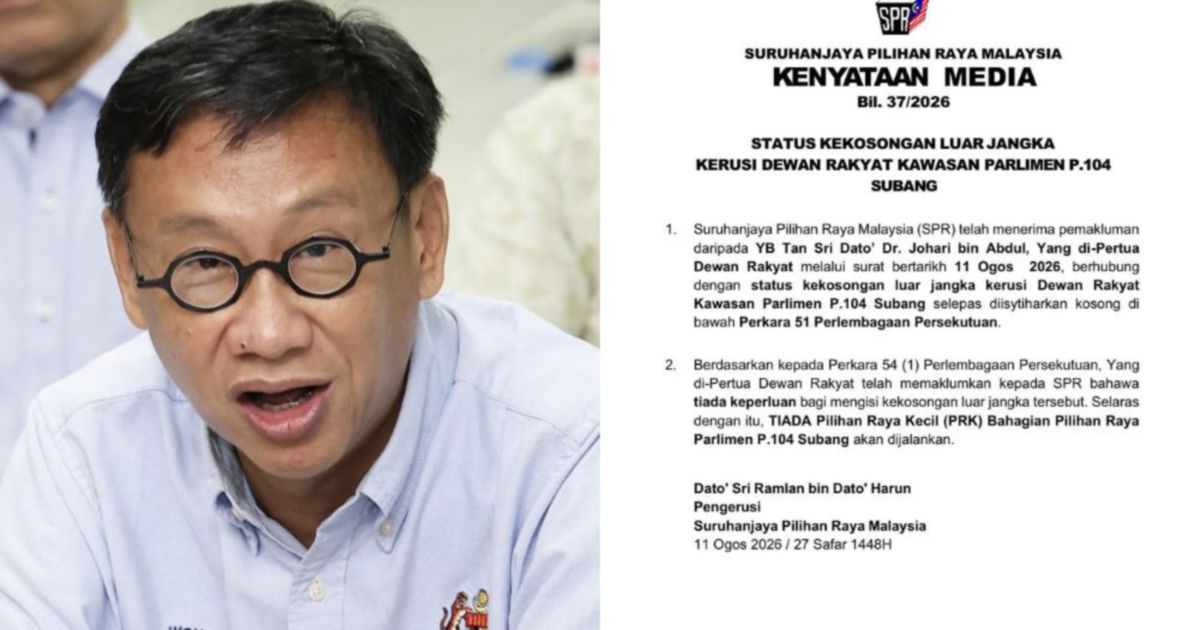
The Election Commission has confirmed that the Subang parliamentary constituency will not hold a by-election following the resignation of Wong Chen, the People's Justice Party (PKR) member who represented the affluent Selangor seat. This ruling has significant implications for constituents in one of the country's most prominent urban seats, as they will go without dedicated parliamentary representation for what could be an extended period.
Wong Chen's decision to step down marks another change in Subang's leadership and raises questions about the circumstances that prompted his departure. His tenure as the area's representative carries particular weight given the constituency's demographics and economic importance within Malaysia's urban landscape. The seat has historically been seen as a barometer for middle-class and professional voter sentiment in the capital region.
Under Malaysia's electoral laws and constitutional provisions, the Election Commission possesses discretionary authority over whether a by-election should be triggered following a parliamentary vacancy. This decision reflects the established procedural framework governing such circumstances, though the exact legal reasoning behind confirming no by-election will occur has not been elaborated in detail. The ruling effectively means Subang residents will lack an elected Member of Parliament during the interim period.
The timing of Wong Chen's resignation within the broader political calendar carries significance for both the constituency and Parliament's composition. Depending on when this occurred relative to the next scheduled general election, the vacancy could range from a matter of months to potentially years. Such extended vacancies create representation gaps that have long been discussed among constitutional scholars and political analysts as potentially problematic for democratic accountability.
For Subang constituents, particularly those with longstanding concerns or local matters requiring parliamentary intervention, the absence of an elected representative presents practical challenges. While administrative services typically continue through local government structures and civil servants, the role of a Member of Parliament in advocating for constituency-specific issues, engaging with federal ministries, and maintaining constituent relations remains irreplaceable within Malaysia's Westminster-derived system.
This development intersects with broader patterns within Malaysian politics where parliamentary seats occasionally change hands through resignation rather than electoral processes. Such transitions often reflect personal political calculations by individual MPs regarding their futures, relationships with party leadership, or family circumstances. Wong Chen's background as a relatively independent-minded parliamentarian known for raising various issues in Dewan Rakyat debates adds another layer to understanding his departure.
The Election Commission's decision also occurs within Malaysia's current political configuration, where coalition arrangements between Pakatan Harapan and other parties have shaped parliamentary dynamics. PKR's positioning within governing coalitions at both federal and state levels means that losing parliamentary seats has wider ramifications beyond simple numerical representation. The stability of parliamentary numbers during this period warrants monitoring, particularly if the government maintained only modest majorities.
Subang itself represents a microcosm of Malaysian urban politics, encompassing diverse professional, business, and residential communities. The constituency's parliamentary representative typically engages with constituency associations, corporate concerns, community groups, and individual residents across an economically diverse area. The transition from Wong Chen's representation to an eventual successor will inevitably reshape the representation landscape in ways both visible and subtle.
The Election Commission's confirmation resolves any ambiguity about whether a by-election process would commence, providing clarity to all stakeholders regarding the constitutional status of the vacant seat. This determination, while final, leaves open the practical question of how representation will be managed during the interim period and what mechanisms might facilitate constituent grievances or requests reaching parliamentary channels.
Looking toward the eventual filling of this seat—presumably at the next general election whenever that occurs—both PKR and opposition parties will likely view Subang as a significant battleground. The constituency's characteristics as an urban, educated voting bloc means electoral campaigns there typically reflect broader national political conversations. Wong Chen's departure creates a blank slate that various political actors will seek to fill according to their respective strategic calculations.
This situation underscores ongoing debates within Malaysia's political establishment regarding parliamentary representation, electoral cycles, and the balance between permitting individual MPs flexibility in their political trajectories while ensuring constituent representation remains continuous. The broader implications extend beyond Subang to how parliamentary vacancies are managed across the system more generally, affecting discussions around electoral reform and constitutional amendment proposals that periodically surface in Malaysian political discourse.

