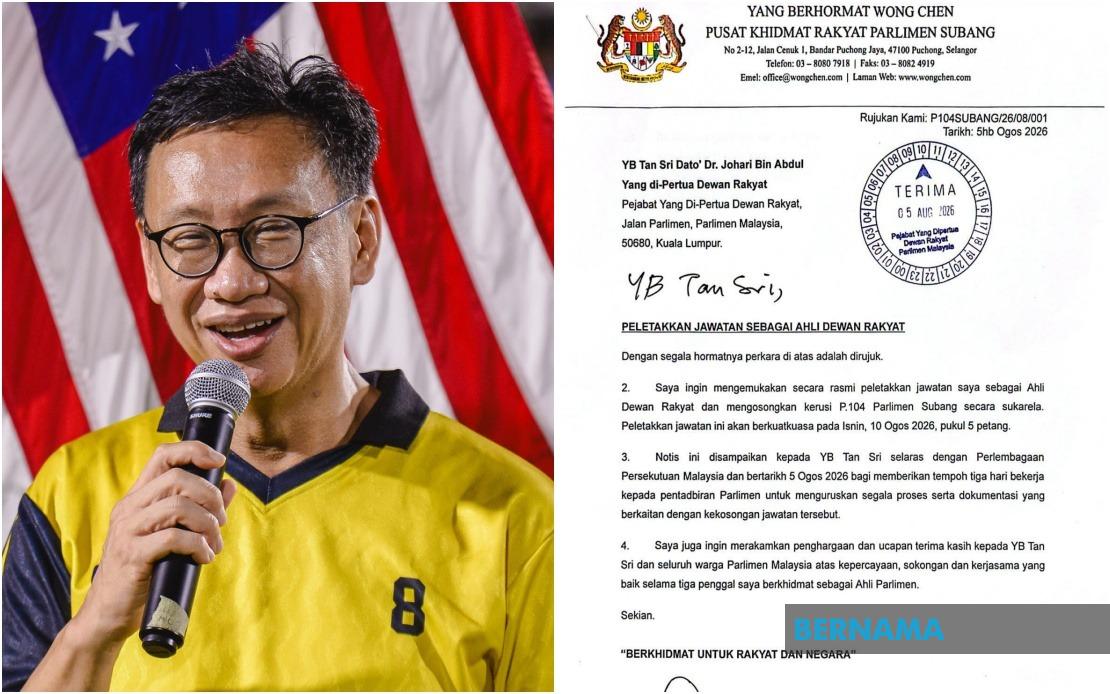
Wong Chen, who has represented the Subang constituency through three consecutive parliamentary terms, has formally relinquished his seat in the Dewan Rakyat effective at 5:00 pm today. The longtime legislator submitted his official resignation documentation to Dewan Rakyat Speaker Tan Sri Johari Abdul on August 5, marking the end of what has been a notably active tenure in Malaysia's lower house of Parliament.
Wong's decision to provide advance notice of his departure underscores a desire to ensure institutional continuity and proper administrative planning. By communicating his intentions five days before his formal departure, he afforded Parliament's administrative machinery adequate time to prepare for the consequent vacancy and initiate whatever procedural steps are required to process his seat's return to the electoral system. This measured approach reflects parliamentary convention and demonstrates consideration for the management structures that oversee parliamentary operations.
In a public statement shared via social media, Wong expressed his appreciation for the institutional support he received during his parliamentary service. His formal letter, dated August 5, 2026, emphasised that his departure represents a voluntary decision made in full accordance with the provisions enshrined in Malaysia's Federal Constitution. This constitutional compliance is noteworthy, as it establishes that his resignation follows established legal frameworks governing parliamentary membership and seat vacancies.
Wong's gratitude extended specifically to Tan Sri Johari and the broader parliamentary staff, acknowledging the cooperative working relationships that characterised his three terms. The tenure of any Member of Parliament depends substantially on the quality of administrative and collegial support available, and Wong's commendation suggests he maintained constructive relationships throughout his time in the legislature. His recognition of institutional personnel reflects awareness that parliamentary effectiveness depends on more than individual members—it requires functional support systems and collaborative engagement.
The implications of this mid-term resignation extend beyond Wong's personal departure. The vacancy of the Subang seat will necessitate a by-election, which represents a significant undertaking for the Election Commission. Subang, as an established parliamentary constituency in Selangor, carries considerable political weight and voter attention. The by-election will provide an opportunity for voters in this constituency to reassess their representation and for political parties to test electoral sentiment in what has historically been a closely contested area.
Wong has scheduled a comprehensive press conference for 11:00 am tomorrow to elaborate on his resignation and presumably address public curiosity regarding the motivations and timing of his departure. This public engagement suggests transparency around his decision-making process. In an era where Malaysian parliamentarians face intense scrutiny from media and constituents alike, Wong's willingness to discuss his resignation directly demonstrates a commitment to public accountability.
The administrative implications of his departure include the removal of parliamentary-related signage and formal acknowledgements of his status. Beginning next month, all billboards, signboards, and official correspondence will cease displaying the honourific title "Yang Berhormat"—the form of address accorded to Members of Parliament. This formal disengagement from parliamentary designation marks the complete conclusion of his tenure and reflects the procedural requirements governing how former legislators are identified in official contexts.
Wong Chen's resignation occurs within a broader context of evolving parliamentary dynamics in Malaysia. The Dewan Rakyat has experienced various shifts in membership and political alignment in recent years, and the loss of experienced legislators can influence the chamber's overall institutional capacity and debate quality. Three-term members typically accumulate substantial procedural knowledge, committee experience, and legislative expertise that contributes meaningfully to parliamentary functioning.
The circumstances surrounding this resignation may resonate differently across Malaysia's political landscape. For the ruling coalition, the loss of a Subang representative necessitates careful strategic consideration regarding by-election prospects. For opposition parties, the vacancy presents a potential opportunity to contest a seat in a constituency that has previously demonstrated competitive electoral dynamics. The actual conduct of the by-election and its outcome will provide meaningful indicators of contemporary voter sentiment in this Selangor-based constituency.
From a broader governance perspective, Wong's decision to resign mid-term raises questions about succession planning and continuity within political representation. While individual legislators are entitled to step down, the frequency and timing of parliamentary departures can affect government stability and the legislative agenda's momentum. Wong's advance notification partially mitigates potential disruption, though the actual impact will depend on what political and personal factors motivated his decision—matters he appears prepared to discuss publicly tomorrow.
The departure also invites reflection on parliamentary career paths in Malaysia. Three terms represents a substantial commitment spanning roughly nine to fifteen years, depending on electoral cycles and parliamentary dissolution timing. The decision to conclude this tenure suggests either a deliberate choice to pursue different endeavours or circumstances that have made continued parliamentary service impractical. Wong's forthcoming press conference should clarify which of these considerations applies.

