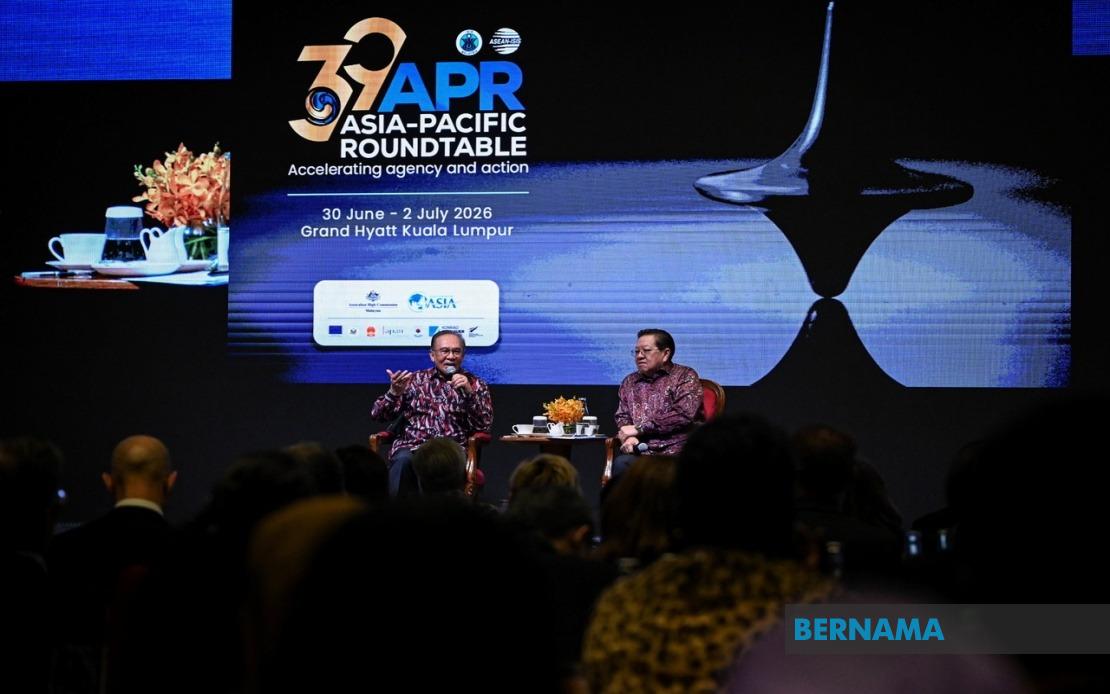
Prime Minister Datuk Seri Anwar Ibrahim has positioned domestic governance reform as Malaysia's paramount strategic objective, arguing that any nation seeking to influence global affairs must first establish robust institutional foundations and ethical standards at home. Speaking at the 39th Asia-Pacific Roundtable in Kuala Lumpur, Anwar outlined a vision where international engagement flows naturally from successful internal transformation rather than preceding it.
The Prime Minister articulated a multifaceted reform agenda centred on three pillars: the elimination of systemic corruption that has long plagued Malaysian institutions, the reduction of socioeconomic disparities that divide communities, and the universal provision of quality education and healthcare services. This platform reflects a deliberate recalibration of governance priorities, signalling that the government views internal credibility and institutional performance as prerequisites for credible participation in regional and global forums.
Anwar's emphasis on domestic excellence carries particular significance for Malaysia's standing in Southeast Asia and beyond. A nation perceived as successfully addressing corruption and inequality gains moral authority in international discussions on governance standards, human rights and democratic practice. Conversely, external engagement from a state troubled by internal institutional weaknesses risks appearing inconsistent or opportunistic. By foregrounding domestic reform, Anwar appears to be building a philosophical and practical case for why Malaysia's next phase of development must prioritize internal consolidation.
The Prime Minister was explicit in rejecting simplistic interpretations of global divisions as inherent conflicts between civilisational blocks. Instead, he articulated a more nuanced analysis, drawing on the work of late Palestinian-American scholar Edward Said, to argue that many international tensions stem not from incompatible worldviews but from ignorance and mutual misunderstanding. This framing has immediate relevance for Malaysia, a nation navigating complex relationships across multiple geopolitical spheres while maintaining its own internal religious and ethnic plurality.
Central to Anwar's vision is the assertion that a Muslim-majority democracy can simultaneously uphold Islamic principles, democratic governance, and inclusive pluralism. This positioning addresses both domestic and international audiences: domestically, it reassures non-Muslim communities about the government's commitment to secular democratic institutions; internationally, it counters narratives suggesting Islam and liberal democracy are incompatible. The Malaysian model, presented this way, offers an alternative template to polarized frameworks increasingly dominating global discourse.
The government's MADANI framework, referenced by Anwar, represents an attempt to operationalize these principles by balancing technological progress with human-centred values. Rather than pursuing development that prioritizes economic metrics alone, the framework seeks to embed considerations of social cohesion, cultural respect, and human dignity into growth strategies. For Malaysian policymakers and regional observers, this suggests a deliberate move away from purely technocratic governance toward what might be termed values-based development.
Anwar's invocation of the Quranic concept of 'li ta'arafu'—often translated as mutual understanding or acquaintance—reflects an attempt to ground inclusive governance in religious and cultural foundations rather than positioning it as a secular or externally-imposed value. This approach potentially resonates across Malaysia's diverse population by suggesting that intercommunal respect and appreciation derive from authentic Malaysian and Islamic sources rather than Western liberal theory. For a multiracial, multireligious nation, such framing can be strategically important in building consensus around inclusive policies.
The Prime Minister's emphasis that societies should aspire beyond mere tolerance toward genuine understanding and appreciation of difference addresses a persistent challenge in Malaysian public discourse. Tolerance often implies a grudging acceptance of the other's presence, whereas the framework Anwar advocates suggests active engagement with and learning from cultural and religious diversity. This distinction matters substantially in practical terms, influencing everything from educational curricula to interfaith dialogue initiatives to corporate diversity policies.
For regional observers and international audiences, Anwar's statements reposition Malaysia within broader conversations about governance, development and the future of democracy in Muslim-majority societies. By insisting that international credibility flows from domestic excellence, he implicitly critiques approaches where governments prioritize external visibility over internal institutional quality. This argument carries weight in Southeast Asia, where several nations have faced criticism for projecting strong international personas while struggling with domestic corruption or institutional weakness.
The emphasis on basic education and healthcare access as fundamental rights rather than conditional benefits also signals a particular vision of the social contract. By framing these services as entitlements that should reach all citizens equitably, Anwar appeals to voters across income levels while articulating a substantive agenda beyond rhetorical commitments. The practical implementation of such commitments will likely determine the government's credibility on governance reform claims.
Anwar's articulation of governance priorities reflects awareness that Malaysia faces multiple simultaneous pressures: managing economic transformation, addressing climate change, navigating regional geopolitical shifts, and sustaining democratic institutions amid global trends toward polarization and institutional erosion. By arguing that domestic governance must anchor Malaysia's response to these challenges, he suggests that attempts to project influence internationally while institutions remain weak or corrupt would be counterproductive.
The broader implication of these statements for Malaysian governance is clear: institutional reform, anti-corruption initiatives, and equitable service delivery are not secondary concerns to be addressed once economic growth is secured, but rather foundational priorities that enable everything else. This reordering of governance logic may prove consequential for how the government allocates resources, structures policy debates, and evaluates success in coming years.

